
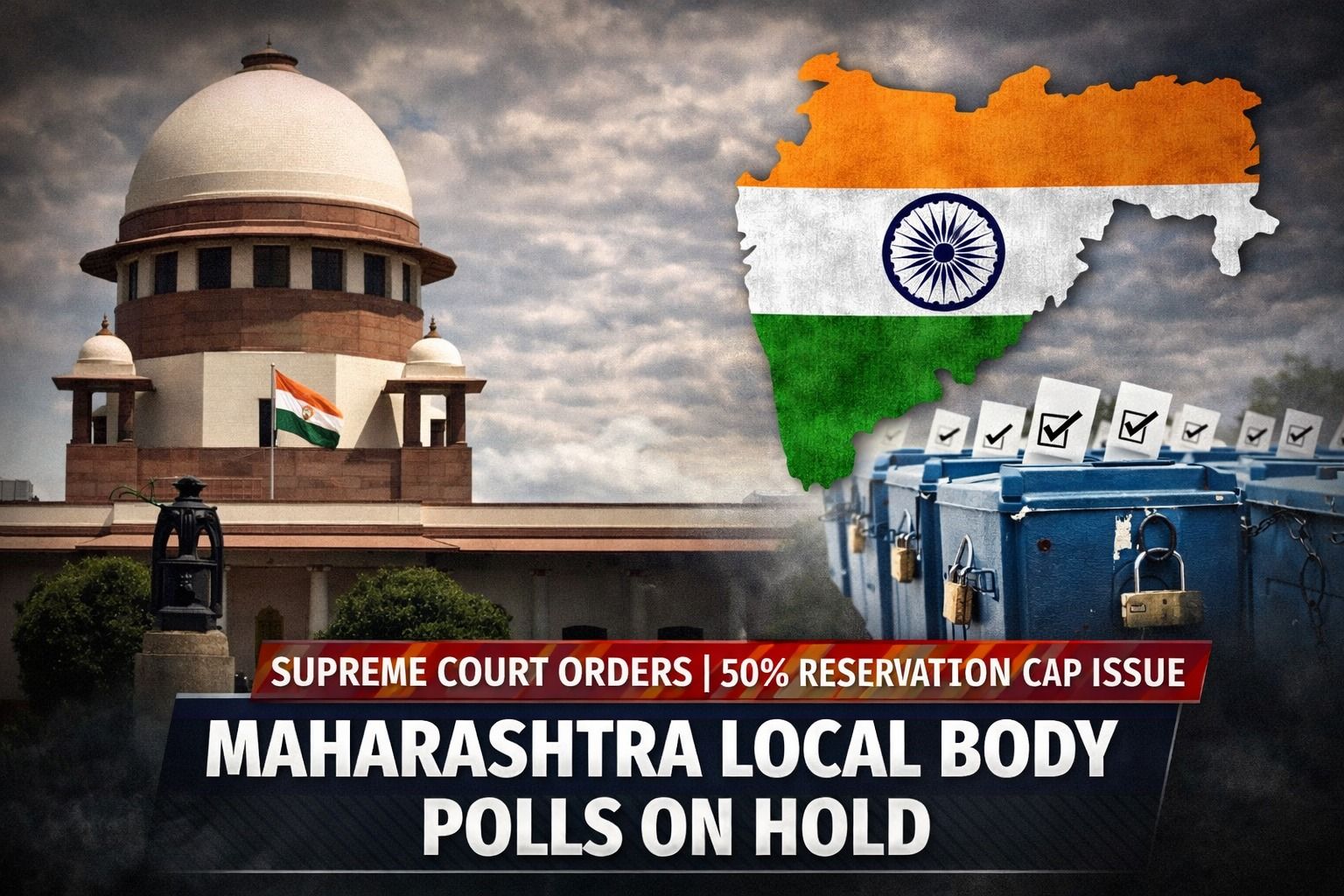
Breaking: Supreme Court’s Major Observation on Pending Maharashtra Local Body Elections; Reservation Cap at Centre of Dispute
Mumbai | Special Correspondent
In a significant development concerning long-pending local self-government elections in Maharashtra, the Supreme Court of India has made a crucial observation regarding the constitutional limit on reservations. The Court indicated that elections cannot proceed in local bodies where total reservation exceeds the 50% ceiling, unless the legal position is clarified.
The development has triggered strong political reactions across the state, with several opposition leaders terming it a “setback” for the Government of Maharashtra. However, the Court itself did not use any political language, focusing strictly on constitutional compliance.
Background of the Dispute
Local body elections in Maharashtra — including municipal corporations, municipal councils, and other self-governing civic institutions — have been pending for an extended period.
The core issue revolves around the total percentage of reservation in these bodies. Under established constitutional principles and prior judicial rulings, total reservations in local bodies should not exceed 50%, except under extraordinary circumstances backed by empirical data.
Petitions before the Supreme Court argue that in certain local bodies, the cumulative reservation quota has crossed this threshold, raising constitutional concerns.
What the Supreme Court Observed
During the hearing, the Supreme Court emphasized:
Elections cannot be conducted where the total reservation exceeds the 50% constitutional cap.
The legal validity of such reservation structures must first be determined.
Constitutional principles must be strictly followed before initiating the electoral process.
The Court’s remarks effectively put a pause on elections in areas where the reservation issue remains unresolved.
Constitutional and Legal Context
The 50% reservation ceiling has been upheld in several landmark judgments relating to affirmative action and electoral representation. The principle aims to balance social justice with equality under the Constitution.
In the context of local self-government institutions, courts have repeatedly insisted on:
Empirical data to justify exceeding the 50% cap (if at all permissible).
Adherence to constitutional mandates.
Transparent and legally sound reservation frameworks.
Until these conditions are satisfied, the Court has indicated that elections should not move forward in disputed jurisdictions.
Political and Administrative Impact
The delay in conducting local body elections has already led to:
Administration of several civic bodies by appointed administrators instead of elected representatives.
Concerns about democratic accountability and local governance efficiency.
Escalating political debates between ruling and opposition parties.
Opposition leaders argue that prolonged delays weaken grassroots democracy. Meanwhile, the state government maintains that it is committed to complying with judicial directives while ensuring social representation.
What Happens Next?
The matter remains under judicial consideration. The next hearing is expected to play a critical role in determining:
Whether the existing reservation framework will be modified.
Whether elections can proceed in phases.
Whether fresh empirical studies or legislative amendments will be required.
Until a final ruling is delivered, uncertainty continues regarding the timeline of Maharashtra’s local body elections.
Conclusion
The Supreme Court’s observation does not cancel elections outright but places constitutional compliance at the forefront. The decision underscores the judiciary’s insistence that democratic processes must operate within the boundaries of constitutional limits.
As the legal proceedings continue, the future schedule of Maharashtra’s local self-government elections now depends largely on how the reservation issue is resolved in court.

Discover more from NewsNation Online
Subscribe to get the latest posts sent to your email.
आपके लिए सुझाव






















































Leave a Reply