newsnationonline.com
Economy & Labor
Published March 29, 2026 · 18 min read
The Great Frost:
Why the Iran War
Is Paralyzing the
American Dream
Geopolitical Gridlock: How a Distant Conflict is Freezing Your Next Career Move — and What America’s Top Economists Say About It
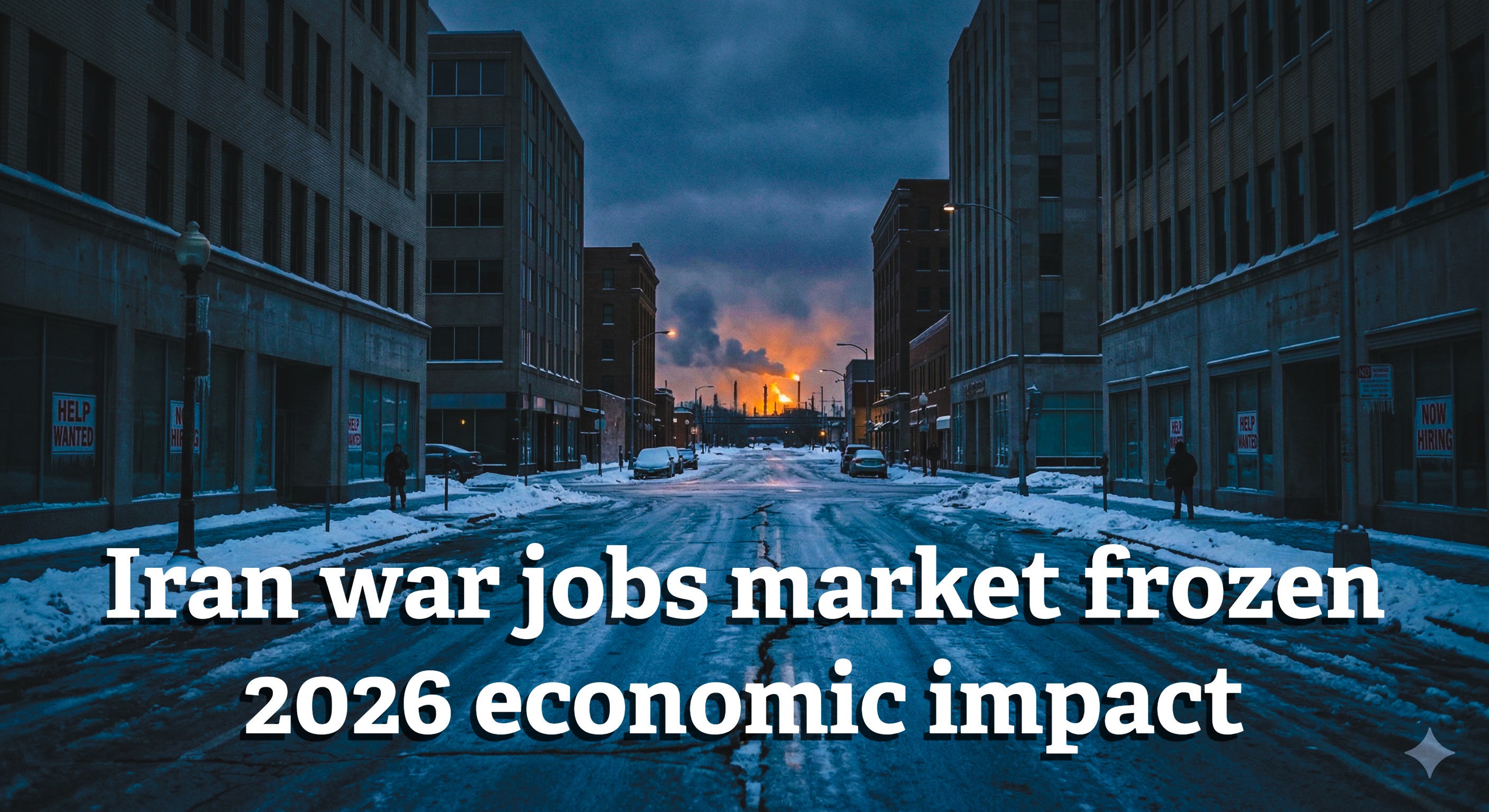
Iran war economy impact: The American labor market, once a roaring engine of post-pandemic recovery, has hit a wall of Siberian proportions. As the 2026 Iran War escalates following the joint U.S.-Israeli strikes launched on February 28, the “hiring thaw” that economists and job seekers had cautiously expected this spring has been replaced by a strategic, high-stakes deep freeze. It is no longer just about interest rates or the relentless march of artificial intelligence displacing white-collar work — it is about a global energy shock of historic scale that has corporate America holding its breath and its checkbooks. US unemployment 2026.
The conflict, triggered by Operation Epic Fury — the code name for joint U.S.-Israeli airstrikes targeting Iranian military and leadership infrastructure — has detonated an economic chain reaction that is now being felt at every level of American life: at the gas pump, in corporate boardrooms, on job boards, and inside the Federal Reserve’s cavernous decision-making chambers. The International Energy Agency has called it “the largest supply disruption in the history of the global oil market” — and the economic aftershocks are only beginning to be tallied.
The Strait of Hormuz — a narrow, 21-mile-wide chokepoint in the Persian Gulf through which roughly 20% of the world’s oil supply normally flows — has been effectively paralyzed since the war began. Before the conflict, the strait was carrying nearly 20 million barrels of oil per day, along with more than one-fifth of global liquefied natural gas (LNG) trade. That flow has faltered dramatically.
Goldman Sachs commodity strategists now expect Brent crude to average $105 in March and spike to $115 in April, before gradually retreating to $80 in the fourth quarter — assuming flows through the Strait of Hormuz remain severely disrupted for roughly six weeks. In a more adverse scenario, where the conflict deepens and the closure persists, Brent crude could peak as high as $140 per barrel. A “severely adverse” disruption could push prices to 0 — a figure that economists warn would be catastrophic for the U.S. economy.
For American workers and consumers, the pain is already concrete. Gasoline prices have climbed from around $3 per gallon earlier this year to over $3.75, with projections pointing toward $4.30–$4.50 in the coming months. For mid-sized logistics, manufacturing, or retail firms, these energy costs act as a silent “shadow tax,” draining the capital that would normally be allocated to onboarding new talent, expanding operations, or investing in growth.
The Mechanism of the Freeze
- Energy Uncertainty Stalls Consumer Spending: Consumer spending accounts for roughly two-thirds of all U.S. economic activity. Americans’ inflation expectations for the year ahead have posted their biggest monthly increase in roughly a year, climbing to 3.8% from 3.4% in February — the highest in all of 2024. When households redirect more dollars toward gas and energy, discretionary spending craters.
- The “Wait-and-See” Mandate: “Uncertainty is delaying, not canceling, hiring plans,” says Gregory Daco, chief economist at EY-Parthenon. CEOs are prioritizing liquidity and balance sheet resilience over expansion, waiting to see if the conflict remains geographically contained or spirals into a multi-year regional catastrophe.
- The Fertilizer Shock: The Strait of Hormuz is also the chokepoint for about one-third of the world’s global fertilizer supply. Minimal exports have already spiked fertilizer prices, threatening U.S. farm yields and, eventually, grocery store prices — adding a secondary inflationary wave that could hit months from now.
- The Hidden Supply Chain Fractures: A shortage of helium from the Gulf could impact semiconductor manufacturing, rippling into car production, consumer electronics, and dozens of industries that most Americans would never associate with a Middle East conflict.
The most alarming quantification of the war’s labor market toll came last week from Goldman Sachs, whose economist Pierfrancesco Mei laid out a detailed framework for how higher energy prices translate directly into payroll destruction. The bank estimates that the oil price shock triggered by the war will suppress payroll growth by roughly 10,000 jobs per month through the end of 2026 — a toll that will be felt most acutely in restaurants, hotels, and retail stores across the country.
Goldman now predicts the U.S. unemployment rate will climb to 4.6% by the end of 2026, up from 4.4% in February — and says the risk of a full recession over the next 12 months has risen to 30%. The bank’s projections align with those of the Federal Reserve’s own internal FRB/US model. In a severely adverse oil price scenario — one not yet considered the base case, but increasingly plausible — the unemployment hit could push significantly higher.
These forecasts land on top of an already fragile foundation. A dismal February jobs report showed the economy unexpectedly lost 92,000 jobs in the previous month, defying estimates of a 60,000-job gain. The U.S. added just 181,000 jobs in all of 2025 — one of the weakest annual totals in decades outside of outright recession years. That number had been expected to improve meaningfully in 2026, before the war reset every projection.
Mark Zandi, Moody’s chief economist, issued a stark warning. “Even before the conflict, I thought recession risks were on the rise,” he told CNBC. He now puts recession odds creeping toward 50%. “The oil shock,” he said, “could be the tipping point.”
“It’s almost as if the entire economy got hit by some superhero ice-blast, with all hiring and firing slowed down.”
— Nicholas Bloom, Economics Professor, Stanford University, via CNBC
Before the first strikes on February 28, the Federal Reserve had been positioned as the hero of 2026. Markets were pricing in two rate cuts this year, with a slim chance of a third. After 18 months of cautious, stop-start easing, the Fed was on course to provide the monetary stimulus that would have unfrozen the jobs market. Then the war changed every calculation.
The Fed held its benchmark rate steady at 3.5%–3.75% for a second consecutive meeting, in a decision that was widely expected but no less sobering. In its post-meeting statement, the Federal Open Market Committee acknowledged that “the implications of developments in the Middle East for the U.S. economy are uncertain.” Fed Chair Jerome Powell told reporters that the near-term effect of higher oil and gas prices will be to lift inflation — but that it remains “too soon to know” how the conflict will affect growth and hiring.
“The Fed is frozen,” Heather Long, chief economist at Navy Federal Credit Union, told CBS News bluntly. “We’re in this world where clearly the risks are elevated to the extreme, and the No. 1 question for the economy is when does the Strait of Hormuz reopen — and that isn’t really an economic question.”
Inside the Fed’s Updated Projections
- Inflation: Fed officials now project the PCE price index at 2.7% for 2026 — both headline and core — up from earlier estimates. Several outside forecasters see it reaching 3%.
- Rate Cuts in 2026: The closely watched “dot plot” shows just one cut this year, down from the two that markets had priced in before the war. Seven Fed officials now pencil in zero cuts in 2026. The committee is “deeply divided,” according to EY-Parthenon’s Daco.
- Rate Hikes on the Table: The Market Probability Tracker from the Atlanta Fed shows a 19.82% probability of a rate hike later this year — a figure that was unthinkable just two months ago. Sonu Varghese of Carson Group warned the Fed “may even start talking about rate hikes later this year.”
- Mortgage Rates Rise Again: The benchmark 30-year fixed mortgage rate had fallen below 6% in late February — its lowest since September 2022. It has since jumped to 6.26%, crushing the brief window of affordability that had just started opening for first-time homebuyers.
“It seems clear that the Fed was blindsided by recent inflation data and paralyzed by the Iran conflict, leaving participants caught like deer in the headlights,” wrote Tim Duy, chief U.S. economist at SGH Macro Advisors, in a note to clients.
The bind is textbook stagflation: the Fed cannot cut rates without risking a 1970s-style inflationary spiral. But keeping rates elevated keeps the jobs market on ice, starves businesses of growth capital, and makes every mortgage, car loan, and small business credit line more expensive. Higher inflation and higher unemployment are generally the worst-case scenario for central bankers — and that scenario is now the base case for the first half of 2026.
Not every sector is frozen. The war has created a brutally bifurcated economy where your industry — not your skills, not your experience, not your ambition — may be the single most important determinant of your near-term career trajectory. The divergence between winners and losers is sharper than anything seen since the pandemic’s sectoral whipsaw of 2020–2021.
| Sector | Status | Detailed Outlook | Key Driver |
|---|---|---|---|
| Tech & SaaS | Frozen | High borrowing costs suppress VC investment and R&D budgets. AI displacement of junior roles continues. Layoffs at mid-tier firms are accelerating quietly. | Rate freeze + AI displacement |
| Defense & Aerospace | Boiling | Massive replenishment orders for precision-guided munitions and allied military support. Contractors like Raytheon, Lockheed, and Northrop are hiring at pace not seen since post-9/11. | DoD replenishment contracts |
| Retail & Travel | Chilled | Discretionary income is being swallowed by gas prices. Consumers are “front-loading” summer travel bookings now out of fear of higher fares later, creating a false early bump before a likely summer contraction. | Gas prices + consumer fear |
| Renewables & Clean Energy | Active | Solar and wind power have become significantly more cost-competitive as oil prices surge. The war has accelerated the “Exit from Oil” mandate among utilities and corporate energy buyers. | Oil shock = renewables urgency |
| Logistics & Trucking | Chilled | Diesel prices have surged, squeezing margins on every shipment. Carriers are deferring fleet expansion and halting driver recruitment. The Red Sea, already closed in 2025 due to Houthi attacks, is expected to remain shut through 2026. | Diesel costs + Strait closure |
| Healthcare & Government | Mixed | Broadly insulated from energy shock, but federal budget uncertainty and potential sequestration talk is creating hesitation in government-adjacent hiring. Private health systems remain steady. | Budget uncertainty |
| Agriculture & Food Production | Chilled | Fertilizer costs have spiked due to Gulf supply disruption. Spring planting decisions are being made under enormous cost pressure, with potential crop yield consequences hitting grocery prices in late 2026. | Fertilizer shortage from Gulf |
The labor market’s dysfunction pre-dates the war — but the conflict has cemented and deepened it into something qualitatively different. Employers are hiring at their lowest rates since 2013, outside of the early Covid-19 pandemic, according to the most recent Bureau of Labor Statistics data. Meanwhile, layoff rates remain historically low — creating a paradox that is particularly brutal for job seekers.
Nicholas Bloom, an economics professor at Stanford University, described the dynamic with unusual vividness during a Harvard Kennedy School webinar on the war’s economic consequences. People who want to change jobs for higher pay, a new city, or a better manager “are finding themselves trapped,” he told CNBC by email. His advice for those currently employed was stark: “Don’t leave it,” he said, warning that things will get harder.
The reasons companies are holding onto their existing workers are deeply rooted in pandemic-era trauma. Businesses remember the brutal scramble to rehire after the Great Resignation of 2021–2022, when workers held historic leverage and job-hopping rates hit multi-decade highs. “As a result, many companies do not want to get caught short workers and have held on to staff,” wrote Scott Wren, senior global market strategist at the Wells Fargo Investment Institute — a dynamic analysts are calling “job hugging.”
But “job hugging” by employers doesn’t help the 4.4% of Americans who are already unemployed, nor recent graduates entering a market where entry-level openings have been disproportionately eliminated by AI tools or frozen by budget cuts. Gregory Daco of EY-Parthenon currently expects a “jobless” expansion with employment gains of just 20,000 per month in the first half of the year — and warns that with recession odds at around 40%, “the risk is that a prolonged pause in hiring eventually turns into more visible softening.”
“If the Strait of Hormuz remains closed and the oil price stays above 0 through April, then I think it’s a game-changer. Then you’re talking about a very different economy. Then you’re talking about layoffs re-entering the picture.”
— Heather Long, Chief Economist, Navy Federal Credit Union, via CNN Business
The psychological toll of the war is proving as economically significant as its material impacts. Consumer sentiment declined 6% this month to a final reading of 53.3, according to the University of Michigan’s closely watched survey — the lowest since December and steeper than economists had projected. Crucially, the decline was not limited to lower-income households most directly affected by gas prices: sentiment fell across all income groups, including the wealthiest Americans.
“Consumers with middle and higher incomes and stock wealth, buffeted by both escalating gas prices and volatile financial markets in the wake of the Iran conflict, exhibited particularly large drops in sentiment,” said Joanne Hsu, the survey’s director.
The stock market has reflected this anxiety. The Dow Jones Industrial Average entered correction territory. The S&P 500 logged its longest weekly losing streak in four years. Oil settled at Iran-war highs. The cycle is self-reinforcing: falling consumer confidence reduces spending, which reduces revenue, which justifies hiring freezes, which increases economic anxiety, which further reduces consumer confidence.
The word that keeps appearing in economists’ notes and trading desks across Wall Street is one that American policymakers spent decades hoping to never utter again: stagflation. The combination of stagnant economic growth alongside high unemployment and high inflation is how the U.S. economy responded to the oil price shocks of the 1970s — and the impact of the current conflict echoes that era through acute supply shortages, currency volatility, and heightened recession risk.
Sam Ori, who directs the Energy Policy Institute at the University of Chicago, offered a sobering historical benchmark. In the past, when oil prices have reached 4–5% of GDP and stayed elevated, “that’s always triggered a recession,” he said. The U.S. will not hit that threshold as quickly as in the 1970s — its economy is far less oil-dependent today — but Ori warned that if prices remain around 0 a barrel for most of the year, he would expect a recession. An indefinite Hormuz closure would “vastly exceed that number” and “would not take a year” to cause severe damage.
The OECD has raised its 2026 inflation forecast for G-20 nations to 4.0%, up from a December estimate of 2.8%, citing the war’s economic impact. Former Federal Reserve Chair Janet Yellen warned that, depending on how the conflict shapes oil markets, economic growth will suffer and the Fed’s task of containing inflation will become substantially more difficult.
With unemployment creeping toward 4.5% and the hiring rate at its lowest in over a decade, the window for easy job-hopping — the career-advancement strategy that defined the Great Resignation era — has slammed shut. The defining labor market dynamic is no longer the “Great Resignation” but what economists are calling the Great Retention: workers clinging to stable roles while the geopolitical storm rages, afraid to risk a leap into an uncertain market.
For workers in frozen sectors — tech, retail, logistics — the calculus is clear but painful: demonstrate indispensability, acquire skills that overlap with the sectors that are growing (defense tech, renewable energy, grid infrastructure, government contracting), and resist the temptation to leave a stable position for an incremental salary gain that may not materialize.
For those already in the job market, the situation is particularly difficult for recent graduates, career-changers, and workers in the sectors hardest hit by the oil shock. The safety net of tax refunds — which have averaged 10.9% higher this year — has provided some buffer, but economists warn that consumer resilience cannot last indefinitely if layoffs begin to pick up.
The single most important variable in every forecast is the one no economist can model: how long the Strait of Hormuz remains effectively closed, and whether diplomatic off-ramps can be found before the economic damage becomes structural rather than cyclical. Oxford Economics warns that baseline assumptions and market reactions may change quickly, and that scenario-based monitoring is now essential for every business and investor.
Until that question is answered, the Great Frost will persist — a Siberian stillness settling over America’s job market, where ambition freezes in the air and every career move feels like crossing thin ice.

Discover more from NewsNation Online
Subscribe to get the latest posts sent to your email.
आपके लिए सुझाव