
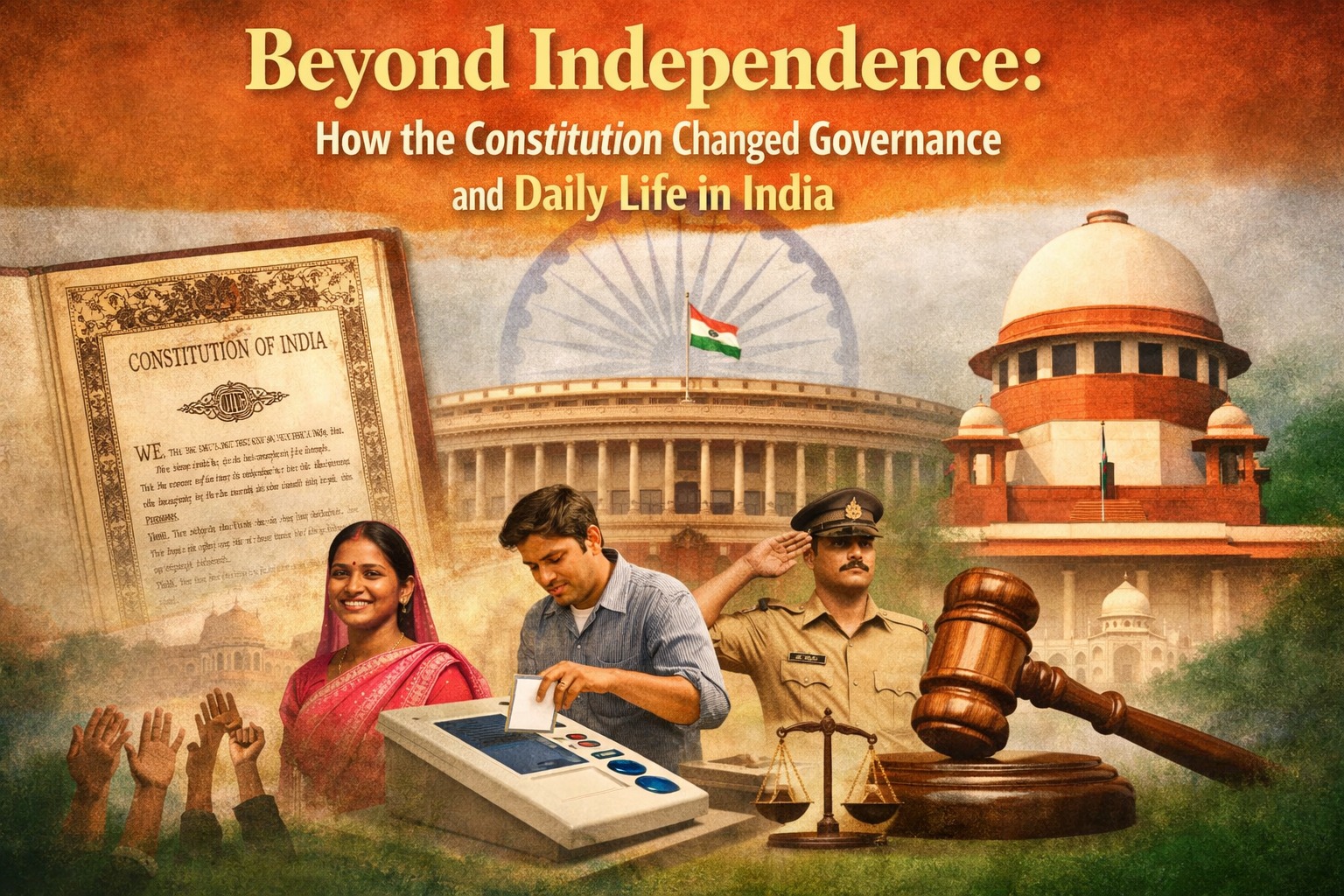
Beyond Independence: How the Constitution Changed Governance and Everyday Life in India
India attained independence on 15 August 1947, but the real transformation of governance began on 26 January 1950, when the Constitution of India came into force. Independence ended colonial rule; the Constitution reshaped power, citizenship, rights, and the everyday relationship between the State and its people. Impact of Constitution on Indian governance.
From Colonial Authority to the Rule of Law
Under British rule, laws were designed primarily to serve imperial interests. Executive authority dominated, and citizens had limited legal remedies against the State. The Constitution reversed this structure by placing everyone—including the government—under the rule of law.
Article 13 empowered courts to invalidate laws violating Fundamental Rights, while Article 32 allowed citizens to directly approach the Supreme Court for their enforcement.
Equality Became a Constitutional Right
Colonial India legally recognized inequality based on caste, race, gender, and social status. The Constitution dismantled this hierarchy through Articles 14 to 18, guaranteeing equality before law and abolishing untouchability.
Access to public spaces, education, employment, and institutions became a constitutional right rather than a social favor.
Fundamental Rights Transformed Daily Life
Freedoms that once depended on the permission of rulers became guaranteed rights. Article 19 ensured freedom of speech, movement, and profession, while Article 21 protected life and personal liberty.
Judicial interpretations later expanded these rights to include privacy, dignity, education, and a clean environment, making the Constitution a living document.
Landmark Supreme Court Judgments That Gave Rights Real Meaning
- Kesavananda Bharati Case (1973): Established the Basic Structure Doctrine, ensuring Parliament cannot destroy the Constitution’s core principles.
- Maneka Gandhi Case (1978): Expanded Article 21 to include fairness, dignity, and due process.
- Puttaswamy Case (2017): Recognized the Right to Privacy as a Fundamental Right.
Separation of Powers Prevented Abuse of Authority
The Constitution divided power among the Legislature, Executive, and Judiciary. This separation ensured accountability and prevented concentration of authority in any single institution.
Courts gained the authority to review executive actions, protecting citizens from misuse of power.
Universal Adult Franchise Strengthened Democracy
India adopted universal adult franchise from the very beginning. Every citizen above 18 years of age—regardless of wealth, gender, education, or caste—received the right to vote.
This turned democracy into a lived experience and enabled peaceful transfer of power through elections.Impact of Constitution on Indian governance.
India Before and After the Constitution: What Truly Changed
| Aspect | Before 1950 | After 1950 |
|---|---|---|
| Source of Power | British Crown | People of India |
| Rights | Granted by rulers | Guaranteed Fundamental Rights |
| Equality | Legal discrimination | Equality before law |
| Voting | Restricted | Universal adult franchise |
| Judiciary | Subordinate | Independent constitutional authority |
How the Constitution Affects Your Daily Life Today
- Freedom to express opinions without fear
- Protection against arbitrary arrest
- Right to move, work, and live anywhere in India
- Equal voting rights for all citizens
How the Constitution Was Crafted
The Indian Constitution was drafted by the Constituent Assembly over nearly three years of extensive debate and consultation. It reflected diverse voices and aimed to balance liberty with order, and unity with diversity.
Constitutional morality is not a natural sentiment. It has to be cultivated.
Dr. B. R. Ambedkar
Frequently Asked Questions
Conclusion: Why the Constitution Still Matters
Independence changed who ruled India. The Constitution changed how India is ruled and how Indians live. It transformed freedom into enforceable rights, authority into accountability, and diversity into unity.
More than seven decades later, the Constitution remains the living foundation of Indian democracy.
Impact of Constitution on Indian governance.

Discover more from NewsNation Online
Subscribe to get the latest posts sent to your email.

























































































Leave a Reply