
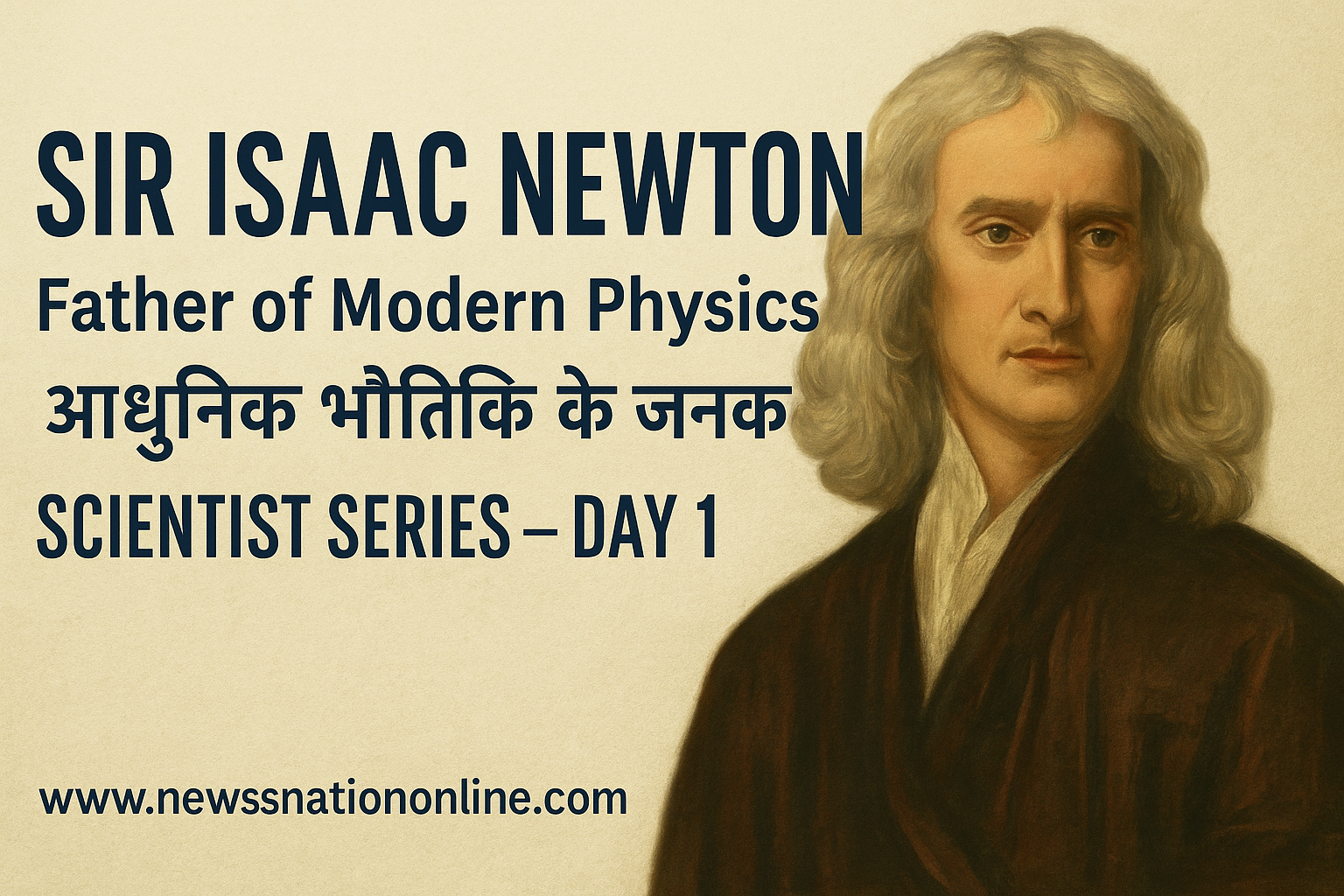
Sir Isaac Newton: Father of Classical Physics and the Scientific Revolution
सर आइज़ैक न्यूटन: शास्त्रीय भौतिकी और वैज्ञानिक क्रांति के जनक
Introduction | परिचय
Sir Isaac Newton (4 January 1643 – 31 March 1727) was a British mathematician, physicist, astronomer, theologian, and author who is widely recognised as one of the most influential scientists of all time. He revolutionized science with his groundbreaking theories on gravity, motion, and optics.
सर आइज़ैक न्यूटन (4 जनवरी 1643 – 31 मार्च 1727) एक ब्रिटिश गणितज्ञ, भौतिकशास्त्री, खगोलशास्त्री, धर्मशास्त्री और लेखक थे, जिन्हें अब तक के सबसे प्रभावशाली वैज्ञानिकों में गिना जाता है। उन्होंने गुरुत्वाकर्षण, गति और प्रकाश विज्ञान पर अपने सिद्धांतों के माध्यम से विज्ञान को पूरी तरह बदल दिया।
Early Life and Education | प्रारंभिक जीवन और शिक्षा
Newton was born in Woolsthorpe, Lincolnshire, England, prematurely and was not expected to survive. His father died before his birth, and he was raised by his maternal grandmother. He showed little interest in farming and was eventually sent to study at Trinity College, University of Cambridge in 1661. There, he studied mathematics, physics, and astronomy.
न्यूटन का जन्म इंग्लैंड के लिंकनशायर स्थित वूल्सथोर्प में समय से पहले हुआ था और उनके जीवित रहने की उम्मीद नहीं की जा रही थी। उनके पिता का निधन उनके जन्म से पहले हो गया था, और उन्हें उनकी नानी ने पाला। खेती में उनकी कोई रुचि नहीं थी, इसलिए उन्हें 1661 में कैम्ब्रिज विश्वविद्यालय के ट्रिनिटी कॉलेज भेजा गया, जहाँ उन्होंने गणित, भौतिकी और खगोलशास्त्र की पढ़ाई की।
The Plague Years and Newton’s Discoveries | प्लेग के वर्ष और न्यूटन की खोजें
In 1665, the Great Plague forced Cambridge to shut down, and Newton returned home. During this time, he made some of his most revolutionary discoveries, including:
- The Law of Universal Gravitation
- Three Laws of Motion
- Differential and Integral Calculus
- Experiments with light and prisms
1665 में प्लेग के प्रकोप के कारण कैम्ब्रिज बंद हो गया और न्यूटन घर लौट गए। इसी अवधि में उन्होंने अपने सबसे क्रांतिकारी अनुसंधान किए, जैसे:
- गुरुत्वाकर्षण का सार्वत्रिक नियम
- गति के तीन नियम
- कलन (कैल्कुलस) का विकास
- प्रकाश और प्रिज़्म पर प्रयोग
Newton’s Three Laws of Motion | न्यूटन के गति के तीन नियम
- First Law (Law of Inertia): An object remains at rest or in uniform motion unless acted upon by an external force.
पहला नियम (जड़त्व का नियम): कोई भी वस्तु तब तक स्थिर रहती है या एकसमान गति से चलती रहती है जब तक उस पर कोई बाहरी बल कार्य नहीं करता। - Second Law: Force = mass × acceleration (F = ma)
दूसरा नियम: बल = द्रव्यमान × त्वरण (F = ma) - Third Law: For every action, there is an equal and opposite reaction.
तीसरा नियम: प्रत्येक क्रिया के लिए एक समान और विपरीत प्रतिक्रिया होती है।
Universal Law of Gravitation | गुरुत्वाकर्षण का सार्वत्रिक नियम
Newton proposed that every object in the universe attracts every other object with a force that is proportional to the product of their masses and inversely proportional to the square of the distance between them.
न्यूटन ने बताया कि ब्रह्मांड की हर वस्तु दूसरी वस्तु को एक बल से आकर्षित करती है, जो उनके द्रव्यमानों के गुणनफल के समानुपाती और उनके बीच की दूरी के वर्ग के व्युत्क्रमानुपाती होता है।
Work in Optics | प्रकाश विज्ञान में कार्य
Newton studied the nature of light and color and proved that white light is made up of a spectrum of colors. His book *Opticks* laid the foundation of modern optics.
न्यूटन ने प्रकाश और रंगों की प्रकृति का अध्ययन किया और यह सिद्ध किया कि श्वेत प्रकाश विभिन्न रंगों के स्पेक्ट्रम से बना होता है। उनकी पुस्तक *Opticks* ने आधुनिक प्रकाश विज्ञान की नींव रखी।
Invention of Calculus | कैल्कुलस का विकास
Independently developed by Newton (and Leibniz in Germany), calculus is a branch of mathematics that deals with rates of change and helps solve problems in physics, engineering, and economics.
न्यूटन (और जर्मनी के लाइबनिज) द्वारा स्वतंत्र रूप से विकसित कैल्कुलस एक गणितीय शाखा है जो परिवर्तन की दर से संबंधित है और भौतिकी, इंजीनियरिंग और अर्थशास्त्र की समस्याओं को हल करने में सहायता करती है।
Later Life and Knighthood | बाद का जीवन और ‘सर’ की उपाधि
In 1705, Queen Anne knighted Newton for his contributions to science. He also served as the President of the Royal Society and Warden of the Royal Mint. He died in 1727 and was buried in Westminster Abbey, a rare honor for a scientist.
Newton’s Impact on Modern Science | आधुनिक विज्ञान पर न्यूटन का प्रभाव
Newton’s principles are the foundation of classical mechanics and continue to be taught in schools and universities. His work bridged the gap between medieval science and modern physics.
न्यूटन के सिद्धांत शास्त्रीय यांत्रिकी की नींव हैं और आज भी विद्यालयों व विश्वविद्यालयों में पढ़ाए जाते हैं। उन्होंने मध्यकालीन विज्ञान और आधुनिक भौतिकी के बीच की दूरी को समाप्त किया।
Inspiration for Students | विद्यार्थियों के लिए प्रेरणा
Newton’s life teaches us that curiosity, observation, and perseverance can lead to greatness. Even during isolation, he used his time productively, proving that self-study and focus can lead to historic achievements.
न्यूटन का जीवन हमें सिखाता है कि जिज्ञासा, अवलोकन और निरंतरता से महानता प्राप्त की जा सकती है। उन्होंने एकांत में रहते हुए भी समय का सदुपयोग किया, यह साबित करते हुए कि आत्म-अध्ययन और एकाग्रता से ऐतिहासिक उपलब्धियाँ संभव हैं।
Famous Quote | प्रसिद्ध उद्धरण
“If I have seen further, it is by standing on the shoulders of giants.”
— Sir Isaac Newton
© http://www.newsnationonline.com | All Rights Reserved | Daily Scientist Series | Day 1

Discover more from NewsNation Online
Subscribe to get the latest posts sent to your email.

























































































Leave a Reply