
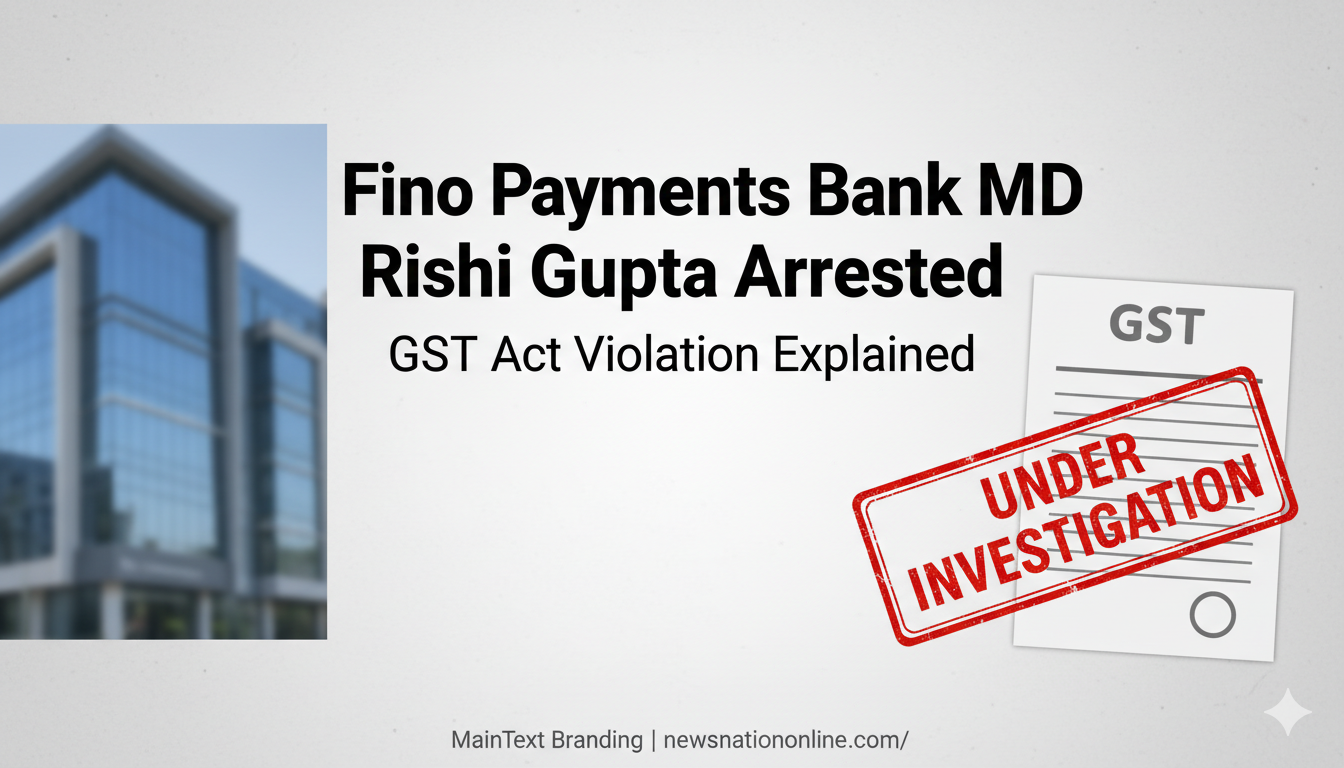
The recent development involving Fino Payments Bank MD Rishi Gupta arrested for GST Act violation has triggered significant attention across India’s financial and regulatory ecosystem. The arrest has raised questions regarding compliance oversight, corporate governance standards, and regulatory enforcement in the Indian banking sector. We present a detailed, structured, and comprehensive examination of the case, its legal implications, financial impact, and what it means for stakeholders.
Who Is Rishi Gupta? Leadership at Fino Payments Bank
Rishi Gupta has been a central figure in the growth trajectory of Fino Payments Bank, serving as Managing Director and Chief Executive Officer. Under his leadership, the bank expanded aggressively in rural and semi-urban India, positioning itself as a key player in the financial inclusion ecosystem.
Fino Payments Bank operates as a payments bank regulated by the Reserve Bank of India (RBI), focusing primarily on digital payments, remittances, micro-savings, and financial access for underserved communities. The institution is widely known for its merchant network model and doorstep banking services.
The arrest of such a senior executive has created ripples not just within the organization but across India’s broader fintech and banking landscape.
Understanding the GST Act Violation Allegations
The Goods and Services Tax (GST) Act governs indirect taxation in India. Any alleged violation under this act typically involves issues such as:
- Incorrect tax filings
- Misrepresentation of taxable transactions
- Failure to deposit collected GST
- Input tax credit discrepancies
- Documentation or compliance irregularities
In the case involving Fino Payments Bank MD Rishi Gupta, authorities have reportedly taken action under provisions that relate to non-compliance or procedural violations under the GST framework. Such cases fall under the purview of the GST Intelligence or Enforcement Directorate.
The GST Act includes stringent enforcement measures, including arrest provisions under Section 69, particularly if the alleged tax evasion exceeds prescribed thresholds.
Legal Framework: Arrest Under GST Law
The GST law provides authorities the power to arrest individuals if there is credible evidence of deliberate tax evasion or fraudulent conduct. The legal framework includes:
Section 69 of the CGST Act
Allows authorized officers to arrest persons believed to have committed specified offenses under Section 132.
Section 132 – Punishment for Offenses
Covers offenses including:
- Issuing invoices without supply of goods/services
- Availing input tax credit fraudulently
- Collecting tax but failing to deposit it
- Tax evasion exceeding statutory limits
If tax evasion exceeds ₹5 crore, the offense can become cognizable and non-bailable.
The arrest of a Managing Director under such provisions signals that authorities consider the matter significant.
Impact on Fino Payments Bank Operations
The immediate question concerns whether operational stability is affected. In similar corporate governance events, companies typically release official statements to reassure stakeholders regarding:
- Continuity of banking operations
- Appointment of interim leadership
- Regulatory compliance reviews
- Internal audit measures
Payments banks operate under strict RBI supervision. Therefore, operational disruptions are generally minimized through contingency management systems.
However, investor sentiment and stock price volatility may arise due to uncertainty surrounding leadership and compliance credibility.
Corporate Governance and Compliance Oversight
This development places strong emphasis on corporate governance mechanisms within regulated financial institutions. Payments banks are subject to:
- RBI prudential norms
- Financial reporting requirements
- GST compliance standards
- Internal audit protocols
- Board-level compliance oversight
Any regulatory investigation at the leadership level may lead to:
- Independent forensic audits
- Board reconstitution
- Strengthening of compliance departments
- Re-evaluation of financial reporting systems
We observe that governance robustness becomes central in restoring institutional confidence.
Regulatory Scrutiny in the Indian Banking Sector
India’s regulatory ecosystem has significantly tightened enforcement standards in recent years. Both the Reserve Bank of India and GST authorities have intensified scrutiny across:
- Fintech entities
- NBFCs
- Payments banks
- Digital wallet operators
The arrest reflects a broader pattern of enforcement-led compliance discipline. Regulatory authorities are increasingly proactive in taking action against senior management where violations are suspected.
Such actions are intended to deter financial misconduct and strengthen systemic accountability.
Investor and Market Reaction
Whenever high-level executives face legal proceedings, financial markets respond cautiously. Key areas of concern include:
- Management continuity
- Regulatory penalties
- Reputational damage
- Financial liabilities
- Long-term compliance costs
If the alleged GST violations involve significant monetary amounts, the bank could face:
- Monetary penalties
- Prosecution proceedings
- Interest liabilities
- Additional compliance directives
However, it is essential to distinguish between individual accountability and institutional liability. Market confidence typically stabilizes once clarity emerges.
What Happens Next: Legal and Regulatory Process
Following arrest under GST provisions, the process usually includes:
- Judicial Custody or Bail Hearing
- Submission of Evidence by GST Authorities
- Detailed Investigation and Audit Examination
- Adjudication Proceedings
- Possible Appeals
If the court grants bail, the accused may continue legal defense while investigations proceed. In corporate cases, organizations often cooperate with enforcement agencies and conduct parallel internal reviews.
The timeline of GST litigation can extend over months or years depending on complexity.
Implications for the Indian Fintech and Payments Ecosystem
India’s digital financial services sector is one of the fastest-growing globally. Payments banks play a crucial role in:
- Financial inclusion
- UPI adoption
- Rural banking penetration
- Digital remittance systems
A case involving a major executive highlights the need for:
- Strong compliance automation systems
- Real-time tax reconciliation
- Robust financial governance frameworks
- Proactive regulatory communication
The sector’s long-term growth remains intact, but governance standards will likely become stricter.
Reputation Management and Crisis Communication
In corporate governance crises, communication strategy becomes vital. Organizations typically adopt:
- Transparent regulatory disclosures
- Investor briefings
- Public clarification statements
- Strengthening of compliance disclosures
If handled effectively, reputational damage can be contained. However, delayed communication can intensify speculation.
Strengthening Compliance: Lessons for Corporate India
This incident underscores essential compliance lessons:
- Board-Level Oversight Is Critical
- GST Reconciliation Must Be Automated
- Regular Internal Audits Prevent Escalation
- Senior Management Accountability Is Non-Negotiable
- Regulatory Risk Assessment Should Be Continuous
Companies operating in financial services must ensure cross-verification between tax filings, financial reporting, and operational accounting.
A Defining Moment for Financial Governance
The case of Fino Payments Bank MD Rishi Gupta arrested for GST Act violation represents a pivotal development in India’s financial compliance narrative. Whether the matter concludes as procedural non-compliance or escalates into a major prosecution will depend on investigative findings and judicial proceedings.
We emphasize that regulatory accountability is integral to maintaining trust in India’s rapidly expanding financial ecosystem. Payments banks, fintech firms, and regulated institutions must view this development as a reminder to fortify governance structures, enhance transparency, and prioritize strict adherence to statutory obligations.
Financial markets reward transparency, discipline, and compliance integrity. As the legal process unfolds, stakeholders will closely monitor developments that shape the future trajectory of Fino Payments Bank and its leadership.
Discover more from NewsNation Online
Subscribe to get the latest posts sent to your email.



























































































Leave a Reply