
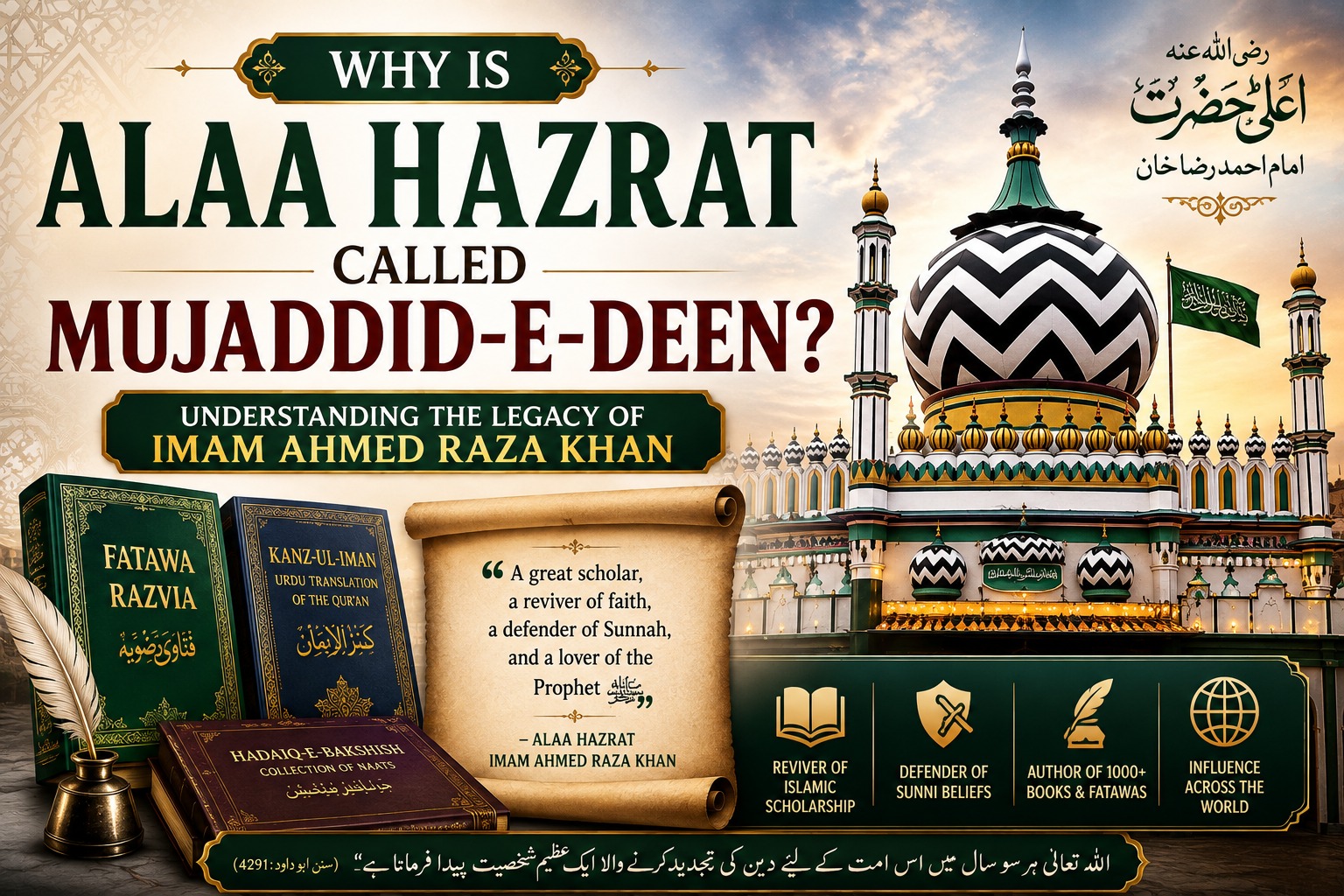
Why Is Alaa Hazrat Called Mujaddid-e-Deen? Understanding the Legacy of Imam Ahmed Raza Khan
By NewsNationOnline Desk
Website: www.newsnationonline.com
Why Is Alaa Hazrat Called Mujaddid-e-Deen? Understanding the Legacy of Imam Ahmed Raza Khan
More than a century after his passing, Imam Ahmed Raza Khan Barelvi (1856–1921) known as Alaa Hazrat, remains influential worldwide.
Moreover, Why Is Alaa Hazrat Called Mujaddid-e-Deen recognizes him as a reviver of the faith.
But what does this title actually mean? Why do countless Sunni Muslims regard Imam Ahmed Raza Khan as a Mujaddid? Is this title based on Islamic tradition, and how do scholars understand it?
This article explores the meaning of Mujaddid-e-Deen, the life and works of Imam Ahmed Raza Khan, and the reasons many scholars and followers consider him one of the great revivers of Islamic scholarship in the Indian subcontinent.
What Does “Mujaddid-e-Deen” Mean?
The Arabic word Mujaddid comes from the root word “Tajdid,” which means renewal or revival. A Mujaddid is understood to be a scholar who revives the teachings of Islam by calling people back to the Quran and the authentic Sunnah without introducing a new religion or changing the fundamentals of Islam.
According to a well-known Hadith recorded in Sunan Abu Dawood, the Prophet Muhammad ﷺ is reported to have said:
“Allah will raise for this community at the beginning of every hundred years someone who will renew its religion.”
Islamic scholars have interpreted this narration in different ways.
Some believe a Mujaddid may be an individual.
Moreover, others consider renewal can occur through a group of scholars.
Throughout Islamic history, several renowned scholars have been regarded as Mujaddids by their followers.
Why Is Alaa Hazrat Called Mujaddid-e-Deen.
Imam Ahmed Raza Khan: A Scholar of Extraordinary Knowledge
Born on 14 June 1856 in Bareilly, Uttar Pradesh, Imam Ahmed Raza Khan belonged to a distinguished family of Islamic scholars.
His father, Maulana Naqi Ali Khan, was himself an accomplished jurist who supervised his son’s education. Historical biographies mention that Imam Ahmed Raza Khan demonstrated remarkable intellectual abilities from an early age.
At approximately 13 years of age, he issued his first Fatwa after receiving approval from his father, marking the beginning of a scholarly career that would span nearly five decades.
His expertise extended far beyond jurisprudence. He mastered:
- Quranic sciences
- Hadith
- Hanafi Fiqh
- Arabic grammar
- Logic
- Philosophy
- Mathematics
- Astronomy
- Inheritance law
- Theology
- Arabic and Persian literature
His vast command of multiple disciplines earned him respect among scholars of his time.
Why Do Many Scholars Call Him Mujaddid-e-Deen?
Followers of Imam Ahmed Raza Khan believe he fulfilled the role of a Mujaddid through his lifelong efforts to preserve traditional Sunni Islamic teachings during a period of significant religious, intellectual, and political change in British India.
Among the reasons often cited are:
Revival of Classical Sunni Scholarship
Imam Ahmed Raza Khan emphasized strict adherence to the Quran, authentic Hadith, and the Hanafi school of jurisprudence. He consistently encouraged Muslims to follow established scholarly traditions rather than personal interpretations lacking classical foundations.
His writings sought to explain Islamic teachings in a manner rooted in the works of earlier scholars while addressing contemporary questions.
defense of the Honor of Prophet Muhammad ﷺ
One of the defining characteristics of Imam Ahmed Raza Khan’s scholarship was his profound reverence and love for the Prophet Muhammad ﷺ.
Throughout his writings, speeches, and poetry, he stressed the importance of respecting the dignity, status, and unique position of the Prophet.
His famous collection of devotional poetry, Hadaiq-e-Bakhshish, continues to be recited in gatherings around the world and reflects his deep spiritual attachment to the Messenger of Allah ﷺ.
Preservation of Islamic Beliefs
During the late nineteenth and early twentieth centuries, numerous theological debates emerged across the Indian subcontinent.
Imam Ahmed Raza Khan authored detailed works explaining Sunni theological positions on issues relating to belief, worship, and Islamic practices. His followers believe these efforts helped preserve traditional Sunni teachings for future generations.
Fatawa Razvia: A Monumental Contribution
Among Imam Ahmed Raza Khan’s greatest scholarly achievements is Fatawa Razvia, a comprehensive collection of Islamic legal opinions.
The work covers thousands of religious and practical issues including:
- Prayer
- Fasting
- Zakat
- Hajj
- Marriage
- Divorce
- Business transactions
- Inheritance
- Social ethics
- Contemporary legal questions
Even today, many Islamic seminaries and Muftis refer to Fatawa Razvia while researching matters of Hanafi jurisprudence.
Its detailed reasoning and extensive citations have made it one of the most influential legal compilations produced in South Asia.
Kanz-ul-Iman: A Landmark Urdu Translation
Another remarkable contribution is Kanz-ul-Iman, Imam Ahmed Raza Khan’s celebrated Urdu translation of the Holy Qur’an.
Unlike a literal translation, Kanz-ul-Iman aims to preserve both the linguistic beauty and reverential tone of the Qur’anic message. It remains widely read among many Urdu-speaking Muslims and has been accompanied by respected commentaries over the years.
The translation continues to be printed and studied across India, Pakistan, Bangladesh, South Africa, the United Kingdom, and other countries.
More Than a Religious Scholar
Imam Ahmed Raza Khan is often described as a polymath because of his knowledge in multiple disciplines.
Historical sources attribute to him works on:
- Astronomy
- Mathematics
- Geometry
- Philosophy
- Logic
- Arabic linguistics
- Persian literature
- Theology
- Jurisprudence
- Qur’anic sciences
Traditional accounts credit him with authoring hundreds of books, treatises, and thousands of Fatwas, making him one of the most prolific scholars of modern South Asian Islamic history.
Influence Across the World
Although Imam Ahmed Raza Khan spent most of his life in Bareilly, his influence spread far beyond India.
Today, his teachings continue to guide millions of Muslims across:
- India
- Pakistan
- Bangladesh
- Nepal
- South Africa
- United Kingdom
- United States
- Canada
- Gulf countries
- East Africa
Numerous mosques, Islamic schools, research institutes, and educational organizations continue to teach his works.
His books have also been translated into English, Arabic, Turkish, French, and several other languages, allowing readers from different backgrounds to access his scholarship.
Urs of Alaa Hazrat
Every year, thousands of devotees from across the globe visit Bareilly Sharif to participate in the Urs-e-Ala Hazrat, commemorating the anniversary of Imam Ahmed Raza Khan’s passing.
The annual event typically includes:
- Qur’an recitation
- Na’at gatherings
- Religious lectures
- Scholarly conferences
- Charity programmes
- Collective prayers
For many attendees, the Urs is not merely a remembrance ceremony but an opportunity to revisit his teachings on faith, knowledge, ethics, and devotion.
Different Scholarly Perspectives
While many Sunni scholars, particularly within the Barelvi tradition, honor Imam Ahmed Raza Khan with the title Mujaddid-e-Deen, it is important to recognize that this is a matter of scholarly interpretation and religious tradition rather than a universally accepted designation across all Muslim schools of thought.
Different Islamic traditions may identify different scholars as Mujaddids for particular centuries or understand the concept of renewal in different ways. Recognizing these diverse perspectives helps readers appreciate the rich intellectual history of Islamic scholarship.
His Legacy in the Modern World
More than one hundred years after his passing, Imam Ahmed Raza Khan’s influence remains visible in religious education, Islamic literature, and devotional life.
His emphasis on:
- acquiring authentic knowledge,
- respecting scholars,
- preserving Islamic traditions,
- following the Qur’an and Sunnah,
- and expressing deep love for the Prophet Muhammad ﷺ,
continues to resonate with millions of Muslims worldwide.
His writings remain subjects of academic research, while his legal opinions continue to be consulted in many seminaries.
Why His Legacy Endures
The continued relevance of Imam Ahmed Raza Khan lies in his ability to combine scholarship with spirituality. His works sought to address the practical needs of Muslims while remaining rooted in classical Islamic sources.
For his followers, the title Mujaddid-e-Deen reflects not only his vast knowledge but also his perceived role in reviving and preserving Sunni Islamic teachings during a transformative period in South Asian history.
Whether viewed from a religious, historical, or academic perspective, Imam Ahmed Raza Khan’s contributions have left a lasting impact on Islamic thought and continue to shape discussions on theology, jurisprudence, and devotion.
Conclusion
The title Mujaddid-e-Deen is among the highest honors bestowed upon Imam Ahmed Raza Khan. Moreover, it reflects their belief that he revitalized Islamic learning, defended traditional Sunni beliefs, and left behind a vast body of scholarly work that continues to guide generations. Additionally, Why Is Alaa Hazrat Called Mujaddid-e-Deen, Alaa Hazrat Mujaddid-e-Deen Imam Ahmed Raza Khan Mujaddid Imam Ahmed Raza Khan Legacy Who is Mujaddid-e-Deen Imam Ahmed Raza Khan Biography Alaa Hazrat Contributions Fatawa Razvia Kanz-ul-Iman Imam Ahmed Raza Khan Books Imam-e-Ahle Sunnat Ahmed Raza Khan Barelvi Sunni Islamic Scholar Alaa Hazrat History Islamic Scholar of India Revival of Sunni Islam.
His legacy is preserved through monumental works such as Fatawa Razvia, Kanz-ul-Iman, and Hadaiq-e-Bakhshish, as well as through the countless institutions, scholars, and students who continue to study and teach his writings.
More than a century after his passing, Alaa Hazrat remains one of the most influential Islamic scholars produced by the Indian subcontinent, and his intellectual and spiritual contributions continue to inspire millions across the globe.
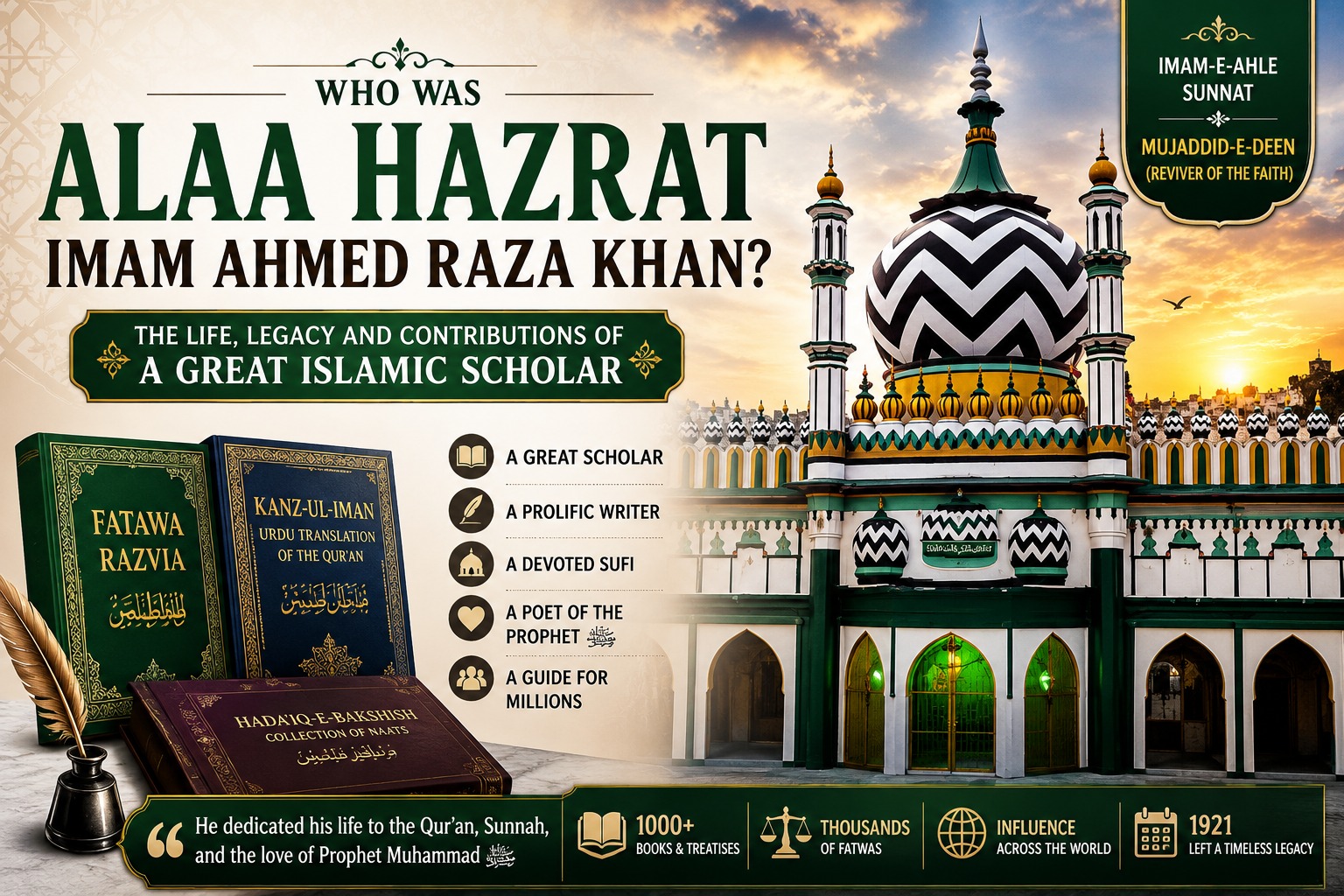
- Who Was Alaa Hazrat Imam Ahmed Raza Khan? Complete Biography
https://newsnationonline.com/ - 108th Urs-e-Ala Hazrat: History, Significance and Celebrations
https://newsnationonline.com/india/108th-urs-e-ala-hazrat-jalna-maulana-ghulam-jilani-misbahi/ - Islam
https://newsnationonline.com/category/india/ - Religion
https://newsnationonline.com/category/religion/
- Dar al-Ifta Egypt (Official Website) – For information on Islamic jurisprudence and fatwa traditions.
Dar al-Ifta Egypt - Al-Azhar University (Official Website) – One of the world’s oldest centers of Islamic learning.
Al-Azhar University - Internet Archive – For historical editions of Fatawa Razvia and other classical Islamic works.
Internet Archive
Discover more from NewsNation Online
Subscribe to get the latest posts sent to your email.
आपके लिए सुझाव


































































































Leave a Reply