

Who Was Alaa Hazrat Imam Ahmed Raza Khan? – The Life, Legacy and Contributions of a Great Islamic Scholar
By NewsNationOnline Desk
Who Was Alaa Hazrat Imam Ahmed Raza Khan? For over a century, the name Alaa Hazrat Imam Ahmed Raza Khan Barelvi (1856–1921) has remained synonymous with Islamic scholarship. Revered across India, Pakistan, Bangladesh, South Africa, and United Kingdom, Alaa Hazrat holds a unique place in Sunni Islam.
This overview explores Who Was Alaa Hazrat Imam Ahmed Raza Khan. In the broader history of Sunni Islam in the subcontinent, his impact endures. Scholars note his devotion to the Prophet Muhammad ﷺ and his role in religious discourse. His legacy continues to inspire generations.
His remarkable contributions to Islamic jurisprudence, Quranic translation, Hadith studies, theology, poetry, mathematics, astronomy, and spirituality continue to influence scholars and ordinary Muslims alike. Even today, his books are taught in Islamic seminaries, his rulings are consulted by Muftis, and his devotional poetry is recited with immense love across the world. (Barkate Raza)
Birth and Early Life
Imam Ahmed Raza Khan was born on 14 June 1856 (10 Shawwal 1272 AH) in Bareilly, Uttar Pradesh, during British India. He belonged to a respected family of Islamic scholars.
His father, Maulana Naqi Ali Khan, was a distinguished Islamic jurist and scholar, while his grandfather was also renowned for his knowledge and piety. Growing up in such an environment allowed young Ahmed Raza Khan to receive rigorous Islamic education from an early age. (Raza Academy)
From childhood, he displayed extraordinary intelligence. Historical accounts mention that he possessed an exceptional memory and grasped complex religious subjects much faster than students much older than him.
A Child Prodigy
One of the most remarkable events from his early life was his ability to issue a religious legal opinion (Fatwa) at the age of approximately 13 years.
After reviewing the Fatwa, his father declared it accurate and authorized him to issue Islamic legal rulings. This marked the beginning of a scholarly career that would continue for nearly five decades. (welcome to kanzul iman Islamic library)
Why Is He Called “Alaa Hazrat”?
The title “Alaa Hazrat” literally means “His Eminent Excellency.”
It was bestowed upon Imam Ahmed Raza Khan by scholars and followers as a mark of profound respect for his vast knowledge, piety, and services to Islam. He is also widely known as:
- Imam-e-Ahle Sunnat
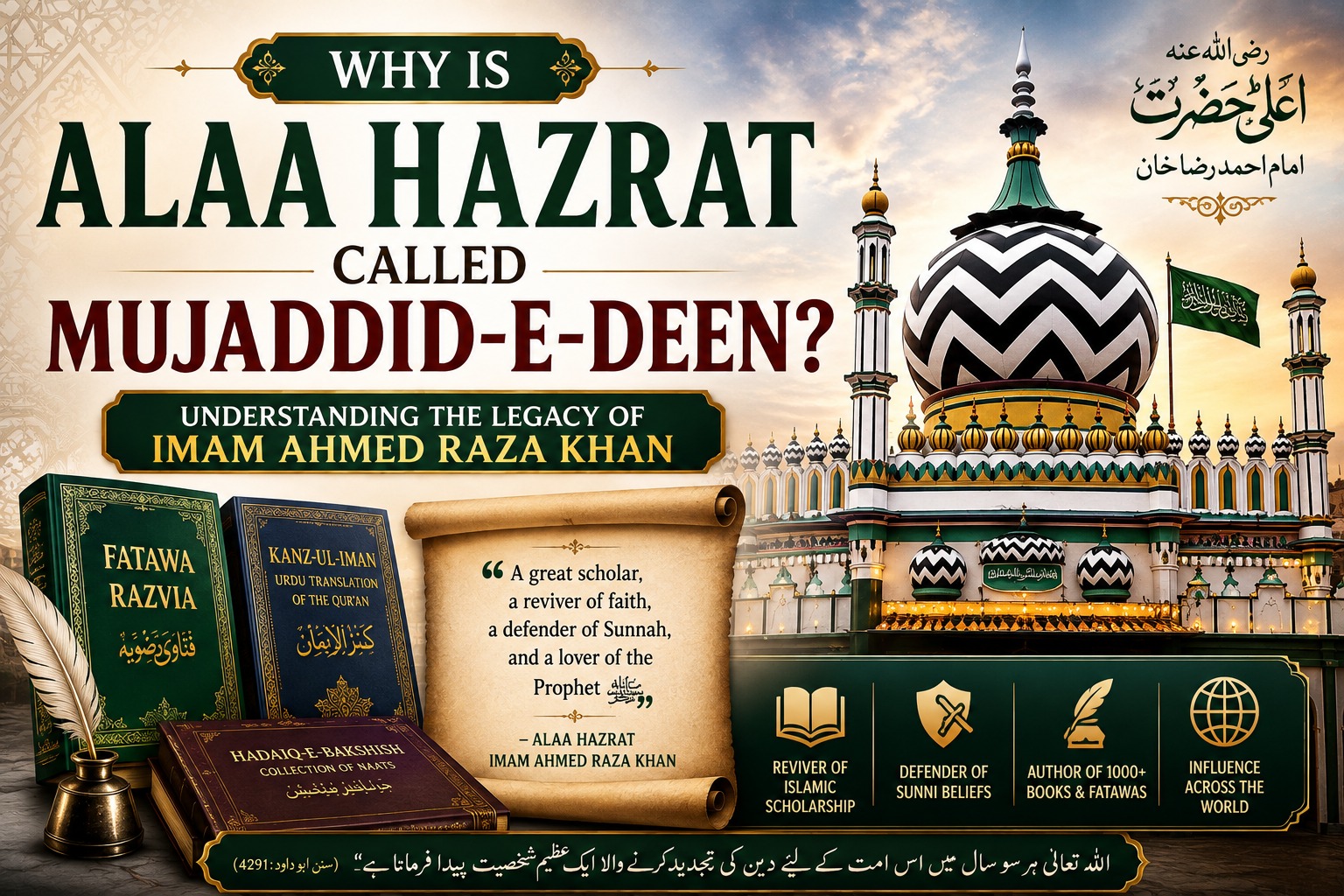
- Mujaddid-e-Deen (Reviver of the Faith)
- Mujaddid of the 14th Islamic Century (among his followers)
- Faqih-e-Islam
- Imam Ahmed Raza Khan Barelvi
These honorifics reflect the esteem in which he is held by many Sunni Muslims, particularly within the Barelvi tradition. (Barkate Raza)
A Scholar of Many Sciences
Although primarily known as an Islamic scholar, Imam Ahmed Raza Khan’s intellectual interests extended far beyond theology.
He studied and wrote on numerous disciplines, including:
- Quranic exegesis (Tafsir)
- Hadith
- Hanafi Fiqh
- Arabic grammar
- Logic
- Philosophy
- Astronomy
- Mathematics
- Inheritance law
- Linguistics
- Theology
Traditional biographical sources describe him as a polymath who authored works across dozens of fields. (welcome to kanzul iman Islamic library)
An Extraordinary Author
One of the defining aspects of Alaa Hazrat’s legacy is his prolific writing.
He is traditionally credited with authoring hundreds of books, treatises, and pamphlets, alongside thousands of legal opinions (fatwas) addressing questions of faith, worship, ethics, family matters, commerce, and social life. Estimates of the total number of works vary across sources, with many traditional accounts placing the figure close to one thousand. (welcome to kanzul iman Islamic library)
His writings remain in circulation across South Asia and beyond.
Fatawa Razvia – His Magnum Opus
Perhaps his most famous scholarly work is Fatawa Razvia, a comprehensive compilation of Islamic legal rulings based primarily on the Hanafi school of jurisprudence.
This monumental collection addresses thousands of practical and theological questions covering:
- Worship
- Marriage
- Business
- Inheritance
- Social conduct
- Modern issues of his era
- Islamic beliefs
The work continues to be widely referenced in many Sunni seminaries and by scholars seeking guidance on Hanafi jurisprudence. (welcome to kanzul iman Islamic library)
Kanz-ul-Iman – A Celebrated Urdu Translation of the Quran
Another enduring contribution is Kanz-ul-Iman, his Urdu translation of the Holy Quran.
The translation is known for its literary elegance and devotional style. It remains one of the most widely read Urdu translations among followers of the Barelvi school and has been accompanied by respected commentaries over the years. (Islamic Chronicles)
Love for the Prophet Muhammad ﷺ
Perhaps no aspect of Imam Ahmed Raza Khan’s life is more closely associated with him than his deep reverence for the Prophet Muhammad ﷺ.
His poetry reflects profound devotion, humility, and spiritual love. Among his best-known poetic works is Hadaiq-e-Bakhshish, a collection of devotional poetry (na’at) that continues to be recited in religious gatherings across the world. (Barkate Raza)
A Spiritual Guide
Imam Ahmed Raza Khan was also associated with the Qadiri Sufi tradition. He emphasized that spirituality should always remain firmly rooted in the Quran, the Sunnah, and the teachings of classical Sunni scholarship.
His approach sought to combine legal scholarship with spiritual refinement, encouraging ethical conduct, remembrance of God, and adherence to established Islamic teachings. (Islamic Chronicles)
His Influence on the Barelvi Movement
Imam Ahmed Raza Khan is regarded as the leading intellectual figure behind what later came to be known as the Barelvi movement, a Sunni revival movement that emerged in the Indian subcontinent in the late nineteenth and early twentieth centuries.
The movement emphasizes:
- Love and reverence for Prophet Muhammad ﷺ
- Following the Hanafi school of law
- Respect for Sufi traditions
- Celebration of Mawlid (where practiced)
- Preservation of traditional Sunni scholarship
His writings helped shape the theological and legal outlook of many Sunni communities in South Asia. (Islamic Chronicles)
Legacy Beyond India
Although Imam Ahmed Raza Khan spent most of his life in Bareilly, his influence spread far beyond India.
Today, educational institutions, research centers, mosques, libraries, and organizations inspired by his teachings exist across:
- India
- Pakistan
- Bangladesh
- South Africa
- United Kingdom
- United States
- Middle East
His books have been translated into multiple languages, making his scholarship accessible to a wider audience. (Barkate Raza)
Urs and Annual Commemorations
Every year, thousands of devotees gather in Bareilly to commemorate the Urs of Alaa Hazrat, marking the anniversary of his passing.
The occasion includes:
- Quran recitation
- Na’at gatherings
- Scholarly conferences
- Religious lectures
- Charity initiatives
- Special prayers
The event draws visitors from many countries and serves as an opportunity to revisit his scholarly and spiritual legacy.
Passing Away
Imam Ahmed Raza Khan passed away on 28 October 1921 in Bareilly at the age of 65.
He was laid to rest in Bareilly, where his shrine continues to attract visitors seeking to pay their respects and learn about his life and contributions. (Islamic Chronicles)
Why Is Alaa Hazrat Still Relevant Today?
More than a century after his passing, Imam Ahmed Raza Khan’s works continue to be studied by scholars, researchers, and students of Islamic thought. His legacy endures through his legal writings, Quranic translation, devotional poetry, and emphasis on preserving classical Sunni scholarship.
At the same time, historians note that some of his theological positions were part of broader scholarly debates within South Asian Islam, and different Muslim traditions have held differing views on aspects of his thought. Despite these differences, his influence on the religious, intellectual, and cultural life of millions of Muslims remains significant and well documented. (Islamic Chronicles)
Conclusion
Imam Ahmed Raza Khan, widely known as Alaa Hazrat, was far more than a religious jurist. He was a scholar, translator, theologian, poet, educator, and spiritual guide. His contributions left a lasting imprint on Islamic scholarship in South Asia and beyond. In exploring Who Was Alaa Hazrat Imam Ahmed Raza Khan, readers learn his true stature.
Whether through Fatawa Razvia, Kanz-ul-Iman, or his devotional poetry, his works continue to inspire discussion, study, and devotion among many Muslims worldwide. Understanding his life offers valuable insight into the intellectual and spiritual history of Islam in the Indian subcontinent.
Suggested Internal Links (NewsNationOnline)
- 108th Urs-e-Ala Hazrat: History, Significance and Celebrations
- Kanz-ul-Iman: Why Alaa Hazrat’s Quran Translation Remains Popular
- Fatawa Razvia: Understanding the Landmark Work of Imam Ahmed Raza Khan
- Top 10 Books Every Student of Islamic Studies Should Read
- Bareilly Sharif: A Spiritual Destination for Millions of Devotees
Suggested External References
- Official resources of organizations preserving the works of Imam Ahmed Raza Khan.
- Academic studies on South Asian Islamic scholarship and the history of the Barelvi movement.
Discover more from NewsNation Online
Subscribe to get the latest posts sent to your email.
आपके लिए सुझाव
































































































Leave a Reply