

By NewsNationOnline Team | October 31, 2025
A Royal Title Lost — and a Legacy in Question
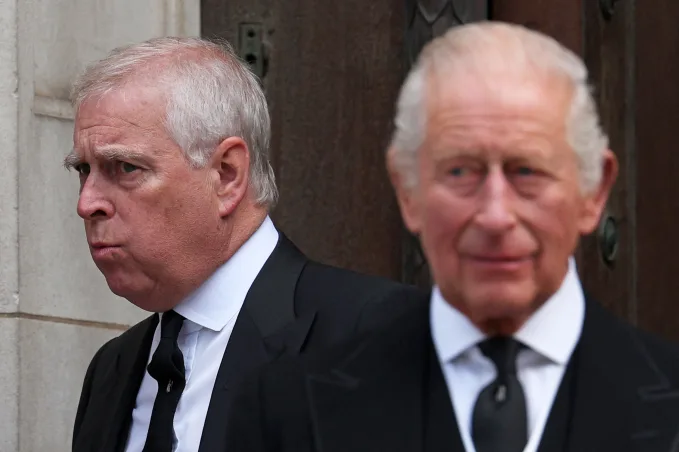
In an unprecedented decision that has stunned Britain and royal watchers worldwide, King Charles III has formally stripped his younger brother of all remaining royal titles and styles. The man long known as Prince Andrew, Duke of York will henceforth be called Andrew Mountbatten Windsor, marking the most dramatic royal demotion in modern times.
The official Buckingham Palace statement released late on October 30 confirmed that Andrew will “no longer hold or use” any royal or military titles and will not be styled as “His Royal Highness” in any capacity.
A Long Decline in Royal Standing

Andrew’s fall from grace has been years in the making. Once celebrated as a decorated naval officer and “the Queen’s favourite son,” his image began to unravel in 2019 amid scrutiny over his friendship with convicted sex offender Jeffrey Epstein. His ill-fated BBC Newsnight interview that same year—intended to clear his name—only deepened public outrage.
In January 2022, amid growing pressure, Queen Elizabeth II removed his honorary military appointments and royal patronages. Though he remained a Duke and continued to live at Royal Lodge, Windsor, he withdrew from public duties.
From ‘Prince Andrew’ to Andrew Mountbatten Windsor
The removal of the “Prince” title is symbolically immense. Palace sources confirm that his entry has already been deleted from the official Royal Family website, and that legal steps are being taken to reflect the change in the Roll of the Peerage. His former titles—Duke of York, Earl of Inverness, and Baron Killyleagh—are now in abeyance and will not be re-granted during his lifetime.
According to constitutional experts, while technically such titles can only be revoked by an Act of Parliament or the royal prerogative, the palace’s announcement makes it clear: Andrew’s royal life is effectively over.
Evicted from Windsor, Exiled to Sandringham
Alongside the loss of titles, Andrew has reportedly been asked to vacate his longtime residence at Royal Lodge, a 30-room mansion on the Windsor Estate where he has lived for over two decades. He is expected to relocate to a smaller, privately funded home on the Sandringham Estate in Norfolk—a quieter, more secluded setting suited to his new low-profile existence.
Royal insiders suggest that future security and household costs will no longer be covered by public funds, reflecting his change in status from “senior royal” to “private citizen of royal descent.”
What This Means for the Monarchy
The decision, though extraordinary, fits within King Charles’s broader campaign to streamline and modernize the monarchy. His reign has emphasised accountability, transparency, and what palace aides describe as a “merit-based royal ethos.”
Royal historian Dr Sarah Evans calls the move “a defining act of internal reform.” She said: > “This is the monarchy asserting control over its narrative. By formally removing Andrew’s titles, Charles is signalling that royal privilege is conditional on conduct—and that even family ties won’t protect those who damage the Crown’s credibility.”
The Road Ahead: Private Citizen, Public Past
For Andrew Mountbatten Windsor, the path forward remains uncertain. While his daughters, Princess Beatrice and Princess Eugenie, retain their titles and positions within the line of succession, their father’s diminished status is likely to cast a long shadow over their future public roles.
Sources close to the family suggest Andrew may focus on private charitable work or business ventures, but royal observers doubt any significant public rehabilitation is possible. “He’s now a Windsor without a role,” one former royal aide remarked. “The institution has moved on.”
A Rare Precedent in Royal History
Few royal figures have faced such sweeping removal of titles in modern Britain. Comparisons are being drawn with King Edward VIII, who abdicated in 1936 to marry Wallis Simpson, and Charles Edward, Duke of Saxe-Coburg and Gotha, who was stripped of his British titles under the 1917 Titles Deprivation Act for supporting Germany during World War I.
Yet Andrew’s case is unique: it stems not from war or abdication, but from reputational damage in an era of media accountability and public ethics.
The End of a Royal Era
In the end, the transformation from *Prince Andrew* to *Andrew Mountbatten Windsor* represents more than a change in title—it marks the monarchy’s attempt to safeguard its future by distancing itself from a troubled past.
For Andrew, it is the beginning of an uncertain life outside the gilded world he once took for granted. For the Crown, it is a reminder that even royal blood cannot guarantee immunity from consequence.
Sources
- Associated Press, BBC News, The Guardian, People, Vanity Fair
Discover more from NewsNation Online
Subscribe to get the latest posts sent to your email.
आपके लिए सुझाव



















































































Leave a Reply