
NewsNation Online | Legal Special Report | 22 October 2026
A new public square with new legal risks
Social media has transformed communication, public accountability, business, political discussion and access to justice. A single post can alert authorities to wrongdoing, but an unverified allegation can also cause irreversible damage. The central legal question is how to preserve democratic participation without sacrificing privacy, dignity, public order and fair trials.
Freedom of speech is fundamental, not unlimited
Article 19(1)(a) protects citizens’ expression, including criticism of public authorities. Article 19(2) permits restrictions only on specified constitutional grounds. In Shreya Singhal v Union of India (2015), the Supreme Court struck down Section 66A of the Information Technology Act for its vague and chilling effect on lawful speech. Mere annoyance or unpopular opinion is not automatically a criminal offence.
Cybercrime and digital evidence
Impersonation, phishing, account intrusion, financial fraud, stalking, threats and non-consensual sharing of intimate images can attract provisions of the Information Technology Act and applicable criminal law, including the Bharatiya Nyaya Sanhita. Screenshots alone may be insufficient: URLs, original messages, timestamps, device records and the integrity of electronic evidence matter. Victims should promptly preserve evidence, approach police or cybercrime authorities, and report financial cyberfraud quickly through official channels.
Privacy and personal data
The Supreme Court’s nine-judge decision in Justice K.S. Puttaswamy v Union of India (2017) recognised privacy as a fundamental right. Social platforms can collect sensitive behavioural and location information. Consent, purpose limitation, security, transparency and effective remedies are important, while the application and commencement of statutory data-protection obligations must be checked against current notifications and rules.
Defamation, misinformation and manipulated content
False allegations can damage reputation and may create civil or criminal consequences depending on the elements of the offence and applicable defences. Criticism, opinion and truthful reporting should not be confused with defamation. Deepfakes and viral rumours intensify the risk. Users should check sources, context and dates before forwarding sensational posts; platforms should provide accessible complaint and correction mechanisms.
Online trials and the independence of justice
A viral accusation is not a judicial finding. Public campaigns may pressure witnesses, stigmatise accused persons and compromise the presumption of innocence. Responsible reporting distinguishes allegations from proven facts, avoids identifying protected victims, and respects court orders. Open discussion of judgments remains valuable when it is accurate and fair.
Responsibilities of advocates, police and platforms
Lawyers must protect client confidentiality, avoid misleading promotion and respect professional conduct rules when posting about matters before courts. Police need regular training in digital evidence, victim-sensitive reporting and lawful investigation. Platforms should address harmful conduct while maintaining transparent moderation, appeals and safeguards against arbitrary censorship.
Adv. Mahesh Dhannawat calls for digital legal literacy
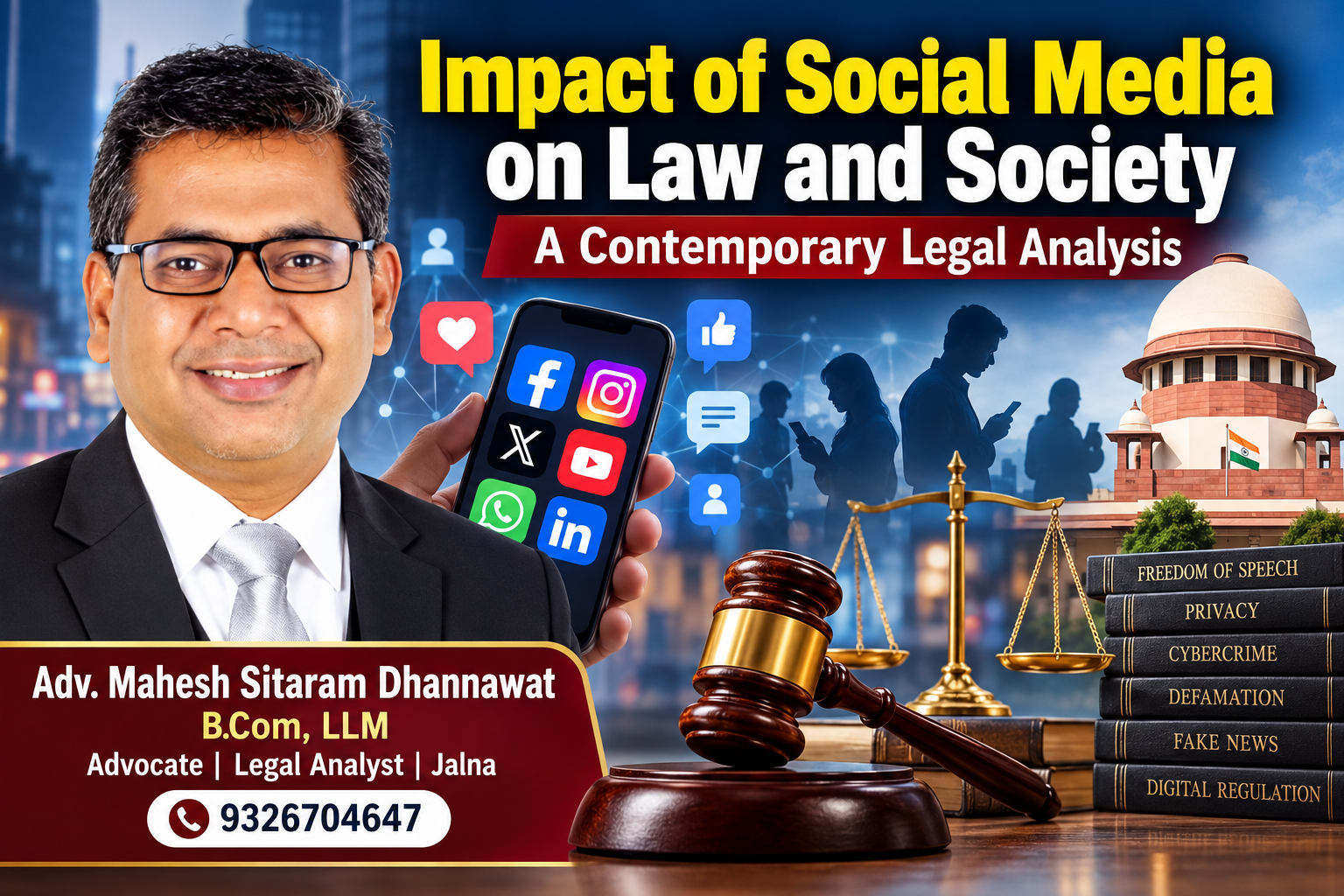
Adv. Mahesh Sitaram Dhannawat, B.Com., LL.M., Jalna, emphasised that freedom of expression must go hand in hand with responsibility. He urged citizens not to forward unverified allegations, called for practical cyberlaw and evidence-handling training for police personnel, and encouraged lawyers and educational institutions to conduct digital legal-awareness programmes. He stressed that online popularity cannot replace proof before a court.
The way forward
Digital literacy, proportionate enforcement, independent courts, stronger security practices and accountable platforms must advance together. A democratic internet should protect robust debate while offering meaningful remedies to victims of fraud, harassment and unlawful disclosure. The objective is not to silence society but to make online participation safer and more just.
Background reference: Shreyansh Rai, “Impact of Social Media on Law and Society: A Contemporary Legal Analysis”, LatestLaws, 30 May 2026. This is an independently prepared news analysis. Adv. Dhannawat’s remarks are presented as an editorially drafted statement for approval, not a verified verbatim quotation.
Discover more from NewsNation Online
Subscribe to get the latest posts sent to your email.
आपके लिए सुझाव











Leave a Reply