The ICC Men’s Cricket World Cup will return to Africa in 2027 for the first time in 24 years, with South Africa, Zimbabwe and Namibia sharing a 57-match tournament across 12 venues. The event runs from October 2 to November 21 and combines some of the continent’s best-known cricket grounds with a new international venue beside one of Africa’s most famous natural landmarks.
The previous Men’s ODI World Cup staged in Africa was the 2003 edition hosted by South Africa, Zimbabwe and Kenya. For 2027, South Africa again provides the majority of venues, Zimbabwe hosts matches in three cities and Namibia joins as a senior ICC tournament host for the first time.
South Africa’s eight World Cup locations
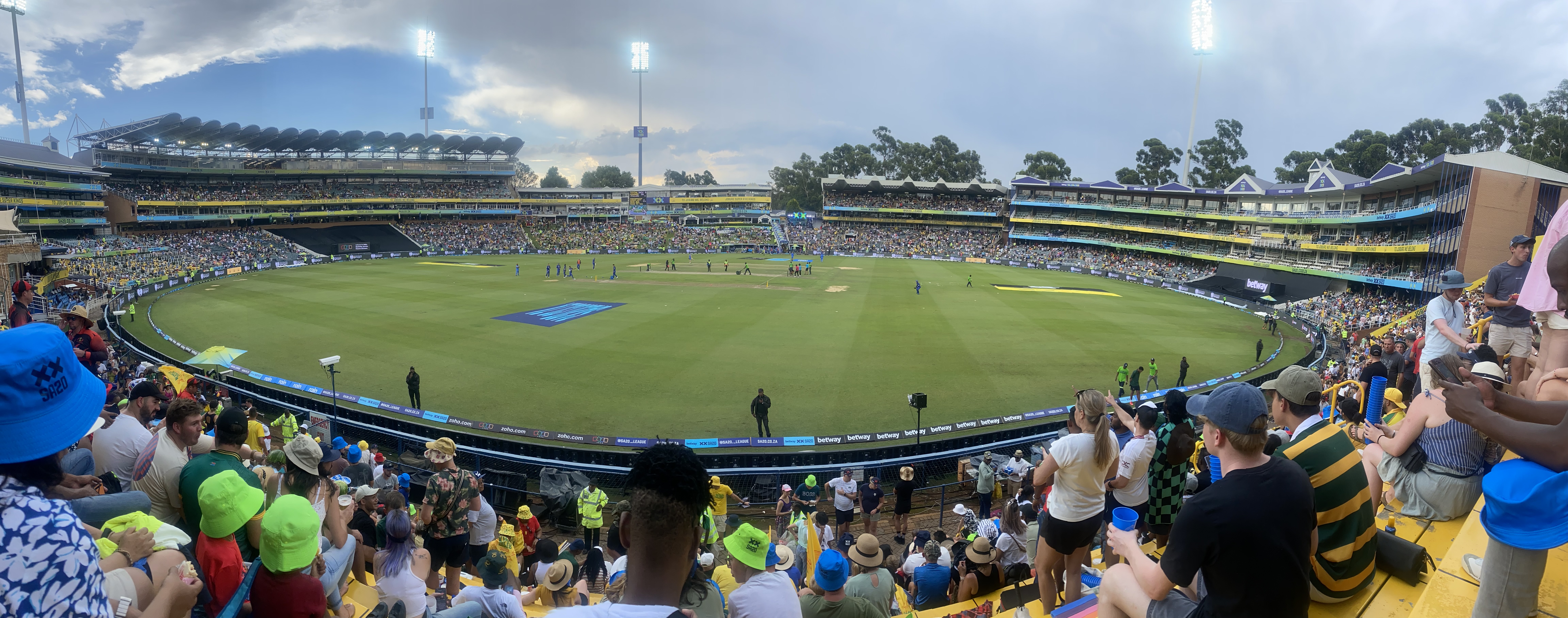
South Africa will stage matches in Johannesburg, Tshwane, Cape Town, Durban, Gqeberha, Bloemfontein, Paarl and KuGompo City. The grounds include the Wanderers, Centurion, Newlands, Kingsmead, St George’s Park, Mangaung Oval, Boland Park and Buffalo Park.
These venues spread the competition across several regions rather than concentrating it in one corridor. Cape Town receives the first main group-stage match — India against Australia on October 7 — as well as the first semi-final on November 17. Tshwane hosts the second semi-final on November 18.
Johannesburg gets India-Pakistan and the final
The Wanderers has perhaps the most eye-catching assignment. India and Pakistan meet there on October 10, and the same stadium hosts the World Cup final on November 21. It also stages Super 7 cricket, giving Johannesburg relevance across multiple phases of the competition.
The ground has substantial World Cup history. It hosted the 2003 ODI final between Australia and India and the 2007 Men’s T20 World Cup final between India and Pakistan. The 2027 schedule adds another chapter without implying anything about which teams will reach the final.
Zimbabwe: Harare, Bulawayo and Victoria Falls
Zimbabwe’s three host cities are Harare, Bulawayo and Victoria Falls. Harare Sports Club and Queens Sports Club in Bulawayo are established international grounds. The Mosi-oa-Tunya International Cricket Stadium at Victoria Falls is the striking new addition.
Zimbabwe will play India at Victoria Falls on October 24 in the final match of the group stage. The stadium is also scheduled for Super 7 fixtures. The use of Victoria Falls connects the sporting event with a globally recognised destination and broadens the geographic identity of the tournament beyond traditional cricket centres.
Namibia makes senior ICC hosting history
Windhoek’s Namibia Cricket Ground opens the entire competition. The three-team Super Series is played there on October 2, 4 and 6, deciding the last entrant to the 12-team group stage. The venue then stages three group matches.
England are among the teams beginning their campaign in Namibia, facing Bangladesh on October 8 and Sri Lanka on October 13. Namibia’s inclusion is historically significant because the country has hosted age-group ICC cricket but not previously a senior ICC tournament.
Why the 12-venue footprint matters
A World Cup spread across three countries creates opportunities and logistical challenges. Teams will move between different climates, altitudes and surfaces, while supporters may build travel plans around several cities. The ICC’s pre-seeding of possible Super 7 pathways is partly intended to provide more certainty about where leading teams could play if they advance.
The host footprint also reflects the expanded scale of the tournament. Fourteen teams take part and 57 matches are scheduled. The first phase is a Super Series, the second contains two groups of six, and the third is a seven-team league before the semi-finals.
Africa’s major ICC tournament history
South Africa has staged several major ICC events since 2003, including the inaugural Men’s T20 World Cup in 2007 and the Women’s T20 World Cup in 2023. Zimbabwe co-hosted the 2003 ODI World Cup and returns as a co-host in 2027. The combined hosting model gives the tournament both continuity and new territory through Namibia and Victoria Falls.
From Windhoek to Johannesburg
The geographic story of the tournament can be read directly from its calendar. It begins in Windhoek, moves into a group phase across all three countries, expands through a Super 7 across the region and ends at the Wanderers. Cape Town and Tshwane provide the semi-final bridge to Johannesburg.
For the complete competition structure, see NewsNationOnline’s 2027 World Cup format explainer. The ICC’s official venue guide provides authoritative host-ground information, while the official schedule lists fixtures by date.
A World Cup built around three hosts
The return to Africa is more than a change of scenery. South Africa supplies established global venues, Zimbabwe reconnects with its 2003 hosting history and Namibia enters new territory as a senior ICC host. Together, the 12 grounds will carry the competition from its qualification-style opening round to a Johannesburg final nearly seven weeks later.
Discover more from NewsNation Online
Subscribe to get the latest posts sent to your email.
आपके लिए सुझाव