
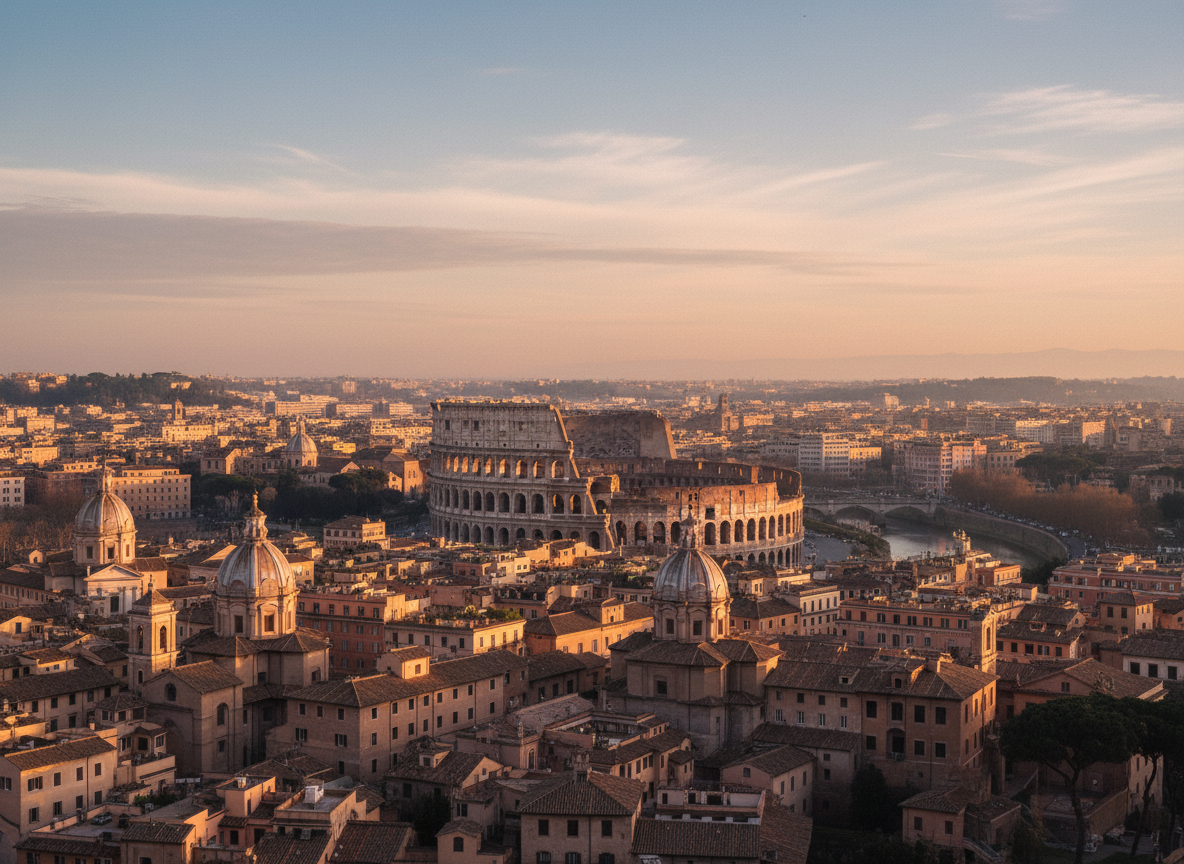
Some of the world’s most influential cities began as trading settlements, religious centres, ports or capitals. Their histories reveal how people exchanged ideas, built institutions and reshaped urban life over centuries. But the phrase “ancient city” can be misleading: many places have experienced repeated destruction, rebuilding, migration and changes in political control. Understanding their histories means looking beyond surviving monuments to the people who lived there.
Rome: Engineering, empire and urban life
Rome developed from a settlement in central Italy into the centre of a republic and then an empire that governed extensive territories around the Mediterranean. Its roads, aqueducts, public baths, forums and amphitheatres demonstrate large-scale engineering and administration. Roman law and Latin also influenced later European institutions and languages, although their impact differed by region.
The Colosseum is a powerful symbol of imperial Rome, but the city also preserves temples, residential buildings, inscriptions and infrastructure. Archaeologists study these traces to understand social hierarchy, migration, commerce and daily routines, not only emperors and military campaigns.
Athens: Civic debate and classical culture
Ancient Athens became an important centre of philosophy, theatre, art and political experimentation. Its fifth-century BCE democracy allowed certain male citizens to participate directly in civic decisions, but excluded women, enslaved people and many residents without citizenship. Describing Athens as the birthplace of modern democracy therefore requires careful qualification.
The Acropolis and Parthenon remain prominent examples of classical architecture. Their conservation also illustrates how ancient monuments can become part of modern debates over heritage, restoration and the location of cultural objects.
Varanasi: A living religious and cultural centre
Varanasi, also called Kashi or Banaras, is among South Asia’s most historically significant religious cities. Located on the Ganges in northern India, it is especially important in Hindu traditions and has long been associated with pilgrimage, learning, music and craftsmanship. Its urban landscape has changed repeatedly, and claims that any present-day building has stood unchanged for thousands of years should be treated cautiously.
Varanasi is not merely an archaeological site. It is a living city whose residents, worshippers, businesses and institutions continue to shape its cultural identity.
Jerusalem: Layers of sacred and political history
Jerusalem holds profound religious significance for Judaism, Christianity and Islam. Its historic landscape contains places associated with different periods of worship, settlement and political rule. Archaeological evidence and written sources reveal a complex urban history, while many historical interpretations and present-day claims remain contested.
Responsible accounts distinguish established archaeological findings from religious traditions and political positions. The Old City and its Walls are on UNESCO’s World Heritage List, and the site’s conservation takes place amid longstanding political and security challenges.
Xi’an: An eastern gateway to exchange
Xi’an, historically associated with Chang’an, served as a capital for several Chinese dynasties. During the Tang period, Chang’an was a major cosmopolitan city connected to overland and wider Eurasian networks often grouped under the term Silk Roads. Merchants, diplomats, religious communities and travellers contributed to exchanges of goods and ideas.
The region is also known for the mausoleum complex of China’s first emperor and its terracotta figures. These objects provide insight into imperial authority, craftsmanship and funerary practices, although they belong to a much earlier period than Tang Chang’an.
Cusco: The Inca capital and a changing city
Cusco, in present-day Peru, was the political and ceremonial centre of the Inca state. Its stonework, streets and sacred spaces demonstrate distinctive Andean planning and construction. After the Spanish conquest, colonial buildings were constructed within and above parts of the earlier urban fabric. This layered landscape makes Cusco important for understanding both Indigenous history and colonial transformation.
The city’s heritage cannot be reduced to a picturesque tourist centre. Contemporary communities, languages and cultural practices are essential to its identity.
How cities influenced one another
Ancient cities were linked through routes carrying food, metals, textiles, manuscripts, beliefs and technologies. Connections were rarely simple or one-way. A city could be politically powerful in one period and economically marginal in another. Researchers examine coins, ceramics, inscriptions, building materials and trade goods to reconstruct these changing networks.
Why preservation is complicated
Historic cities must balance conservation with housing, transport, livelihoods and public services. Tourism can fund restoration but also increase pressure on infrastructure and residents. Archaeological excavations may reveal new evidence while disrupting everyday life. Effective heritage policy therefore needs both expert conservation and meaningful community involvement.
How to explore historic cities responsibly
Use official heritage guidance and respect sacred sites, local residents and restricted archaeological areas. Seek qualified local interpretation, particularly where histories are contested. Avoid assuming that a modern city is identical to the society that first occupied its location.
Further reading and related guides
Explore the UNESCO World Heritage List, including official descriptions of historic urban properties. For wider context, read our guides to the world’s oldest civilizations and the Seven Wonders of the World.
Frequently asked questions
What makes a city ancient?
There is no single universal cutoff. Historians consider evidence of settlement, urban institutions and the periods being studied.
Are the world’s oldest cities still inhabited?
Some historic settlements remain inhabited, but claims of uninterrupted occupation depend on how boundaries, settlement gaps and archaeological evidence are defined.
Why are historic cities important today?
They preserve evidence of cultural exchange, governance, architecture and everyday life, while remaining home to contemporary communities.
Discover more from NewsNation Online
Subscribe to get the latest posts sent to your email.
आपके लिए सुझाव












Leave a Reply