
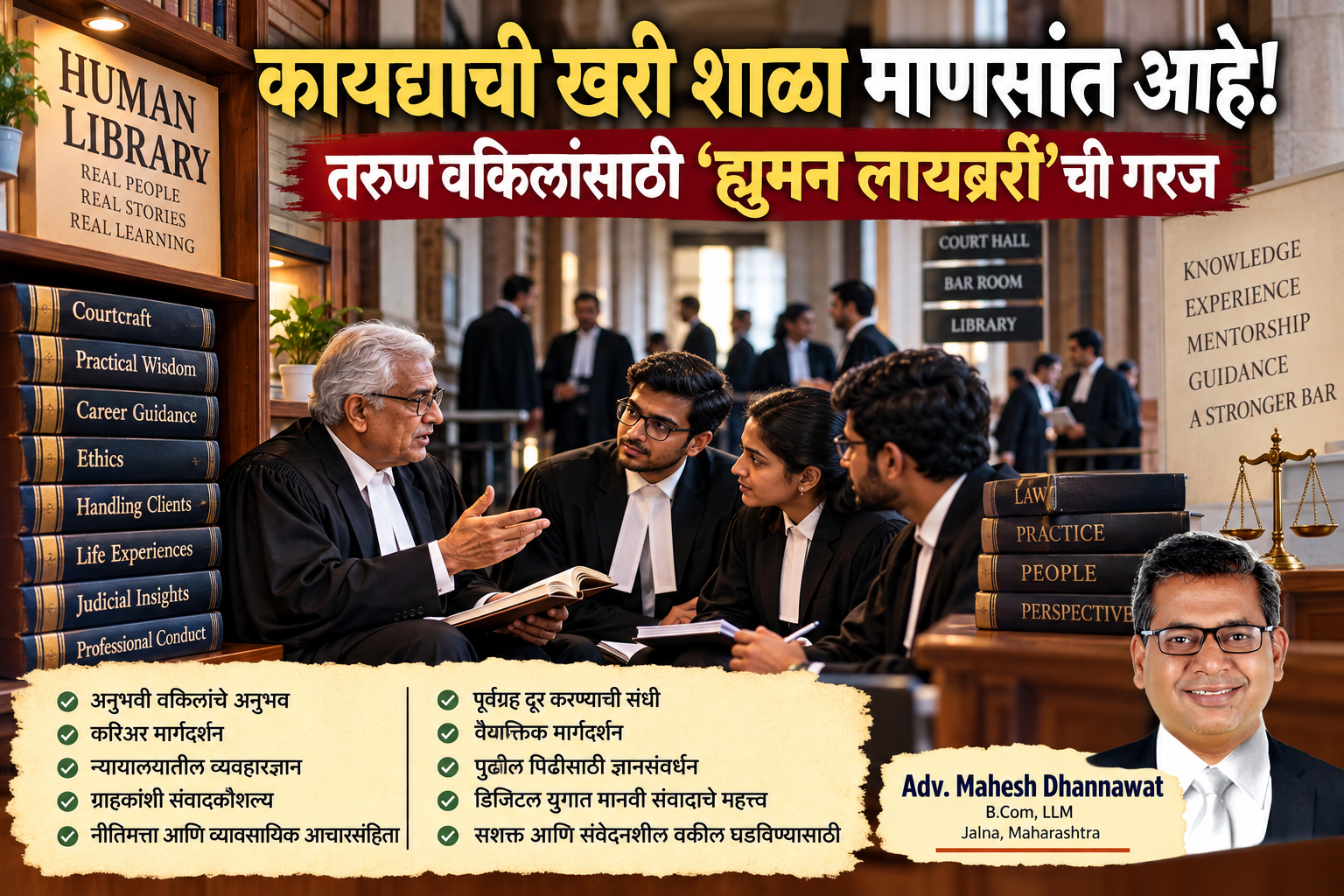
Jalna | Legal Affairs Special Report — A law degree provides foundational knowledge, but courtroom advocacy also demands practical judgment, professional ethics, client communication and experience. A Human Library can connect young lawyers with seasoned professionals.
Advocate Shridhar Prabhu examined this concept in his Verdictum column published on May 21, 2024.
The courtroom corridor as a classroom
Lawyers often spend considerable time waiting for hearings. Conversations between senior and junior advocates offer insights into courtroom conduct, litigation strategy and professional challenges that textbooks rarely capture.
The gap in legal education
Law schools cover substantive and procedural law, but internships do not always provide sufficient experience in client conferences, drafting, case preparation, cross-examination or oral advocacy. First-generation lawyers and those in smaller towns can face additional barriers.
What is a Human Library?
In a Human Library, people share knowledge and lived experiences directly through conversations. The movement began in Copenhagen, Denmark, in 2000. In a legal adaptation, senior advocates, retired judicial officers and specialist practitioners could serve as human books.
Relevance to district courts
District and taluka Bar Associations could host regular mentoring sessions, giving rural practitioners, women advocates and first-generation lawyers better access to professional guidance and networks.
Adv. Mahesh Dhannawat’s statement
“A law degree creates an advocate, but the guidance of experienced lawyers helps create a competent, responsible and compassionate legal professional. Bar Associations should become centres of continuing education, mentorship and ethical development. Every young lawyer deserves an opportunity to learn regardless of background.” Adv. Mahesh Sitaram Dhannawat, B.Com., LL.M., has approved this statement.
A practical programme
Monthly interactive sessions could cover civil and criminal litigation, family disputes, consumer law, drafting, cross-examination, courtroom etiquette, legal aid and professional ethics. With confidentiality safeguards, selected sessions could be recorded for educational access.
AI cannot replace human mentorship
AI-powered research and digital databases can help lawyers work more efficiently. Yet empathy, judgment and courtroom instincts develop through experience and direct professional interaction. Technology should complement mentorship.
Conclusion
Human Libraries could strengthen intergenerational learning, improve professional standards and support better access to justice. The legal profession needs strong human relationships alongside new technology.
Source: Inspired by Advocate Shridhar Prabhu’s Verdictum column dated May 21, 2024. Independently prepared news analysis, not a reproduction.
Discover more from NewsNation Online
Subscribe to get the latest posts sent to your email.
आपके लिए सुझाव







Leave a Reply