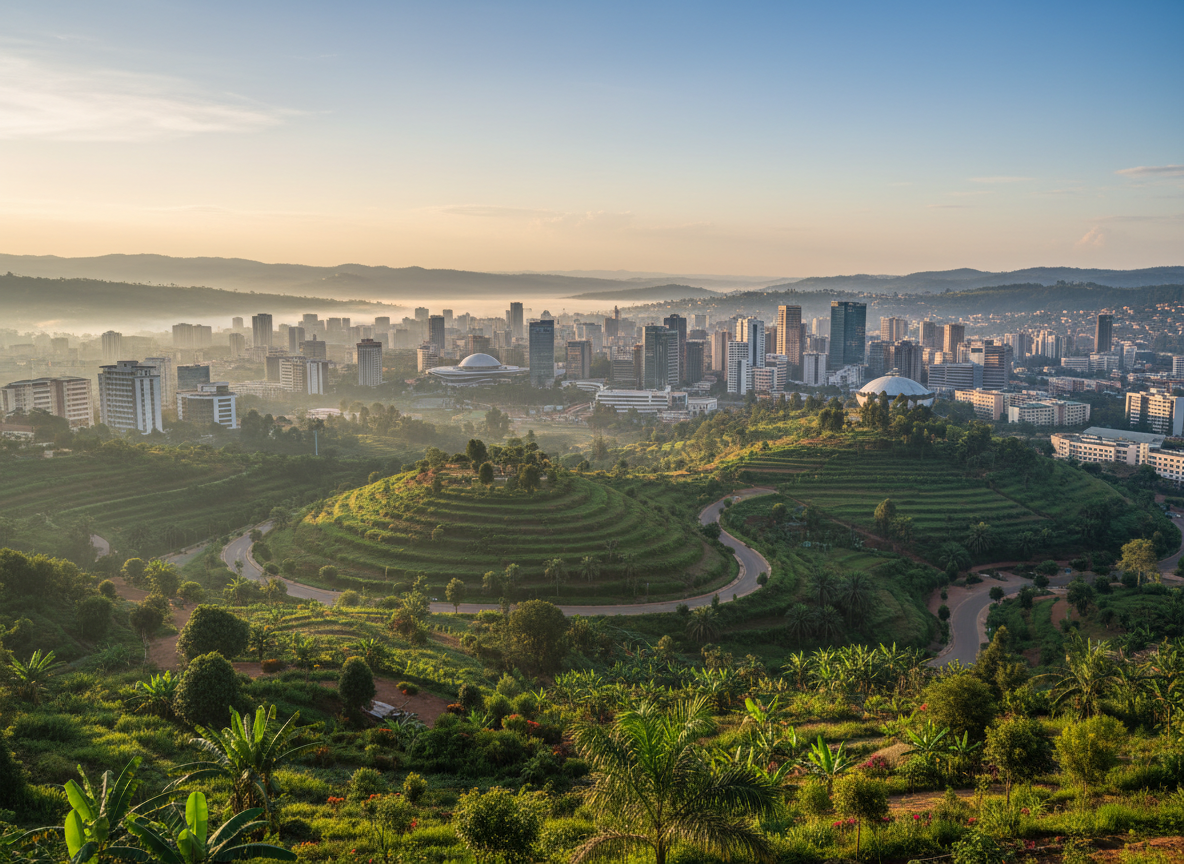
Rwanda is a compact Great Lakes country where green hills, volcanic mountains, rainforest, savanna and Lake Kivu come together in a remarkably varied landscape. Its capital Kigali is set across rolling hills, while the northwest is dominated by the Virunga volcanoes and mountain-gorilla habitat. In the southwest, ancient rainforest and highland ecosystems define Nyungwe, while Akagera in the east provides a very different savanna and wetland environment.
Rwanda’s cultural story is equally significant. The country has memorial sites connected with the 1994 Genocide against the Tutsi, royal heritage around Nyanza, traditional arts and dance, and a growing body of internationally recognised natural heritage. In 2023, UNESCO added Nyungwe National Park and the Memorial sites of the Genocide: Nyamata, Murambi, Gisozi and Bisesero to the World Heritage List. citeturn0search5

1. Kigali — Rwanda’s Hilltop Capital
Kigali is Rwanda’s capital and largest city, spread across ridges and valleys in the centre of the country. The city combines government districts, business centres, neighbourhood markets, museums and memorial sites with extensive green spaces. Kandt House Museum, the Kigali Genocide Memorial and Nyamirambo are among the places that help explain the city’s history and cultural life.
2. Kigali Genocide Memorial and the Memorial Sites
The Kigali Genocide Memorial is one of the most important sites for understanding Rwanda’s modern history. UNESCO’s World Heritage property, inscribed in 2023, includes the memorial sites at Nyamata, Murambi, Gisozi and Bisesero. These places commemorate victims of the 1994 Genocide against the Tutsi and form part of Rwanda’s remembrance landscape.
3. Volcanoes National Park
Volcanoes National Park protects the Rwandan section of the Virunga volcanic range. The park is internationally known for mountain gorilla conservation and research. Its landscape of bamboo forest, montane vegetation and volcanic peaks includes Mount Karisimbi, Mount Bisoke, Mount Muhabura, Mount Gahinga and Mount Sabyinyo.
4. Musanze and the Virunga Volcanoes
Musanze is the main urban centre near Volcanoes National Park. The surrounding countryside is dominated by volcanic peaks and intensely cultivated highlands. The region is also known for lava caves and dramatic geological formations created by past volcanic activity.
5. Nyungwe National Park
Nyungwe National Park protects one of Africa’s oldest and most important montane rainforests. UNESCO inscribed Nyungwe National Park on the World Heritage List in 2023 as a natural property. The forest contains exceptional biodiversity, including chimpanzees, colobus monkeys and hundreds of bird species. Its highland wetlands and forests are also important sources of water.
6. Canopy Walkway and Nyungwe Forest
The Nyungwe canopy walkway provides a high-level perspective over the rainforest. Suspended above the forest floor, it offers views of the dense vegetation and surrounding hills. The broader Nyungwe landscape is important not only for tourism but also for scientific research, watershed protection and conservation.
7. Akagera National Park
In eastern Rwanda, Akagera National Park presents a striking contrast to the volcanic northwest and rainforest southwest. Its landscape includes savanna, woodland, lakes and wetlands. The park supports elephants, lions, leopards, buffalo, giraffes, zebras, antelope and a wide variety of birds.
8. Lake Kivu
Lake Kivu forms part of Rwanda’s western frontier with the Democratic Republic of the Congo. It is one of the African Great Lakes and is surrounded by steep green hills, fishing communities and resort towns. The lake’s deep waters contain dissolved gases, making its geological characteristics particularly unusual.
9. Rubavu and Gisenyi
Rubavu, commonly associated with Gisenyi, is a lakeside city on the northern shore of Lake Kivu. The waterfront, volcanic landscape and proximity to the DRC border give the city a distinctive regional character. Goma lies directly across the border, making this one of the Great Lakes region’s most closely connected urban areas.
10. Kibuye and the Lake Kivu Shoreline
Kibuye, officially Karongi, sits among the hills on Lake Kivu’s eastern shore. The area is known for scenic coves, islands, fishing communities and winding mountain roads. The surrounding landscape illustrates why Rwanda is often associated with steep green hills and lake panoramas.
11. Nyanza and the Royal Palace
Nyanza was an important centre of the former Rwandan monarchy. The King’s Palace Museum preserves a reconstruction of a traditional royal residence and presents aspects of royal history and material culture. A second palace, built in a more modern architectural style, forms part of the heritage landscape.
12. Huye and the National Museum of Rwanda
Huye, formerly Butare, is one of Rwanda’s major educational and cultural centres. The National Museum of Rwanda contains collections related to history, archaeology, ethnography and traditional life. The city also provides a gateway to the southern highlands and nearby cultural sites.
13. Gishwati-Mukura Forest
Gishwati-Mukura is a protected forest landscape in western Rwanda. Its forests are important for primates, birds, plants and watershed protection. The landscape has also become part of Rwanda’s broader effort to restore forest habitats and connect fragmented ecosystems.
14. Nyamata and Bisesero
Nyamata and Bisesero are among the memorial sites included in Rwanda’s UNESCO World Heritage property commemorating the Genocide against the Tutsi. Nyamata is associated with a former church memorial site, while Bisesero is located in the hills of western Rwanda and is connected with the history of resistance and mass killings during 1994. These are sites of remembrance and should be approached with appropriate respect.
15. Rwandan Food, Coffee, Tea, Music and Crafts
Rwandan cuisine reflects a highland agricultural economy. Beans, bananas, cassava, sweet potatoes, maize and vegetables are common staples, while grilled meat and freshwater fish are also found. Coffee and tea are important agricultural products, and Rwanda has developed a strong specialty-coffee culture.
Traditional culture includes drumming, dance, storytelling, basket weaving, pottery and woodcraft. The famous Intore dance tradition is associated with ceremonial performance and historical royal culture. Contemporary Rwandan music adds modern influences to these older traditions.
UNESCO World Heritage in Rwanda
UNESCO currently lists two World Heritage properties in Rwanda: Nyungwe National Park and the Memorial sites of the Genocide: Nyamata, Murambi, Gisozi and Bisesero, both inscribed in 2023. UNESCO currently records no additional sites on Rwanda’s Tentative List. citeturn0search5
For authoritative heritage information, readers can consult the UNESCO Rwanda country page, the Nyungwe National Park page and the Memorial sites of the Genocide page.
Current Travel Safety in 2026
Rwanda’s overall travel situation differs by region. As of 26 September 2026, the UK Foreign, Commonwealth & Development Office advises against all but essential travel to parts of Rusizi District within 10 kilometres of the Democratic Republic of Congo border, including the Rwandan islands in Lake Kivu and Kamembe Airport. It warns that the Rwanda-DRC border can be affected by the conflict in eastern DRC and that crossings can close at short notice. citeturn0search0turn0search4
The same official guidance says terrorism cannot be ruled out, although crime levels are described as relatively low overall. It also highlights road-safety risks, seasonal flooding and landslides, and special precautions for visitors going near the DRC border for gorilla or chimpanzee trekking. citeturn0search2
Rwanda has also introduced health-screening and border measures in response to the current Ebola outbreak in the DRC. Entry requirements and border measures can change with little notice, so travellers should check official guidance before departure. citeturn0search3
For the latest practical information, consult the UK FCDO Rwanda travel advice and Rwanda’s official immigration information before making travel arrangements.
Rwanda in the Great Lakes Region
Rwanda’s geography connects directly with several countries already covered in this series. Its western border meets the Democratic Republic of the Congo, while its southern frontier meets Burundi. The Great Lakes landscape continues toward Uganda and Tanzania, while the wider Congo Basin links Rwanda’s western forests to ecosystems across Central Africa.
Readers can continue the country-by-country series with the guides to Republic of the Congo, Central African Republic, Cameroon and Chad.
The Bottom Line
Rwanda packs an extraordinary range of landscapes into a relatively small country: Kigali’s hills, the Virunga volcanoes, mountain-gorilla habitat, Nyungwe’s ancient rainforest, Akagera’s savanna and the deep waters of Lake Kivu. Its two UNESCO World Heritage properties also give the country an important natural and remembrance heritage dimension.
For 2026, however, the travel picture must be read region by region. Border areas near the DRC require particular attention to current official warnings, while entry and health measures can change in response to regional developments. This guide is intended to provide geographical, cultural and heritage context, with practical travel decisions based on the latest official advisories.
Featured image: AI-generated editorial illustration of Kigali, Rwanda, created for NewsNationOnline.
आपके लिए सुझाव
