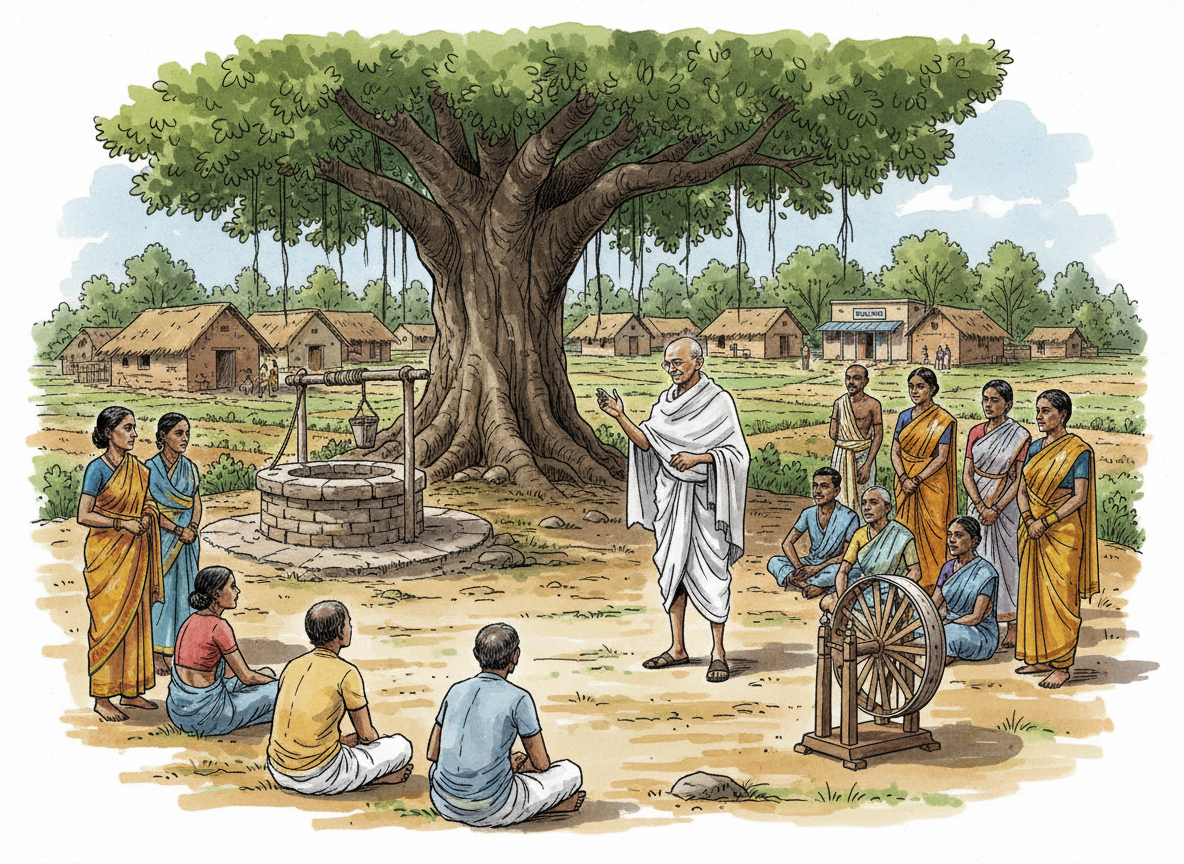

Image: Mahatma Gandhi during a village visit, historical photograph.
Mahatma Gandhi’s political work was closely connected to his ideas about village life. He argued that India’s future should not be understood only through cities, industries and central institutions, but also through the social and economic conditions of its villages.
Why villages mattered to Gandhi
Gandhi believed that a large part of India’s population lived in rural communities and that national reconstruction therefore required attention to village economies, health, education and local organisation.
Village industries and khadi
Gandhi promoted spinning, weaving and other village industries as ways of creating local economic activity and reducing dependence on imported goods.
Sanitation and public health
Cleanliness and sanitation were recurring themes in Gandhi’s constructive work. He encouraged communities to take responsibility for their surroundings and public health.
Education in the village
His Nai Talim approach connected education with productive work and community life, reflecting his wider belief that schools should engage with local realities.
Local self-government
Gandhi’s writings frequently discussed decentralised political and economic organisation. His ideas about village self-rule later became part of wider debates about Panchayati Raj and decentralisation.
The debate over Gandhi’s village ideal
Gandhi’s vision has also been debated by economists, political thinkers and historians, particularly over industrialisation, technology, productivity and the scale of economic development needed for modern India.
Read NewsNationOnline’s Constructive Programme feature, Khadi feature and Nai Talim feature. Explore the Gandhi Heritage Portal.
Discover more from NewsNation Online
Subscribe to get the latest posts sent to your email.
आपके लिए सुझाव