
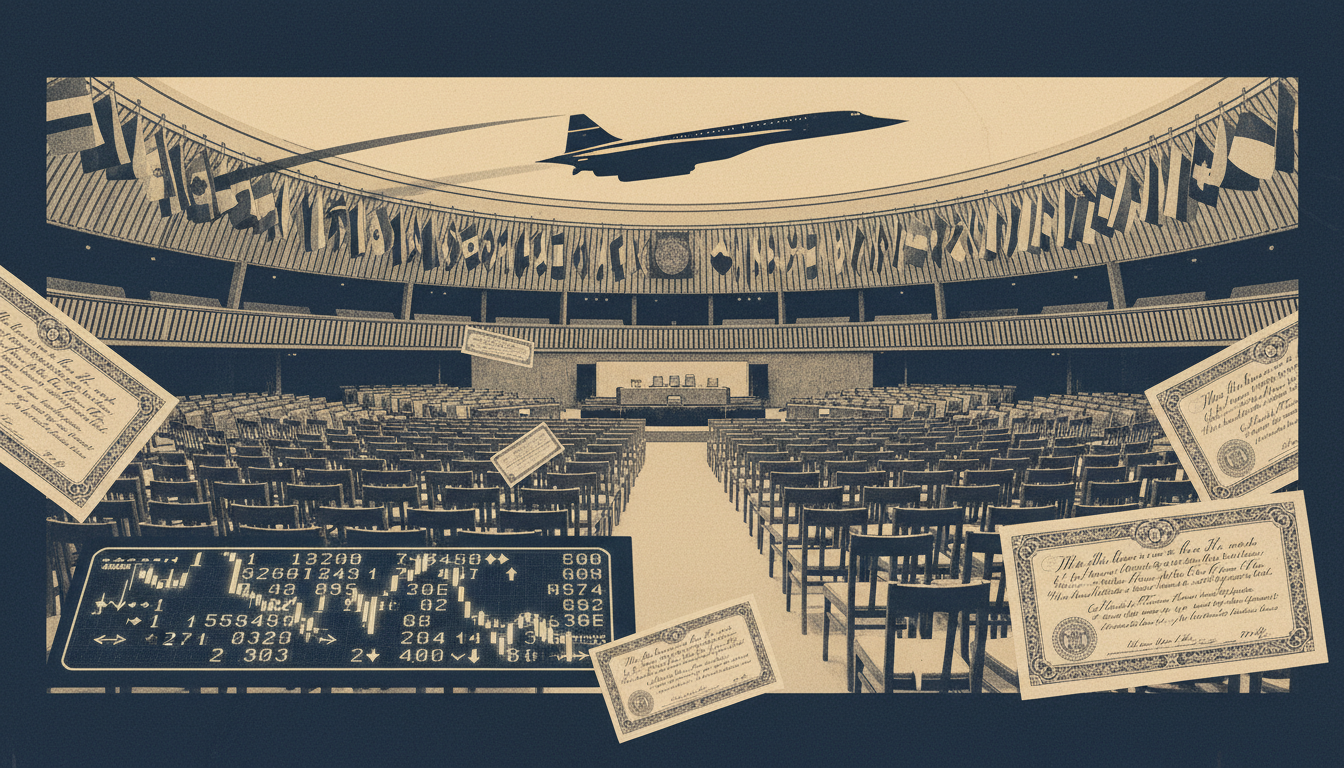
October 24 links four striking moments in modern history: the birth of a global institution, the collapse of confidence on Wall Street, a mass demonstration of women’s unpaid and paid labour, and the end of a celebrated aviation era. In 1945 the United Nations Charter came into force. In 1929 a wave of selling unsettled the New York stock market. In 1975 women across Iceland withdrew their labour for a day. In 2003 Concorde made its final scheduled commercial journey. The events are unrelated in cause, but together they show how institutions, economies, social movements and technologies change—and why their consequences are rarely simple.
1945: The United Nations officially begins
The United Nations formally came into existence on October 24, 1945, when its founding Charter entered into force. The Charter had been signed in San Francisco on June 26, but signatures alone did not establish the organisation. Ratification by the five permanent members of the Security Council and a majority of the other signatories was required. The distinction matters: the date commemorates a legal and institutional beginning, not the first discussion of international cooperation or the moment the document was signed.
The new organisation emerged from the devastation of the Second World War and the perceived failures of the League of Nations. Its founders hoped to create a forum where states could negotiate disputes, coordinate humanitarian work and collectively respond to threats to peace. The Charter’s principles included the sovereign equality of member states and restrictions on the use of force. Yet the Security Council’s permanent-member veto also reflected the unequal distribution of power among the war’s major victors.
There were 51 founding members in 1945, including India, which was still under British rule. India’s presence as a founding member illustrates how the international order was being reorganised even before many colonies achieved independence. Membership later expanded dramatically as decolonisation changed the world’s political map. The UN now has 193 member states, but the historical composition of its most powerful council remains a continuing subject of debate.
United Nations Day is an occasion to examine achievements without treating the institution as a world government. Peacekeeping, humanitarian coordination, development programmes and international treaties have provided channels for cooperation. At the same time, conflicts, vetoes, funding disputes and failures to protect civilians expose the limits of collective action. The organisation depends heavily on the political will of its members. For an accessible explanation, see NewsNationOnline’s guide to how the United Nations works. The UN’s own Charter page documents the founding date and principles.
1929: Black Thursday and a market losing confidence
On Thursday, October 24, 1929, panic swept the New York Stock Exchange as investors tried to sell shares after a long speculative boom. Nearly 12.9 million shares changed hands, an extraordinary volume at the time. The day became known as Black Thursday. A group of prominent bankers attempted to restore confidence through large purchases, and the market briefly steadied. That temporary relief did not mean the crisis had ended.
Share prices had risen sharply during the 1920s, encouraged by optimism about industrial growth and by speculative purchases, including investments made with borrowed money. When prices weakened, leveraged investors faced pressure to sell. Falling prices encouraged further selling, creating a dangerous feedback loop. This explains why a market can move rapidly even without a single new economic event causing every transaction.
The worst-known subsequent trading days were Black Monday, October 28, and Black Tuesday, October 29. The Federal Reserve’s historical account places the crash within the broader boom and subsequent collapse. It would be misleading to say that October 24 alone caused the Great Depression. Banking failures, declining demand, international economic pressures and policy decisions helped deepen the downturn over the following years. Black Thursday is best understood as a warning sign and an early stage of a larger financial disaster.
For today’s readers, the episode remains a lesson about debt, financial confidence and the difference between rising asset prices and durable prosperity. Historical parallels should nevertheless be used carefully: the structure, regulation and global connections of present-day markets differ considerably from those of 1929. Another market anniversary is discussed in our October 19 history feature, which covers the separate 1987 Black Monday crash.
1975: Iceland’s Women’s Day Off
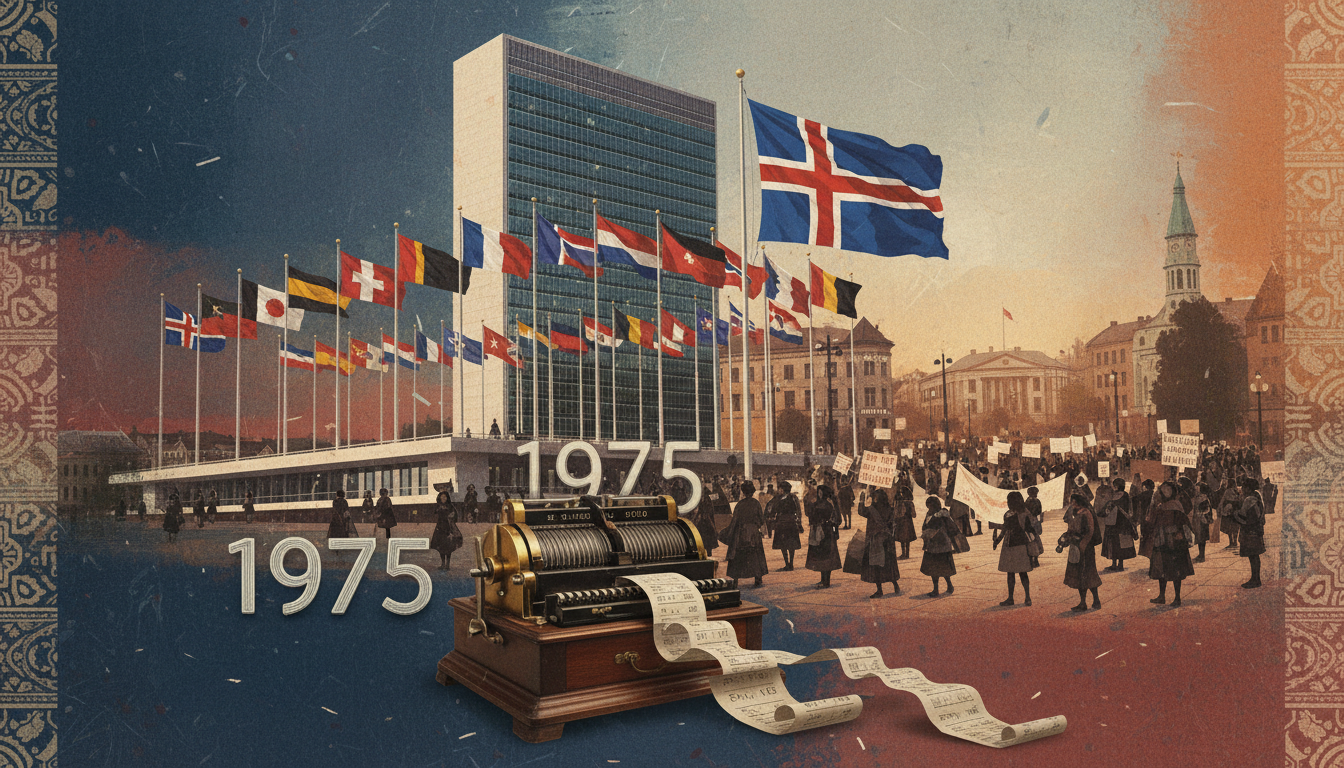
On October 24, 1975, women across Iceland stopped doing paid work and household labour to demonstrate how much society depended on their contributions. Organisers called the action the Women’s Day Off. According to Iceland’s Women’s History Archives, organisers estimated that around 90 percent of women participated and approximately 25,000 people gathered at a central rally in Reykjavík. Those figures are contemporary movement estimates, not the result of a modern census of every participant.
The action was deliberately broad. It united women from different political backgrounds and workplaces while making domestic care work visible. Schools, shops and other services felt the absence of workers; households had to reorganise childcare and daily routines. Rather than limiting the debate to wages, the protest asked why the work that sustained homes and communities was often undervalued or treated as invisible.
The demonstration took place during the United Nations’ International Women’s Year. Iceland passed important equality legislation in the following period, and the 1975 action became a powerful reference point for later campaigns. It would be too simplistic, however, to credit one protest with every subsequent advance. Political organising, lawmaking, education and persistent public debate also mattered. The Women’s History Archives of Iceland preserve the event’s documentary record and explain its continuing significance.
2003: Concorde’s final commercial flight
On October 24, 2003, British Airways ended its scheduled Concorde passenger service. Its last commercial transatlantic flight, BA002, travelled from New York’s John F. Kennedy Airport to London Heathrow. Concorde had entered airline service in 1976 and could cruise at approximately twice the speed of sound, dramatically shortening journeys across the Atlantic. It was an engineering achievement and a luxury travel icon, but never an ordinary mass-market aircraft.
High operating costs, limited passenger capacity, noise restrictions and a narrow customer market complicated its economics. The fatal Air France Concorde crash in July 2000, followed by the fleet’s temporary grounding, was another major chapter in the aircraft’s history. Air France had already withdrawn its Concorde service earlier in 2003. British Airways’ official Concorde history confirms October 24 as the final scheduled commercial flight date.
Concorde’s retirement did not mean supersonic flight was technically impossible. It demonstrated that technical brilliance alone cannot guarantee a sustainable passenger business. The environmental effects of high-speed aviation, affordability, safety and airport restrictions all shape whether an innovation can remain in everyday use.
What October 24 teaches us
These anniversaries do not tell one simple story of progress. The UN represents cooperation constrained by power politics; Black Thursday shows how quickly speculative confidence can disappear; Iceland’s protest demonstrates the public force of collective action; and Concorde shows the gap between technological possibility and commercial viability. A responsible historical account keeps those tensions visible instead of turning every anniversary into either a celebration or a warning. For further reading, consult the United Nations, Federal Reserve History, Iceland’s Women’s History Archives and British Airways.
Discover more from NewsNation Online
Subscribe to get the latest posts sent to your email.
आपके लिए सुझाव













Leave a Reply