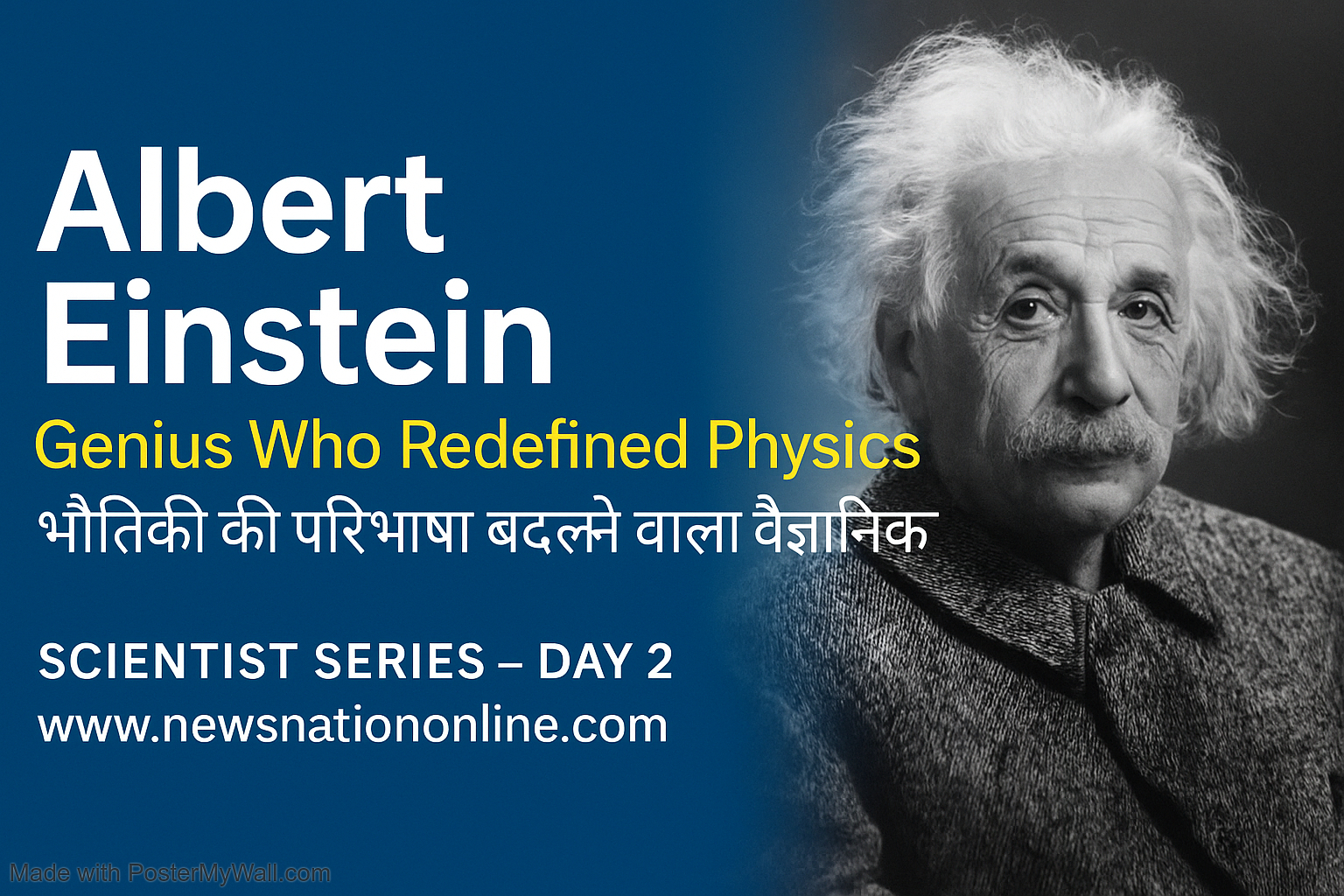
Albert Einstein — Genius Who Redefined Physics
अल्बर्ट आइंस्टीन — भौतिकी की परिभाषा बदलने वाला वैज्ञानिक
Introduction | परिचय
Albert Einstein (1879–1955) was a German-born theoretical physicist best known for developing the theory of relativity, one of the two pillars of modern physics. His famous equation, E = mc², fundamentally changed our understanding of space, time, and energy.
अल्बर्ट आइंस्टीन (1879–1955) एक जर्मन मूल के सैद्धांतिक भौतिकशास्त्री थे जिन्होंने सापेक्षता सिद्धांत (Theory of Relativity) विकसित किया, जो आधुनिक भौतिकी के दो मुख्य स्तंभों में से एक है। उनका प्रसिद्ध समीकरण E = mc² ने स्थान, समय और ऊर्जा की हमारी समझ को बदल दिया।
Early Life and Education | प्रारंभिक जीवन और शिक्षा
Einstein was born in Ulm, Germany. Though a slow speaker as a child, he had an intense curiosity for science and mathematics. He studied at the Swiss Federal Polytechnic in Zurich and later worked at the Swiss Patent Office, where he developed many of his revolutionary theories.
आइंस्टीन का जन्म जर्मनी के उल्म शहर में हुआ था। बचपन में वह धीमे बोलते थे, लेकिन विज्ञान और गणित में उनकी गहरी रुचि थी। उन्होंने स्विस फेडरल पॉलिटेक्निक, ज्यूरिख से पढ़ाई की और बाद में स्विस पेटेंट ऑफिस में काम करते हुए अपने कई क्रांतिकारी सिद्धांतों को विकसित किया।
The Theory of Relativity | सापेक्षता का सिद्धांत
In 1905, Einstein published four groundbreaking papers, including the Special Theory of Relativity. It introduced the idea that time and space are not absolute but relative to the observer’s motion. Later, he proposed the General Theory of Relativity in 1915, describing gravity as the curvature of space-time.
1905 में आइंस्टीन ने चार महत्वपूर्ण शोधपत्र प्रकाशित किए, जिनमें विशेष सापेक्षता सिद्धांत (Special Relativity) शामिल था। इसमें बताया गया कि समय और स्थान स्थिर नहीं होते, बल्कि वे प्रेक्षक की गति पर निर्भर करते हैं। बाद में 1915 में उन्होंने सामान्य सापेक्षता सिद्धांत (General Relativity) प्रस्तुत किया, जिसमें गुरुत्व को अंतरिक्ष-समय के वक्रण के रूप में परिभाषित किया गया।
Famous Equation: E = mc² | प्रसिद्ध समीकरण: E = mc²
This equation shows the relationship between energy (E), mass (m), and the speed of light (c). It means a small amount of mass can be converted into a large amount of energy — the principle behind nuclear energy.
यह समीकरण ऊर्जा (E), द्रव्यमान (m), और प्रकाश की गति (c) के बीच संबंध को दर्शाता है। इसका अर्थ है कि थोड़े से द्रव्यमान से विशाल ऊर्जा प्राप्त की जा सकती है — यही परमाणु ऊर्जा का सिद्धांत है।
Contributions to Science | विज्ञान में योगदान
- Photoelectric Effect (Won Nobel Prize in 1921)
- Special and General Relativity
- Brownian Motion explanation
- Quantum Theory foundation
- फोटोइलेक्ट्रिक प्रभाव (1921 में नोबेल पुरस्कार मिला)
- विशेष और सामान्य सापेक्षता सिद्धांत
- ब्राउनीयन गति की व्याख्या
- क्वांटम सिद्धांत की नींव
Later Life and Legacy | बाद का जीवन और विरासत
Einstein moved to the USA in 1933, escaping Nazi Germany. He joined the Institute for Advanced Study in Princeton and remained there till his death. He was also a humanitarian and pacifist, advocating for peace and civil rights.
आइंस्टीन 1933 में नाज़ी शासन से बचने के लिए अमेरिका चले गए। उन्होंने प्रिंसटन स्थित इंस्टिट्यूट फॉर एडवांस्ड स्टडी में कार्य किया और वहीं जीवन के अंत तक रहे। वे मानवतावादी और शांतिवादी भी थे, जिन्होंने शांति और नागरिक अधिकारों के लिए आवाज उठाई।
Inspiration for Students | विद्यार्थियों के लिए प्रेरणा
Einstein emphasized imagination over rote learning. He believed in questioning everything and encouraged self-learning. His life reminds students that curiosity and creativity can shape the future.
आइंस्टीन ने रटने की बजाय कल्पनाशक्ति को महत्व दिया। वे हर चीज पर प्रश्न उठाने और आत्म-अध्ययन में विश्वास रखते थे। उनका जीवन विद्यार्थियों को यह सिखाता है कि जिज्ञासा और रचनात्मकता भविष्य को आकार दे सकती है।
Famous Quote | प्रसिद्ध उद्धरण
“Imagination is more important than knowledge.”
— Albert Einstein
© http://www.newsnationonline.com | All Rights Reserved | Daily Scientist Series | Day 2

Discover more from NewsNation Online
Subscribe to get the latest posts sent to your email.
आपके लिए सुझाव