

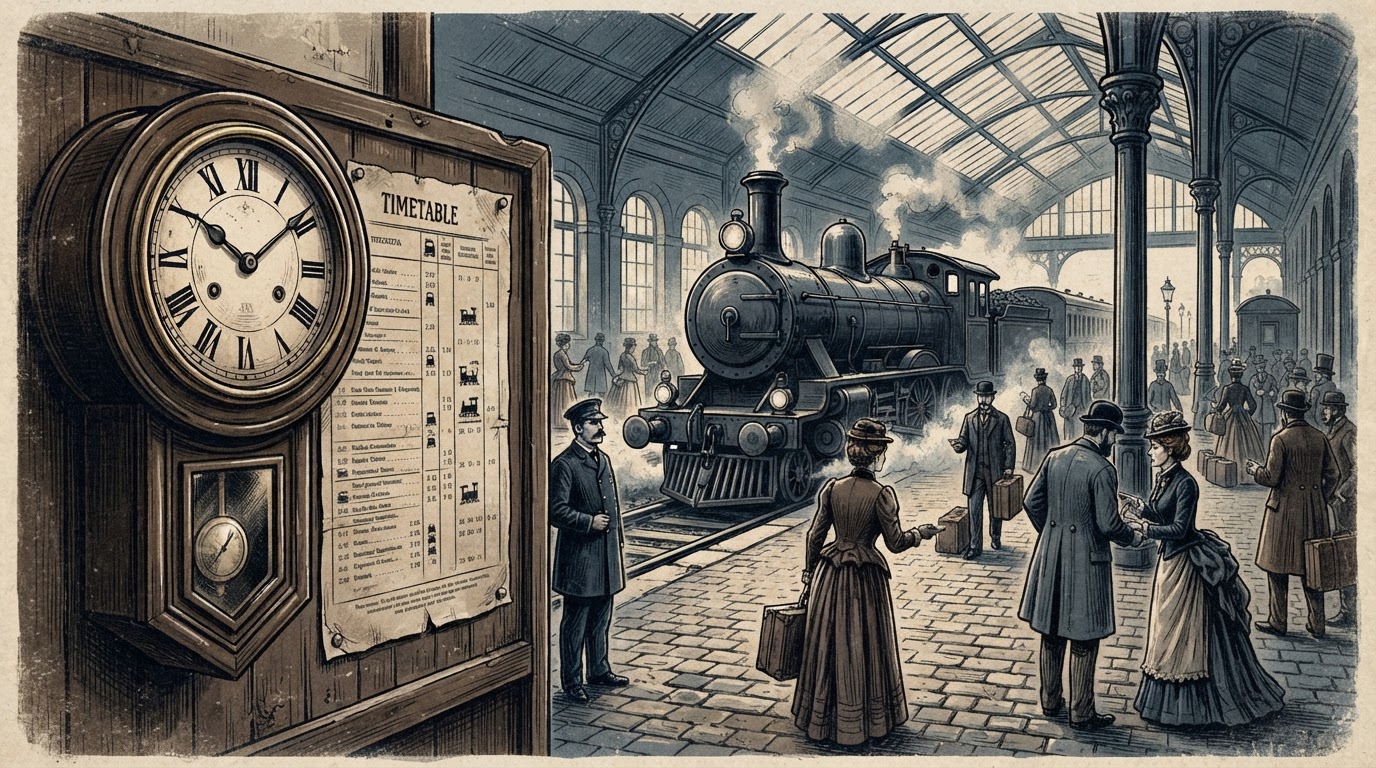
November 18 connects three very different chapters of world history: the reorganization of everyday time, a breakthrough in popular animation, and a devastating tragedy involving coercive control. In 1883 North American railroads adopted standardized time zones; in 1928 the animated short Steamboat Willie opened in New York; and in 1978 more than 900 people died at Jonestown in Guyana. Their stories show how technological systems, cultural creativity and human vulnerability can leave lasting marks on society.
1883: Railroads change the way North America tells time
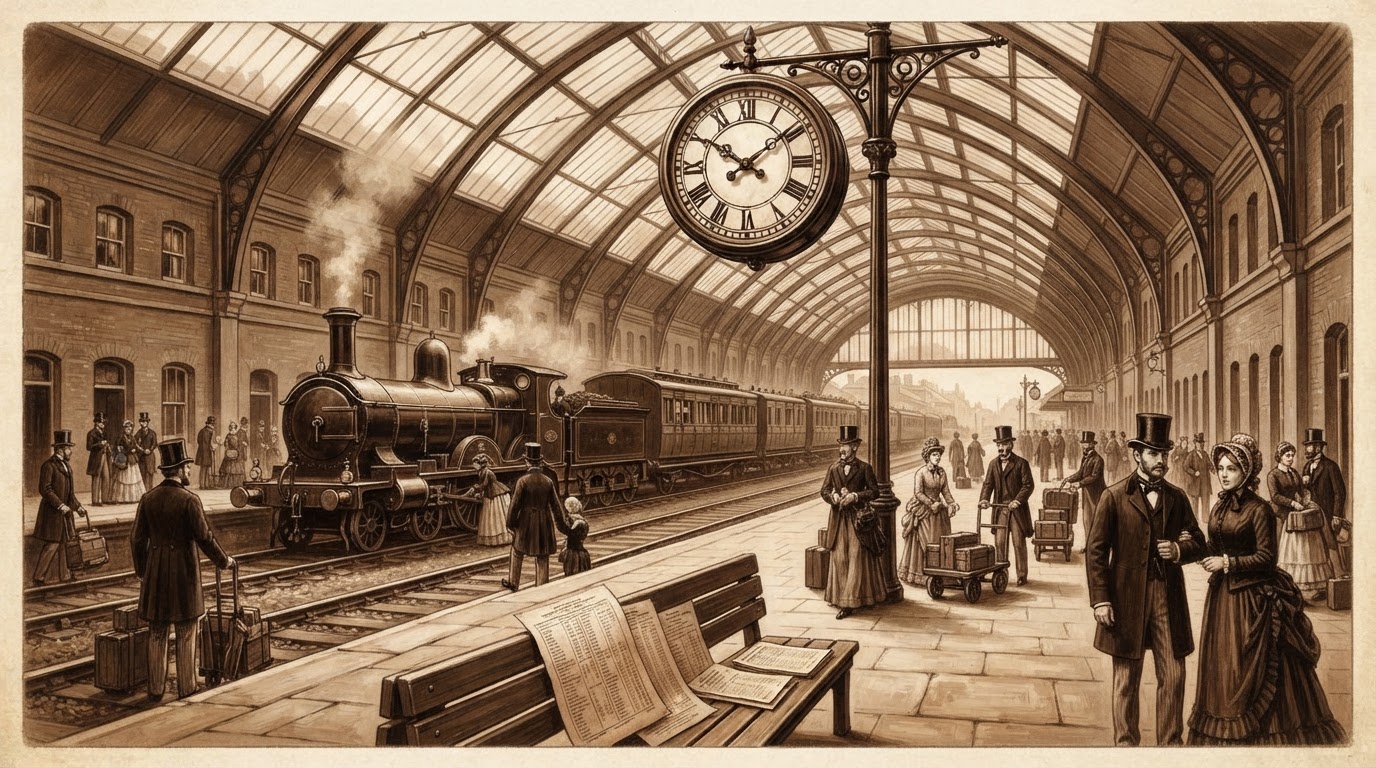
On November 18, 1883, railway companies across much of the United States and Canada switched to standardized railway time. Before that change, communities commonly used local solar time. Noon was tied to the sun’s position, so neighboring towns could have clocks showing different minutes. Such variation was manageable when journeys were slow, but the railway network made it increasingly troublesome. A passenger changing trains needed to interpret different local schedules, and dispatchers faced operational risks when coordinating trains over long distances.
The solution was to organize railway operations around shared regional standards rather than the local clock of each station. The four familiar continental zones—Eastern, Central, Mountain and Pacific—became central to the new arrangement. This was not an overnight national law ordering every household to reset its clock. It was initially a railway-led change, which towns, businesses and institutions adopted at different speeds. Some communities resisted the loss of local time, and legislation governing national standard time came later.
The Library of Congress identifies November 18 as the decisive railway transition. The Smithsonian’s National Museum of American History explains the previous confusion of local clocks, while its collection of an 1883 railway guide shows how timetables communicated the new system. A surviving Union Pacific instruction illustrates the practical work of implementing the change.
The importance of this event extends beyond trains. Coordinated time later became essential to telecommunications, broadcasting, aviation, financial markets and computing. The 1883 change did not create every time-zone practice used around the globe today, but it demonstrated how an interconnected society needs common rules for clocks. It is also a reminder that infrastructure decisions made by private companies can become conventions followed by the wider public.
1928: Steamboat Willie and a new era of animated sound
On November 18, 1928, Steamboat Willie premiered in New York. The short cartoon, associated with Walt Disney and animator Ub Iwerks, introduced many cinema audiences to Mickey Mouse in a commercially released film. It was not the first Mickey cartoon conceived or produced, and it was not the first animated film ever to experiment with synchronized sound. Its significance lies in the effective, entertaining coordination of moving pictures, music and sound effects, which helped audiences recognize animation as a distinctive audiovisual art form.
The short’s riverboat setting and playful musical action made sound part of the storytelling rather than an optional accompaniment. Timing mattered: movements, jokes and musical beats were arranged to reinforce one another. The success of this approach encouraged studios to invest in sound-era animation, even though many other artists and production teams contributed to the medium’s development. The film’s later status as a symbolic starting point for Mickey Mouse can obscure the broader history of experimental animation that preceded it.
According to the Associated Press anniversary account, the November 18 release is one of the day’s notable cultural milestones. The lasting lesson is about creative adaptation: the arrival of synchronized sound changed what audiences expected from films, and successful studios had to rethink the relationship between performance, technology and narrative.
1978: The Jonestown catastrophe in Guyana
November 18, 1978, also marks one of the darkest events in modern American and Guyanese history. At Jonestown, a settlement established by the Peoples Temple organization under Jim Jones, more than 900 people died in a mass killing and suicide event. Many of the dead were children, who could not meaningfully consent to what happened. Describing the catastrophe simply as a voluntary “mass suicide” fails to convey the coercion, intimidation and murders documented in the historical record.
Peoples Temple had initially attracted followers with messages about social equality and community. Over time, however, former members and relatives raised concerns about abuse, isolation and control. US Representative Leo Ryan visited Guyana to investigate. On November 18, members of the group attacked his departing party at the Port Kaituma airstrip, killing Ryan and four others. At the settlement, Jones directed the fatal poisoning that took the lives of hundreds of residents.
The Federal Bureau of Investigation’s case history describes the airstrip attack and the subsequent investigation. The PBS American Experience account distinguishes 909 deaths at Jonestown from the wider total of 918 deaths in Guyana associated with that day’s violence, including deaths at the airstrip and in Georgetown. Such distinctions matter: historical totals vary depending on which locations and victims are counted.
Survivors’ testimony and investigative records also make clear that this was a tragedy involving real people with families, aspirations and varied reasons for joining the organization. Reducing the victims to a stereotype or using the event as a casual metaphor diminishes that history. The more useful questions concern how leaders build unchecked power, how vulnerable people can become isolated, and how warning signs can be taken seriously without stigmatizing ordinary religious or communal life.
What November 18 teaches us
These anniversaries are not linked by a single cause. The railway change demonstrates cooperation around shared technical standards; Steamboat Willie illustrates the possibilities and limits of a creative technological breakthrough; Jonestown reveals the human cost of coercion and failed safeguards. Reading them together shows why historical anniversaries should be more than a list of dates. Their significance emerges from context, evidence, and the lives affected.
For more date-based historical explainers, visit our Today in History archive, including the November 17 edition. Primary institutional records and reputable historical reporting are linked above so readers can explore the evidence and understand where shorthand accounts require qualification.
सीधे अपनी Facebook फ़ीड में पाएँ — News Nation Online पेज को Follow करें।
Discover more from NewsNation Online
Subscribe to get the latest posts sent to your email.
आपके लिए सुझाव









Leave a Reply