

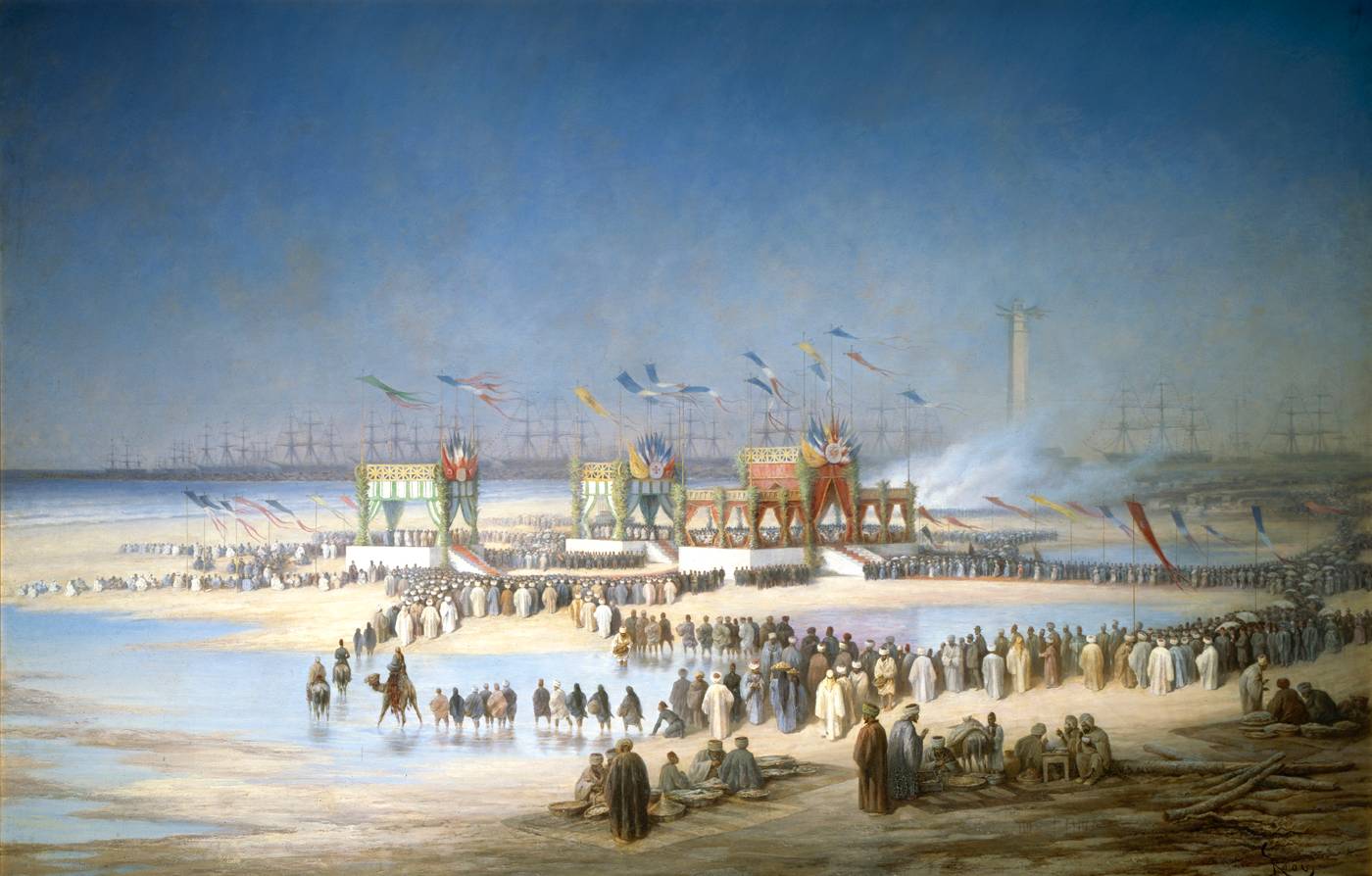
1869: The Suez Canal opens to navigation
On November 17, 1869, Egypt inaugurated the Suez Canal, joining the Mediterranean and Red seas through the Isthmus of Suez. Its opening transformed maritime geography. Vessels travelling between Europe and Asia could use a much shorter route instead of sailing around the southern tip of Africa. The canal was an engineering achievement, but its history cannot be understood solely as a celebration of technology. Work began in 1859 and took roughly a decade. Ferdinand de Lesseps played a prominent role in promoting the scheme, while Egypt provided the land and much of the labour. Egyptian workers, including people subjected to compulsory labour during part of the project, faced extremely difficult conditions. Disease, financial pressures and political disputes were part of the story. The human cost deserves attention alongside the grand inaugural procession. The Suez Canal Authority records that a procession of ships passed through the waterway at its inauguration, with international dignitaries attending. Egypt’s ruler Ismail Pasha staged an elaborate ceremony. Yet questions of ownership, financing and sovereignty would continue long after the opening celebrations ended. In 1875 Britain acquired a substantial shareholding in the canal company, and British military occupation of Egypt followed in 1882. In 1956 President Gamal Abdel Nasser nationalised the canal, precipitating the Suez Crisis involving Britain, France and Israel. The canal later closed after the 1967 Arab-Israeli war and reopened in 1975. These later developments underline the strategic consequences of a waterway originally promoted as a commercial shortcut. The canal remains an important link in international shipping, but the significance of November 17 is broader than cargo movements. It invites readers to consider who built transformative infrastructure, who controlled it, and who benefited from it. The Library of Congress and the Suez Canal Authority document the date and historical background.1970: Lunokhod 1 reaches the lunar surface
On November 17, 1970, the Soviet Luna 17 spacecraft landed on the Moon and deployed Lunokhod 1, a remotely controlled robotic rover. The event marked a major advance in the exploration of another world by machines. Unlike human lunar expeditions, the rover could be directed from Earth and used instruments to study terrain and soil. The spacecraft had launched on November 10 and entered lunar orbit before landing in the Mare Imbrium region. After touchdown, Lunokhod 1 rolled down ramps onto the lunar surface. Operators on Earth guided it while managing the delay in radio communication and the hazards of uneven terrain. Its cameras transmitted pictures and its scientific equipment examined lunar conditions. The mission helped demonstrate that a mobile robotic platform could operate beyond Earth for an extended period. That lesson would prove relevant to later planetary rovers, including missions to Mars. The achievement belonged to the Soviet space programme during the Cold War. The United States had already landed astronauts on the Moon, and both countries were pursuing different approaches to exploration. Lunokhod 1 showed the scientific value of robotic mobility rather than replacing the achievements of human spaceflight. For a mission chronology, see the Luna 17 record.1989: A student protest ignites the Velvet Revolution
On November 17, 1989, a student demonstration in Prague was violently suppressed by communist police. The protest commemorated students persecuted during the Nazi occupation fifty years earlier. The police response triggered wider demonstrations and helped begin what became known as the Velvet Revolution in Czechoslovakia. The date carried a double historical meaning. In 1939 Nazi authorities had repressed Czech student resistance, closing universities and punishing student leaders. In 1989 a commemoration of those events became a moment of protest against a different authoritarian system. This continuity made student participation especially symbolic. Demonstrations grew over the following days, drawing workers, artists and other citizens. The movement’s prominent figures included playwright and dissident Václav Havel. The Communist Party leadership lost its monopoly on power, and Havel became president in December 1989. The transition was comparatively peaceful, although it was preceded by police violence and years of political repression. The Czech Ministry of Foreign Affairs describes November 17 as a foundational moment in the country’s democratic transition. The revolution also unfolded within a larger wave of change across Central and Eastern Europe as communist governments weakened in 1989. Its outcome was not inevitable on the first night of protests; sustained civic mobilisation and changing regional circumstances mattered.Why November 17 still matters
These anniversaries belong to different fields, but they share a lesson about historical change. The Suez Canal rearranged commercial routes while exposing inequalities of power. Lunokhod 1 expanded the reach of scientific instruments. Prague’s students helped turn public remembrance into a demand for political reform. Each event also reminds us to distinguish a milestone date from the longer processes before and after it. Sources: Library of Congress; Suez Canal Authority; Czech Ministry of Foreign Affairs; Luna 17 mission chronology. Explore more in our Today in History archive.Also read:
➤ १७ नवंबर का इतिहास: स्वेज नहर, चंद्रमा पर रोवर और मखमली क्रांति
➤ १६ नवंबर का इतिहास: सिकंदर बाग की लड़ाई, यूनेस्को और अंतरिक्ष संदेश
➤ November 16 in History: Sikandar Bagh, UNESCO, Arecibo and Tolerance
जालना, महाराष्ट्र और देश-दुनिया की ताज़ा खबरें
सीधे अपनी Facebook फ़ीड में पाएँ — News Nation Online पेज को Follow करें।
👍 Facebook पर Follow करेंसीधे अपनी Facebook फ़ीड में पाएँ — News Nation Online पेज को Follow करें।
Discover more from NewsNation Online
Subscribe to get the latest posts sent to your email.
Never miss a storyFollow News Nation Online on WhatsApp for breaking news from India and the world.
आपके लिए सुझाव







Leave a Reply