


November 13: A date connecting rights, remembrance and exploration
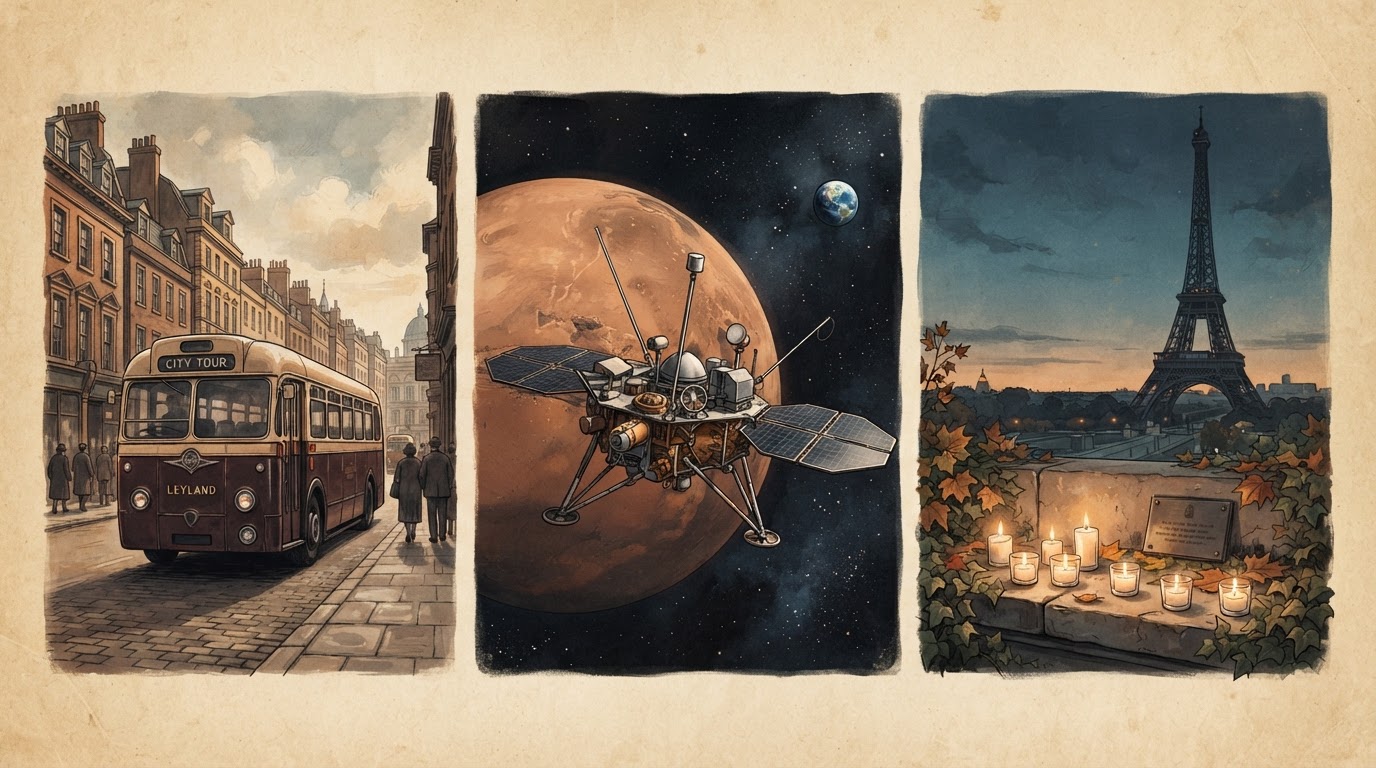
November 13 brings together different kinds of historical turning points: a constitutional victory against racial segregation in the United States, the arrival of a spacecraft at Mars, and the remembrance of people murdered in coordinated attacks in France. These episodes should not be treated as equivalent. One concerns the long struggle for equal citizenship, another scientific discovery, and the third mass violence and its human consequences. Their shared date offers a useful opportunity to examine evidence, historical context and the difference between a landmark event and the longer process surrounding it.
1956: The Supreme Court upholds a ruling against segregated buses
On November 13, 1956, the United States Supreme Court affirmed a federal court decision in Browder v. Gayle. The lower court had ruled that laws requiring racial segregation on Montgomery, Alabama, buses violated the Fourteenth Amendment. The Supreme Court’s action was decisive, but it did not arrive in isolation. Black residents had challenged discrimination for decades, and the Montgomery bus boycott had begun in December 1955 after Rosa Parks was arrested for refusing to surrender her seat.
The case was named for Aurelia Browder and included plaintiffs Claudette Colvin, Susie McDonald and Mary Louise Smith. Their participation matters because accounts of the civil-rights movement sometimes reduce a broad community campaign to a handful of famous individuals. Attorney Fred Gray brought the federal constitutional challenge. In June 1956 a three-judge district court ruled against the segregation requirements; Alabama and Montgomery appealed.
The Supreme Court affirmed the decision without a full written opinion on November 13. The ruling did not mean that buses immediately became integrated that morning. Legal orders and local compliance still had to follow. The boycott ended on December 20, 1956, after Montgomery complied with the ruling. The distinction between a judicial decision and its implementation is central to understanding how constitutional rights become everyday realities.
The boycott was also an economic and organizational campaign. Residents arranged alternative transport, walked long distances and maintained solidarity despite pressure. Martin Luther King Jr. emerged as a prominent leader, but the movement relied on numerous organizers, churches, drivers, plaintiffs and ordinary passengers. Its achievement illustrates how grassroots activism and courtroom litigation can reinforce each other.
For primary historical context, see the Supreme Court Historical Society’s account of Browder v. Gayle. The anniversary is best understood as a major legal step, not the end of racial inequality in American transportation or society.
1971: Mariner 9 transforms the study of Mars
NASA’s Mariner 9 became the first spacecraft to orbit another planet in November 1971. Some NASA anniversary accounts use November 13, reflecting the date in the United States, while NASA’s technical mission chronology places the orbit-insertion engine firing at 00:18 UTC on November 14. That time-zone distinction is important for an accurate ‘on this day’ chronology.
Launched on May 30, Mariner 9 followed an earlier mission, Mariner 8, whose launch had failed. Its goal was not simply to pass Mars but to remain in orbit and survey the planet over time. A major dust storm obscured much of the surface when it arrived. Instead of declaring the mission unsuccessful, controllers waited for the atmosphere to clear and used the opportunity to observe Mars’s moons.
Once the storm subsided, the spacecraft revealed immense volcanoes, deep canyon systems and evidence of landscapes shaped by ancient geological processes. NASA records that it returned more than 7,000 images and mapped roughly 85 percent of the surface. The mission helped scientists replace an incomplete picture based on brief flybys with a far richer planetary portrait.
Mariner 9 also demonstrates why space history needs precise dates. A milestone described as November 13 in an American historical retrospective can fall on November 14 in Universal Time. Both descriptions can refer to the same maneuver, but readers deserve to know the clock being used. See NASA’s anniversary history and NASA’s technical mission summary.
2015: Paris and Saint-Denis attacks leave 130 victims
On the evening of November 13, 2015, coordinated terrorist attacks struck Paris and nearby Saint-Denis. Attackers targeted people at a concert venue, cafés and restaurants, and near the Stade de France. French authorities recorded 130 people killed in the attacks. The violence traumatized survivors, bereaved families and communities well beyond France.
The attacks were carried out by extremists associated with the Islamic State organization. Reporting the perpetrators’ affiliation should not imply responsibility on the part of a wider faith or population. The victims were people going about ordinary activities: enjoying music, dining, meeting friends or attending a sporting event. Their lives, rather than the attackers’ notoriety, belong at the center of remembrance.
The immediate aftermath involved emergency medical care, investigations, public mourning and debates about security and civil liberties. Governments confronted the challenge of preventing further attacks while maintaining legal safeguards and social cohesion. Those debates continued beyond the first weeks and cannot be reduced to a single policy outcome.
On November 27, 2015, France held a national tribute at Les Invalides. The French Interior Ministry’s record documents the ceremony and the 130 victims. On an anniversary, responsible coverage avoids sensational descriptions and gives space to survivors’ experiences and the lasting work of remembrance.
Why these anniversaries matter
These histories illuminate different responsibilities. The Montgomery case shows the importance of organized civic action and enforceable legal rights. Mariner 9 shows how careful observation can overturn scientific assumptions and why precise dating matters. Paris reminds readers that public memory must account for human loss without spreading collective blame.
Historical anniversaries are useful when they encourage questions rather than merely repeat a list of dates. Who made change possible? Which records establish the timeline? What happened after the headline event? Readers can explore other verified anniversaries in the Today in History archive.
सीधे अपनी Facebook फ़ीड में पाएँ — News Nation Online पेज को Follow करें।
Discover more from NewsNation Online
Subscribe to get the latest posts sent to your email.
आपके लिए सुझाव















Leave a Reply