

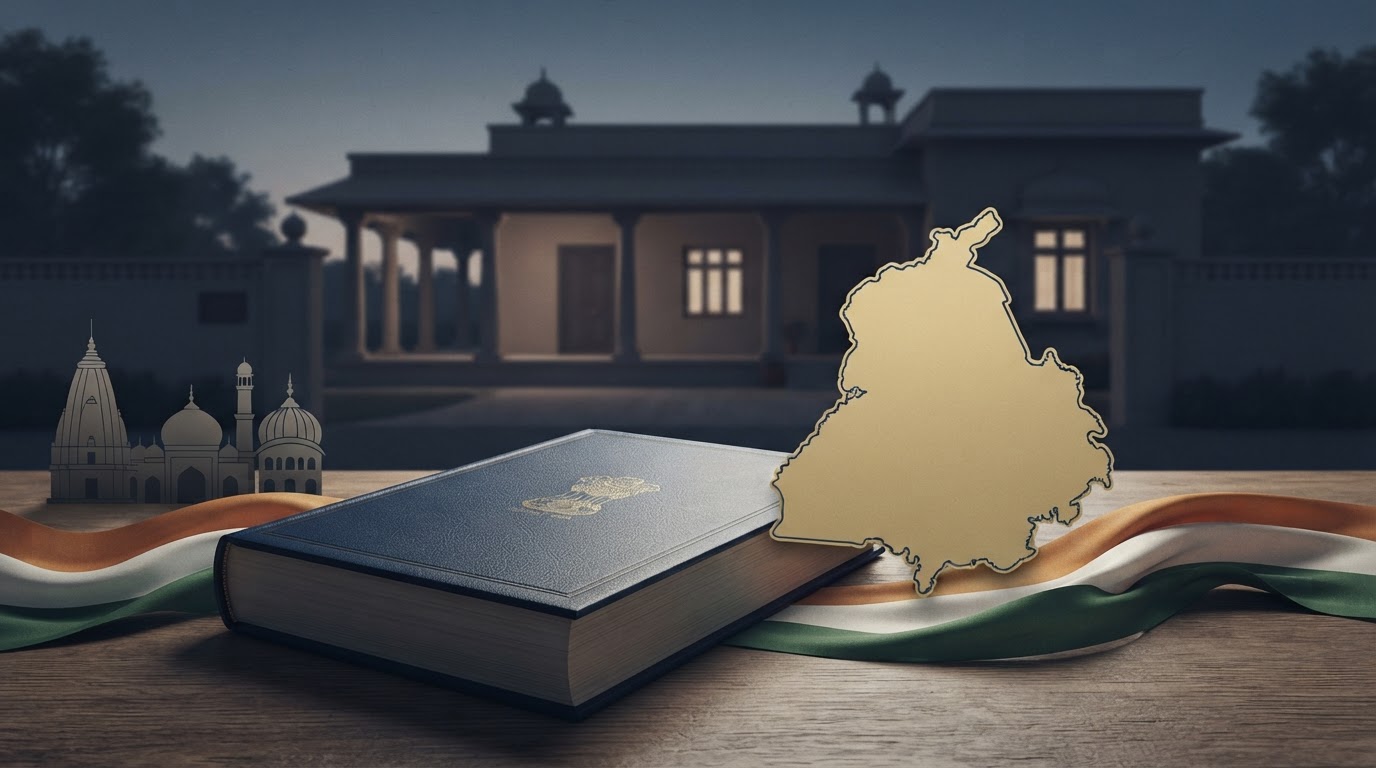
Sheesh Mahal Row Reopens: BJP’s Punjab Election Pitch, Religious Faith and the Question of Accountability
As the BJP-led Delhi government showcases Arvind Kejriwal’s former official residence, the temple’s images have become a political talking point. With Punjab’s next Assembly election approaching, the controversy raises questions about political timing, public expenditure and respect for personal faith.
The BJP-led Delhi government opened former Chief Minister Arvind Kejriwal’s official residence at 6, Flagstaff Road—popularly branded by the BJP as ‘Sheesh Mahal’—to journalists on 27 November 2026. The tour displayed furnishings and fittings, while an expenditure board put the overall figure at ₹58.83 crore. Images of Jesus Christ alongside Hindu deities in a marble shrine also attracted attention and triggered political commentary. The religious imagery has added another layer to an already contentious debate over the renovation of a government residence.
Why bring the controversy back into the Punjab political arena?
The timing matters. The Indian Express has reported that the reopening of the bungalow comes ahead of the Punjab Assembly election, while India Today notes that the temple visuals have become part of the political contest over Kejriwal’s image and his outreach to Hindu voters in Punjab. The BJP had raised the ‘Sheesh Mahal’ issue earlier, including during the 2025 Delhi election campaign; therefore, it would be inaccurate to say the party had remained silent until now. The more pertinent question is why the issue is being repackaged and given renewed prominence at this moment, and how much of the presentation is directed at the political contest in Punjab.
Political parties are entitled to scrutinise one another. But citizens should be able to distinguish between evidence-based questions about public expenditure and messaging designed to generate a fresh political controversy. If the focus is accountability in Delhi, the evidence and audit findings should lead the discussion. If the focus is Punjab, voters deserve debate on the performance, promises and plans of all parties for the state—not merely a recycled controversy from Delhi.
A government-owned residence is not a private property
One distinction should not be lost in the political noise: 6, Flagstaff Road was a government-owned official residence allotted to the Chief Minister. The renovation was therefore work on public property, not the development of a privately owned house belonging to Kejriwal. That fact does not, by itself, justify the expenditure or excuse any violation of rules. Public money must be accounted for, and every rupee spent on an official residence must withstand scrutiny. But the distinction between improving an official government property and building or improving a personal asset is relevant to a fair public discussion.
The CAG report tabled in the Delhi Assembly in March 2026 was reported as placing renovation and construction expenditure at ₹33.66 crore, 342 per cent above the preliminary estimate of ₹7.91 crore, and flagging cost escalation and procedural concerns. Separately, the Delhi government’s display during the media tour cited ₹58.83 crore for the property and its listed items. These are figures presented in different contexts and should not be casually treated as identical. The audit observations deserve examination through records, explanations from the departments concerned and due process.
A place of worship should not become a political weapon
The presence of images of Jesus Christ alongside Hindu deities in a personal shrine does not, on its own, establish wrongdoing in public expenditure. India’s constitutional framework protects freedom of conscience and religion under Article 25, subject to constitutional limitations. Citizens may debate political claims, but ridiculing or questioning an individual’s choice of religious imagery risks turning personal faith into an instrument of electoral messaging.
Statement of Adv. Mahesh Dhannawat
“Public money must be accounted for, and if the audit has identified irregularities, the responsible authorities must answer through documents, investigation and due process. But we must also remember that this was a government-owned official residence, not a privately owned house developed as a personal asset. That distinction does not erase accountability; it gives the debate its proper context. Bringing images from a place of worship into political attacks, particularly when Punjab’s electoral contest is approaching, risks distracting citizens from the real questions—governance, public services, employment, education and the promises made to voters. Political parties should seek public trust through their work, not by turning personal faith into a campaign prop.”
Punjab voters deserve a debate about Punjab
The BJP has every right to demand answers about the cost and procedure of the renovation. AAP, in turn, must respond to substantiated questions rather than rely only on political counter-allegations. But Punjab’s citizens should not be reduced to an audience for Delhi-centred political theatre. They deserve clear answers on jobs, agriculture, drugs, public health, education, law and order, state finances and the delivery of public services.
The test is simple: publish the records, explain the expenditure, examine the audit findings and take lawful action wherever wrongdoing is established. At the same time, respect constitutional freedoms and keep religious identity out of opportunistic political mudslinging. Accountability is essential—but it must be consistent, evidence-based and relevant to the people’s concerns.
— Adv. Mahesh Dhannawat
Background: India Today report on the temple visuals and media tour (27 November 2026) | The Indian Express report on the Punjab election context | CAG findings reported by The New Indian Express.
Read Next
 Punjab Politics: Why Has BJP Revived the Sheesh Mahal Row Now? Questions Over Kejriwal’s Government Residence and Religious ControversyNov 28, 2026
 Constitution is a shield for the people, not just a book: BJP’s Lal Singh Arya in MumbaiNov 26, 2026
 Jalna Congress urges thousands to join ‘Samvidhan Bachao’ rally in Thane on November 26Nov 25, 2026
 Jalna Congress Pays Tribute to Indira Gandhi on Birth AnniversaryNov 19, 2026
Most Read
- Raza Academy Founder Muhammad Saeed Noori Honoured at Kichhauchha Sharif for 50 Years of Service
- Jalna Gets ₹15 Crore for Civic Works After Corporator Darshana Khotkar-Zol’s Follow-up
- How to Apply for Indiramma Family Life Insurance Scheme Telangana
- Apple Ordered to Pay $5.7 Billion in US Patent Infringement Case
- अंबड में 100 बेड अस्पताल का लोकार्पण, पर 14 साल लड़ने वाले एमपीजे को न्योता तक नहीं; लोगों में नाराजगी
Get it straight in your Facebook feed. Follow the News Nation Online page.
Discover more from NewsNation Online
Subscribe to get the latest posts sent to your email.
Suggested for You


Leave a Reply