

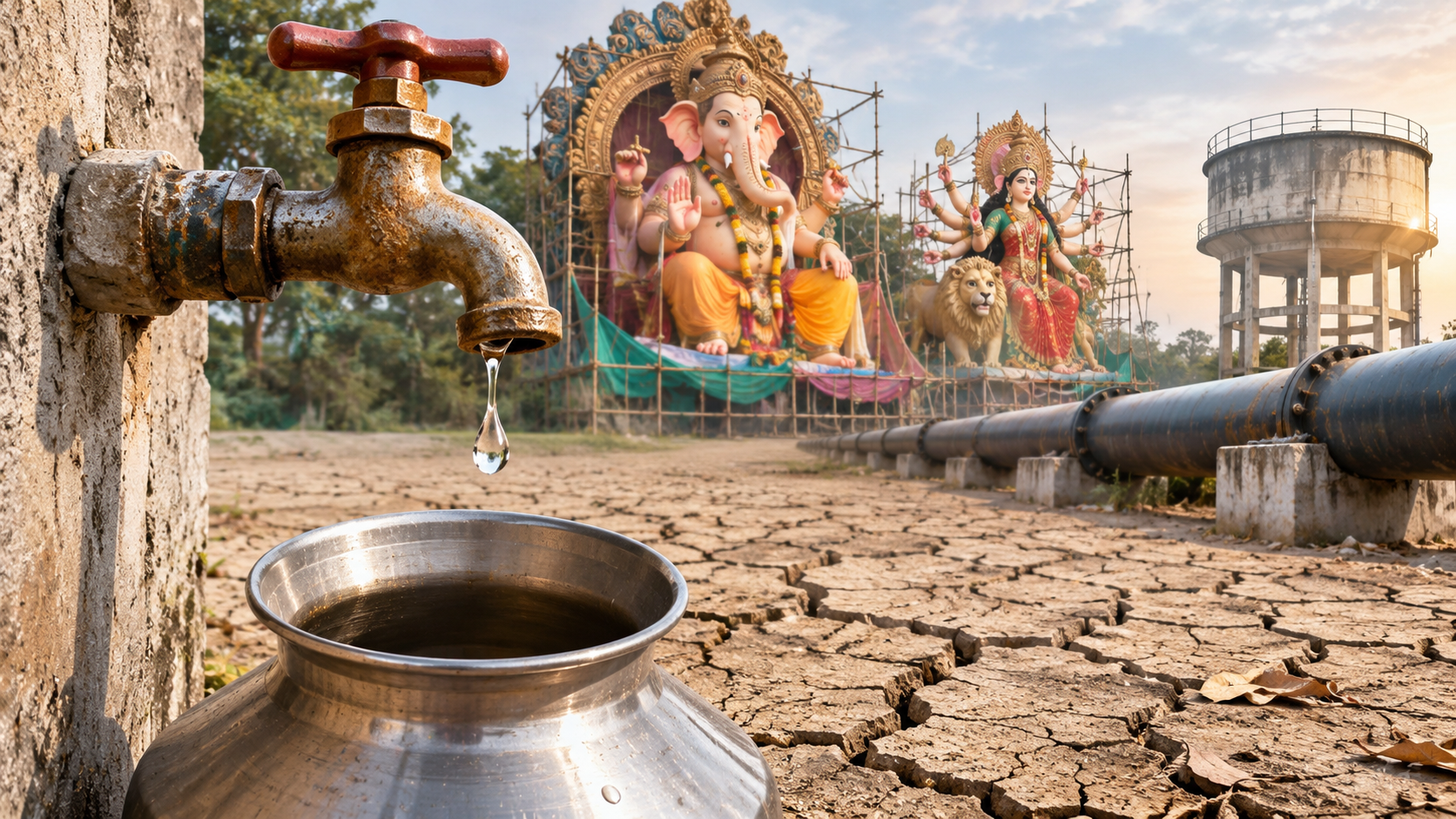
JALNA: At a time when every drop of water matters, the Jalna Municipal Corporation’s approach to water conservation raises an uncomfortable question: is conservation a genuine administrative priority or merely a subject for letters, announcements and newspaper headlines? The Corporation has now warned of penalties of ₹5,000, ₹10,000 and ₹25,000 for different violations involving unauthorised connections and wastage of drinking water. Municipal Commissioner Anjali Sharma has also announced direct inspections across the city. But citizens are entitled to ask whether these announcements will translate into consistent action.
The contradiction is difficult to ignore. Adv. Mahesh Dhannawat had earlier raised the issue of restricting the height of Ganesh and Durga idols, keeping in view the growing scale of celebrations and the need to conserve water. A letter was issued to him in connection with the matter, but the subject was not placed before the Municipal Corporation’s General Body meeting. Given the pressure on water resources and the need for advance planning, the issue deserved a meaningful discussion and a considered decision. The correspondence took place, but the matter did not reach the meeting where policy-level deliberation could have happened.
The latest warning, as reported in the newspaper clipping, covers unauthorised water connections, tampering with municipal pipelines, leakage, and the use of drinking water for washing vehicles or roads. It states that water theft or misuse through the public water-supply system may attract a fine of ₹5,000 for the first violation, ₹10,000 for the second and ₹25,000 for the third, along with the possibility of criminal proceedings. Residents have also been urged to repair leakage in household connections, taps, valves and internal pipelines without delay.
Also read: Super Bowl 2027: Date, Kickoff Time, TV Channel, Halftime Show and Location
Water conservation, however, cannot be reduced to imposing penalties on citizens. It requires planning, institutional accountability and consistency. The administration must lead by example—by identifying wastage, repairing leaks promptly, planning supply responsibly and examining water use during public celebrations and events. Citizens must certainly use drinking water responsibly, but the Corporation must also demonstrate that it is willing to consider difficult conservation measures before a crisis becomes unavoidable.
Adv. Mahesh Dhannawat has questioned this gap between stated concern and administrative follow-through. If a proposal directly connected with water conservation—regarding the height of Ganesh and Durga idols—was acknowledged through a letter but not placed before the General Body, what assurance is there that the latest appeal and penalty warnings will not remain on paper as well? The message of “save water” must be reflected in decisions, budgets, implementation and public accountability—not merely in official statements. Every drop saved today is an investment in Jalna’s tomorrow. The city needs action rather than announcements, decisions rather than correspondence, and measurable results rather than another set of warnings.
सीधे अपनी Facebook फ़ीड में पाएँ — News Nation Online पेज को Follow करें।
Discover more from NewsNation Online
Subscribe to get the latest posts sent to your email.
आपके लिए सुझाव


Leave a Reply