

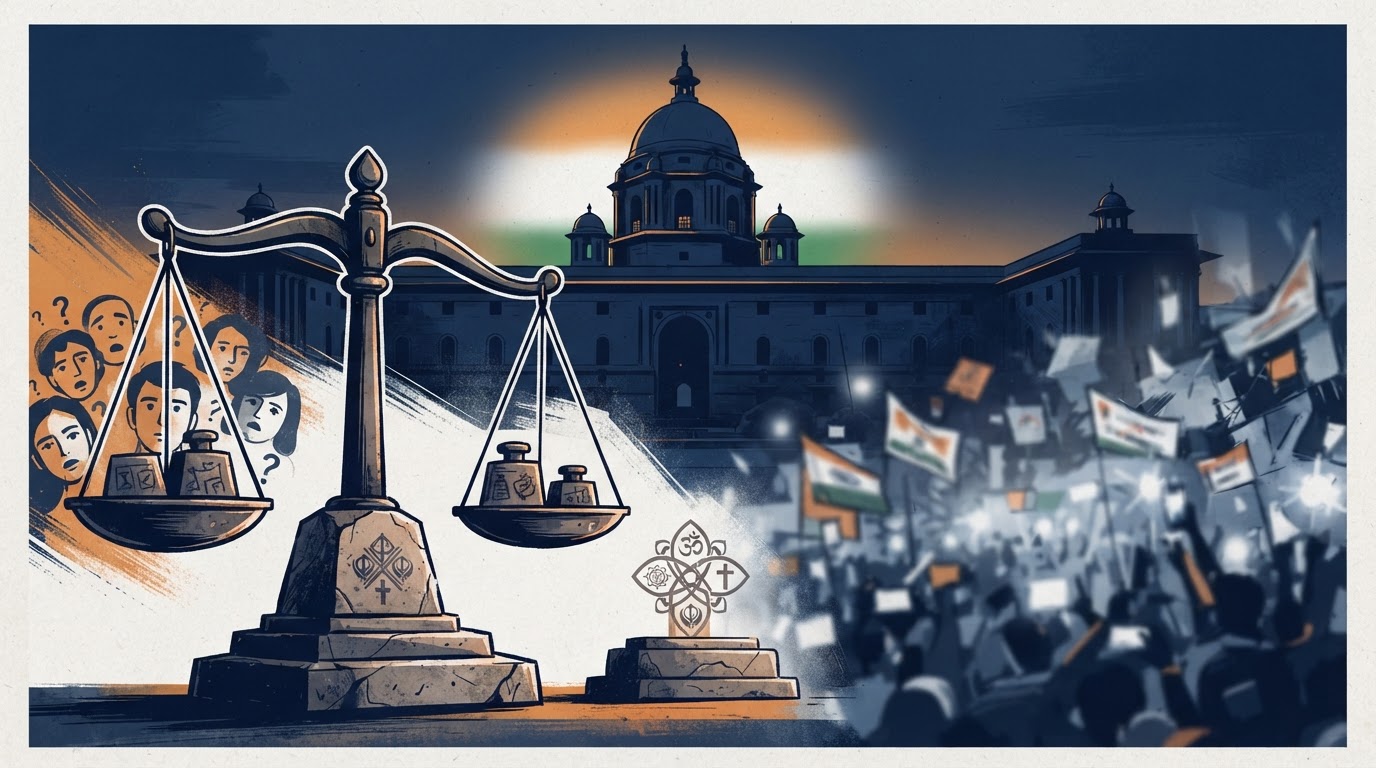

Politics Over Personal Faith: Why Has BJP Revived the Sheesh Mahal Row Now?
Punjab politics angle: With the BJP and AAP contesting political space in Punjab, images from Arvind Kejriwal’s former official residence have become another point of political messaging. The latest media tour at 6, Flagstaff Road, Delhi, organised by the BJP-led Delhi government on November 27, 2026, highlighted the alleged expenditure on the residence. A framed image of Jesus Christ alongside Hindu deities in the marble shrine then became a separate talking point. India Today reported that the religious imagery triggered social-media jibes and added a religious dimension to the dispute.
Why was BJP silent until now?
A question citizens can reasonably ask is why the BJP has chosen this moment to revive the issue with such a high-profile public display. If the renovation involved excessive or improper expenditure, the relevant questions should be pursued through audit records, invoices, legislative scrutiny and due process. The public deserves a clear account of what was spent, who approved it and whether rules were followed. But the timing and presentation of the media tour also invite scrutiny: is the focus consistent financial accountability, or political messaging at a moment when Punjab’s political contest makes Kejriwal’s public image especially significant?
A government residence is not a private property
There is also an important distinction that should not be blurred. The bungalow was a government-owned official residence allotted to the Chief Minister; it was not Kejriwal’s privately owned house. Renovation and furnishing of an official residence can certainly be questioned, particularly when public money is involved. Government ownership does not excuse extravagant or unauthorised spending. Equally, the fact that improvements were made to a government property should not be misrepresented as the development of a personal asset. The proper test is the documented expenditure, applicable rules, necessity and approvals—not political slogans.
Do religious symbols answer questions about public expenditure?
The presence of images of Jesus Christ alongside Hindu deities in a place of worship does not, by itself, establish financial wrongdoing. India’s constitutional framework protects freedom of conscience and religion under Article 25, subject to constitutional limits. Political disagreement over expenditure should not become ridicule of a person’s religious choices or a test of religious identity. The BJP is entitled to question the cost of the residence; citizens are equally entitled to question whether the religious angle serves any genuine public-accountability purpose.
Adv. Mahesh Dhannawat’s statement
Adv. Mahesh Dhannawat said, “If public money has been spent improperly, the responsible persons must be held accountable on the basis of audit findings, invoices and due process. But we must distinguish a government-owned official residence from a privately owned house. The fact that the property belongs to the government does not give anyone a licence for excessive spending, yet it is equally wrong to blur that distinction for political effect. Making a place of worship or the presence of different religious images a subject of ridicule takes the debate away from evidence. In a constitutional democracy, political parties should compete on governance, transparency and public service—not turn personal faith into a campaign weapon.”
Punjab needs a debate on governance
The Sheesh Mahal controversy has acquired a Punjab political dimension because the BJP and AAP are competing over political narratives and voter confidence in the state. That makes responsible scrutiny even more important. Political parties should explain their record on employment, agriculture, public services, education, health, law and order and the use of public funds. The public deserves answers on the bungalow’s expenditure, but it also deserves a debate that does not reduce governance to religious symbolism.
The bottom line: Investigate expenditure where evidence warrants it. Publish the records. Fix responsibility if rules were broken. But do not confuse accountability with political spectacle, or public property with private ownership. Democracy needs facts, fairness and respect for constitutional freedoms.
— Adv. Mahesh Dhannawat
Sources: India Today, November 27, 2026; The Indian Express, November 27, 2026.
Read Next
 Sheesh Mahal Row Reopens: BJP’s Punjab Election Pitch, Religious Faith and Accountability | Adv. Mahesh DhannawatNov 28, 2026
 Constitution is a shield for the people, not just a book: BJP’s Lal Singh Arya in MumbaiNov 26, 2026
 Jalna Congress urges thousands to join ‘Samvidhan Bachao’ rally in Thane on November 26Nov 25, 2026
 Jalna Congress Pays Tribute to Indira Gandhi on Birth AnniversaryNov 19, 2026
Most Read
- Raza Academy Founder Muhammad Saeed Noori Honoured at Kichhauchha Sharif for 50 Years of Service
- Jalna Gets ₹15 Crore for Civic Works After Corporator Darshana Khotkar-Zol’s Follow-up
- How to Apply for Indiramma Family Life Insurance Scheme Telangana
- Apple Ordered to Pay $5.7 Billion in US Patent Infringement Case
- अंबड में 100 बेड अस्पताल का लोकार्पण, पर 14 साल लड़ने वाले एमपीजे को न्योता तक नहीं; लोगों में नाराजगी
Get it straight in your Facebook feed. Follow the News Nation Online page.
Discover more from NewsNation Online
Subscribe to get the latest posts sent to your email.
Suggested for You


Leave a Reply