Washington, October 2, 2026: Expectations for another U.S. interest-rate increase in October have cooled sharply after senior Federal Reserve policymakers argued for patience and the latest inflation figures came in softer than economists had feared. The shift has become one of the most important stories for American households and global markets because the Fed’s next decision can influence mortgage costs, credit-card rates, business borrowing, the dollar and stock valuations.
The debate is not over. Dallas Federal Reserve President Lorie Logan said this week that at least another half percentage point of tightening may ultimately be needed to make monetary policy modestly restrictive enough to return inflation toward the central bank’s 2% goal. At the same time, New York Fed President John Williams and Fed Vice Chair Philip Jefferson have emphasized that policymakers can take more time to assess incoming data before making the next move.
Why expectations changed so quickly
The immediate catalyst was a combination of softer inflation data and cautious comments from influential Fed officials. Reuters reported that investors largely abandoned expectations of an October increase after Williams said there was no need for urgency and Jefferson delivered a similarly patient message.
That followed the Commerce Department’s latest personal consumption expenditures data. The PCE price index rose 0.3% in August and was 3.4% higher than a year earlier, while the core measure increased 0.2% for the month and 3.0% year over year. Inflation therefore remains above the Fed’s 2% objective, but the report was milder than expected and earlier figures were revised lower.
The Fed had raised rates in September, its first increase in more than three years, as officials responded to renewed inflation pressure. The question now is not whether inflation has disappeared—it clearly has not—but whether policymakers need to tighten again immediately or can wait for additional evidence.
The jobs report becomes the next major test
Attention is now turning to the September employment report. Economists surveyed by Reuters expected nonfarm payrolls to increase by about 90,000 after August’s 162,000 gain, with the unemployment rate remaining around 4.1%. If the labor market remains stable without a sharp acceleration in wage pressure, it could strengthen the case for waiting before another rate increase.
That does not mean one jobs report will mechanically determine the decision. The Federal Open Market Committee considers a broad range of indicators, including inflation, employment, wages, consumer demand, financial conditions and expectations. Energy prices are an especially important complication in 2026 because the prolonged Middle East conflict and pressure on diesel supplies have added another source of inflation risk.
Why consumers should care about the Fed
The federal funds rate is an overnight rate between banks, but changes in monetary policy ripple through the financial system. Higher policy rates can contribute to more expensive borrowing for households and businesses. Credit-card rates, auto loans, home-equity borrowing and some mortgage rates can all be affected directly or indirectly by expectations for the Fed and by moves in Treasury yields.
Savers can experience the opposite effect, as higher rates may support yields on savings accounts, certificates of deposit and money-market products. The impact is therefore uneven: borrowers generally prefer cheaper credit, while savers can benefit from higher returns on cash. Businesses also face different consequences depending on how much they borrow, their pricing power and the strength of consumer demand.
Treasury yields add another layer of pressure
The bond market has been unusually volatile. The benchmark 10-year U.S. Treasury yield reached 5.34% on Thursday, its highest level in roughly 24 years, before retreating. Long-term yields are influenced by more than the Fed’s overnight rate: investors also price in expected inflation, economic growth, government borrowing and the return they demand for holding longer-dated debt.
For Wall Street, that matters because higher bond yields can make fixed-income assets more competitive with stocks and raise the discount rate investors apply to future corporate earnings. Technology and other growth-oriented shares can be particularly sensitive to rapid changes in yields, although individual company results and the extraordinary scale of artificial-intelligence investment remain powerful forces in the current market.
NewsNationOnline’s latest U.S. news roundup provides broader context on the Federal Reserve, trade and other developments affecting the American economy. Readers following markets can also explore our Business coverage for related company and financial-market developments.
Fed officials are not speaking with one voice
A central feature of the current debate is the range of views inside the Federal Reserve System. Logan has argued that additional tightening of 50 basis points or more will be necessary to put policy in a modestly restrictive position. Fed Governor Michael Barr has also said further increases are likely to be required, citing inflation risks from energy prices and heavy AI-related investment.
Williams and Jefferson, however, have stressed the value of waiting for more information. These positions are not necessarily contradictory about the longer-term destination of rates. Policymakers can agree that inflation remains too high while disagreeing about how quickly rates need to move and how much evidence should be collected between decisions.
AI investment has entered the inflation debate
Artificial intelligence is also becoming part of the monetary-policy discussion. Massive spending on data centers, chips, electricity infrastructure and related construction can raise demand for capital, workers and energy in the short run. Fed Governor Lisa Cook has identified the AI build-out as a potential inflation risk heading into 2027, even while acknowledging that AI could improve productivity over the longer term.
This creates an unusual economic tension. Productivity improvements can eventually allow an economy to produce more without generating the same inflation pressure, but the investment boom required to build that capacity can itself create bottlenecks before those benefits arrive. Policymakers therefore have to distinguish between temporary supply pressures and persistent inflation.
What happens at the October Fed meeting?
The Federal Reserve’s next policy meeting is scheduled for late October. Markets currently see a pause as substantially more plausible than they did only days ago, but expectations can change quickly when new employment, inflation or energy-price data arrive. Market pricing is not a promise from the Fed and should not be treated as one.
The most important signals to watch are whether inflation continues to moderate, whether the labor market remains resilient without accelerating wage pressure, and whether oil and diesel prices generate another broad rise in consumer costs. Policymakers will also assess financial conditions after the surge in Treasury yields.
The bigger picture
The latest shift in expectations illustrates why monetary policy in 2026 remains unusually difficult. The U.S. economy has continued to expand, consumer spending has been resilient and unemployment remains relatively low, yet inflation is still above target and global energy shocks remain a threat. Moving too slowly could allow inflation to become more persistent; moving too aggressively could unnecessarily weaken employment and investment.
For households and investors, the takeaway is not that interest rates are certain to stay unchanged in October. It is that the Fed now appears to have more room to wait for evidence before deciding. The next jobs and inflation reports could therefore matter as much as any speech from Washington.
Sources and image credit
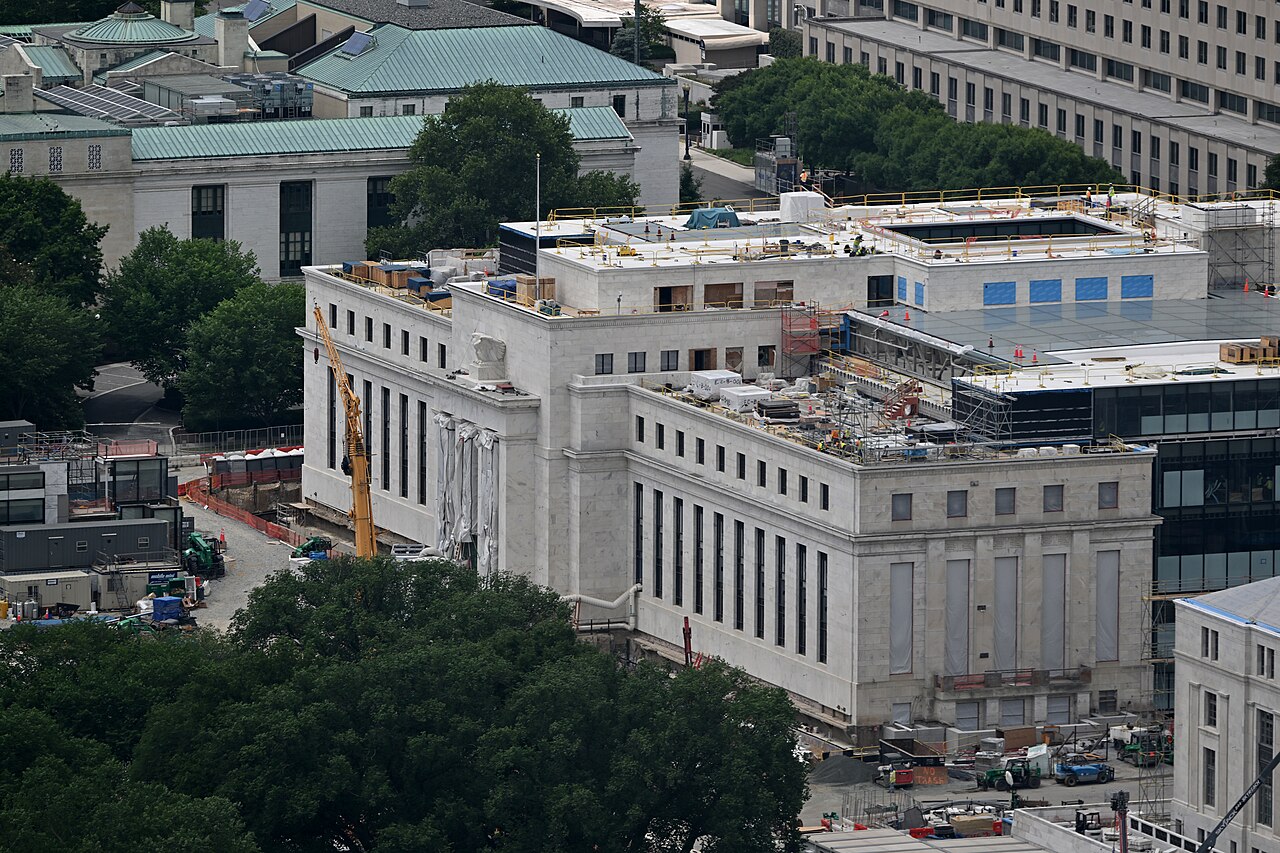
This report draws on Reuters coverage of Federal Reserve officials, U.S. inflation, employment expectations and financial markets, together with public Federal Reserve information. Featured image: Marriner S. Eccles Federal Reserve Building during renovation, June 2026, G. Edward Johnson via Wikimedia Commons, CC BY attribution.
आपके लिए सुझाव
