

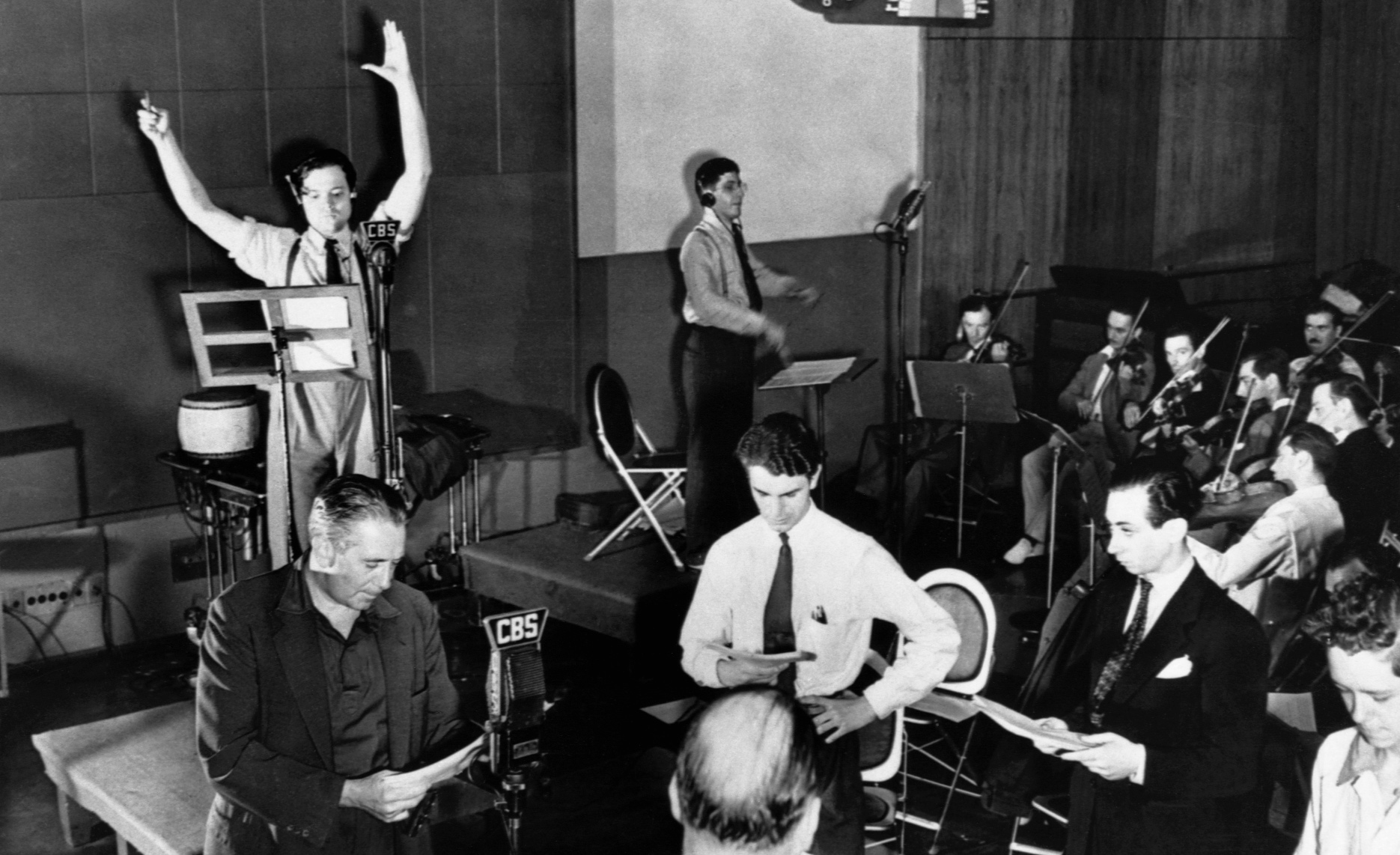
1938: Orson Welles broadcasts The War of the Worlds
On Sunday, October 30, 1938, the Mercury Theatre on the Air presented a radio adaptation of H. G. Wells’s science-fiction novel The War of the Worlds. Orson Welles directed and narrated the production. Its most distinctive device was the imitation of live news bulletins describing an imaginary invasion by Martians. For listeners who joined after the introduction, the interruptions and urgent reports could sound unsettlingly realistic. The setting was relocated from the novel’s English landscape to the United States, including an invented crisis in New Jersey. The programme belonged to a recognised drama series, and the broadcast contained statements identifying it as fiction. Nevertheless, some listeners misunderstood what they were hearing. Newspapers subsequently reported extraordinary scenes of fear, and the story entered popular memory as an episode in which radio had supposedly panicked an entire nation. That familiar version requires caution. The Library of Congress notes that a contemporary audience survey found only a small share of households listening to the show and that many listeners understood its fictional character. There were genuine instances of confusion, but the evidence does not support the sweeping claim that virtually everyone was terrified. Some newspaper coverage helped magnify the legend. The episode remains relevant because it reveals how format affects credibility. An invented story presented in the language of breaking news can exploit an audience’s expectations, especially during a tense international period. Yet historians must also distinguish the audience’s actual response from later sensational retellings. The anniversary is therefore as much about media literacy and the history of journalism as it is about radio entertainment.1947: Twenty-three countries sign the GATT agreement
On October 30, 1947, representatives of 23 countries signed the General Agreement on Tariffs and Trade, or GATT, in Geneva. The World Trade Organization’s historical account confirms both the date and the number of original participants. India was among them, alongside economies from Europe, the Americas, Asia and other regions. World War II had left governments searching for ways to rebuild economies and avoid the destructive trade restrictions associated with earlier decades. GATT combined negotiated reductions in customs duties with rules intended to make international trade more predictable. The first negotiations produced thousands of tariff concessions. The agreement was designed as an interim arrangement while governments considered a broader International Trade Organization. That proposed organization never took shape as intended. GATT instead became the central framework for successive rounds of trade negotiations. Its provisional application began on January 1, 1948. Decades later, the Uruguay Round led to the establishment of the World Trade Organization in 1995. The original agreement thus had a far longer institutional life than many of its architects anticipated. Its legacy is complicated. Supporters credit rules-based trade and lower tariffs with facilitating exchange, investment and economic growth. Critics point to unequal bargaining power, uneven distribution of gains, and continuing disputes over agriculture, industrial policy and development. The agreement did not eliminate protectionism or economic inequality. Its lasting importance lies in establishing a durable forum in which countries could negotiate common rules instead of relying entirely on unilateral measures.1961: The Soviet Union tests the Tsar Bomba
On October 30, 1961, the Soviet Union detonated the most powerful nuclear device ever tested. Known as the Tsar Bomba, the atmospheric explosion took place over the Novaya Zemlya test area in the Arctic. The Arms Control Association’s nuclear-testing chronology records the test on this date and estimates a yield of about 58 megatons; other historical accounts commonly round the figure to approximately 50 megatons. The test occurred amid the Cold War arms race, when the United States and the Soviet Union competed in nuclear weapons development and strategic deterrence. The immense blast demonstrated engineering capacity, but it also dramatized the catastrophic destructive potential of thermonuclear weapons. Its significance was primarily political and symbolic; greater explosive yield did not automatically translate into a practical or strategically useful weapon. Accounts of the test sometimes focus on spectacular descriptions of the fireball and shock wave. The larger historical issue is the human and environmental danger of atmospheric nuclear testing. Radioactive fallout, public-health concerns and the risk of escalation fueled international demands for limits on testing. The Comprehensive Nuclear-Test-Ban Treaty Organization documents the wider nuclear-testing climate around the early 1960s. The 1963 Partial Test Ban Treaty subsequently prohibited nuclear tests in the atmosphere, outer space and underwater for its parties, although underground testing continued. The 1961 explosion should not be celebrated simply as a record-breaking technological achievement. It is also a reminder of why verification, diplomacy and arms-control agreements became urgent international concerns.1974: Muhammad Ali defeats George Foreman in Kinshasa
On October 30, 1974, Muhammad Ali faced the undefeated heavyweight champion George Foreman in Kinshasa, then the capital of Zaire and today the capital of the Democratic Republic of the Congo. The contest became known as the Rumble in the Jungle. Ali was 32 and Foreman 25; many observers expected the younger champion’s punching power to prevail. Ali instead employed a calculated strategy, often leaning against the ropes and defending while Foreman expended energy. The approach became famous as the rope-a-dope, although the contest involved far more than passive endurance. Ali also counterpunched, adjusted his timing and seized his opportunity in the eighth round, when he knocked Foreman out and regained the world heavyweight championship. The Smithsonian National Portrait Gallery records the date, location and decisive finish. The fight carried meanings beyond sport. Ali’s opposition to the Vietnam War had cost him his title and years of competition, and his return resonated with audiences interested in civil rights and political conscience. At the same time, the event was staged under President Mobutu Sese Seko’s authoritarian government, which used international spectacle to promote Zaire’s image. Celebrating Ali’s skill need not obscure that political setting. The bout helped make Ali a global sporting icon and changed perceptions of how an experienced challenger could defeat a physically formidable champion. Foreman’s later career would also be extraordinary, but October 30 remains closely associated with Ali’s tactical intelligence, resilience and ability to turn a heavily anticipated contest into a defining historical moment.What connects these October 30 anniversaries?
History becomes more useful when dates are verified, achievements are placed in context, and the limitations of familiar stories are acknowledged. Readers can explore October 29 in History, October 28 in History, or the Today in History archive for more carefully sourced anniversaries. Image note: The featured photograph shows a typical Mercury Theatre rehearsal in 1938, not the October 30 broadcast itself. Source: Acme Telephoto via Wikimedia Commons; listed as public domain in the United States.Also read:
➤ Ban Dangerous Rockets and Deafening Firecracker Bombs Across Maharashtra: Adv. Mahesh Dhannawat
➤ Western Disturbance North India Rain, Snowfall: What to Expect
➤ November 9 in History: Berlin Wall Falls, 1938 Pogrom and 1965 Blackout
जालना, महाराष्ट्र और देश-दुनिया की ताज़ा खबरें
सीधे अपनी Facebook फ़ीड में पाएँ — News Nation Online पेज को Follow करें।
👍 Facebook पर Follow करेंसीधे अपनी Facebook फ़ीड में पाएँ — News Nation Online पेज को Follow करें।
Discover more from NewsNation Online
Subscribe to get the latest posts sent to your email.
Never miss a storyFollow News Nation Online on WhatsApp for breaking news from India and the world.
आपके लिए सुझाव


