
October 29 in history connects political transformation, financial panic, the origins of computer networking and a remarkable return to space. On this date in 1923, the Republic of Turkey was proclaimed. Six years later, Wall Street endured the trading turmoil remembered as Black Tuesday. In 1956, an attack on Egypt began a new phase of the Suez Crisis. In 1969, two American computers exchanged the first host-to-host message on ARPANET. In 1998, astronaut John Glenn returned to orbit at age 77.
1923: Turkey formally becomes a republic
On October 29, 1923, Turkey’s Grand National Assembly proclaimed the republic and elected Mustafa Kemal, later known as Atatürk, as its first president. It did not create the new state out of nothing in a single evening. The assembly had been established in Ankara in 1920, the Ottoman sultanate had been abolished in November 1922, and Ankara had been designated the capital earlier in October 1923.
İsmet İnönü formed the first republican cabinet on October 30. Supporters viewed the change as an affirmation of national sovereignty and a break with dynastic government. It also laid the institutional groundwork for major reforms to law, education and public life.
A balanced reading also recognizes that state-building was contentious. The transition was not experienced identically by every community, and debates about centralization, religion, minority rights and political participation continued. Turkey’s Ministry of Culture and Tourism provides an official chronology confirming the proclamation and presidential election.
1929: Black Tuesday deepens the Wall Street crash
On October 29, 1929, the New York Stock Exchange witnessed extraordinary selling pressure. The date became known as Black Tuesday. The Dow Jones Industrial Average fell nearly 12 percent that day, according to Federal Reserve History. The previous day, Black Monday, had already produced a fall of nearly 13 percent. This was not a market that had been healthy until one unexpected Tuesday: share prices had been retreating from their September highs amid growing anxiety over speculative valuations.
During the 1920s, stock ownership expanded and investors increasingly borrowed money to purchase shares. Borrowing magnified gains when prices rose but exposed investors to forced selling when prices fell. The crash damaged wealth and confidence, and it placed pressure on banks and businesses. Yet historians and economists caution against treating the stock-market collapse as the sole cause of the Great Depression. Banking failures, monetary contraction, falling demand and international economic strains all contributed to the depth and duration of the downturn.
Black Tuesday is therefore a warning about leverage, financial fragility and the limits of market optimism, not a claim that every major price decline must become a depression. For the preceding week’s market turmoil, readers can also see our October 24 history feature on Black Thursday. The Federal Reserve’s historical account separates the dramatic trading days from the broader economic crisis.
1956: The Suez Crisis turns into war
October 29, 1956, also marks the beginning of Israel’s military advance into Egypt’s Sinai Peninsula during the Suez Crisis. The conflict followed Egyptian President Gamal Abdel Nasser’s nationalization of the Suez Canal Company in July. Britain and France, long associated with the canal’s operation and strategic importance, opposed the move. Secret discussions among British, French and Israeli representatives produced a coordinated military plan, documented in United States diplomatic records.
The Israeli attack was followed by an Anglo-French ultimatum and military intervention. The episode cannot be reduced to a single country’s stated security rationale: control of the canal, colonial influence, regional tensions and the competing calculations of several governments all mattered. Egypt saw the intervention as an attack on its sovereignty. International pressure, including opposition from the United States and the Soviet Union, eventually helped bring the operation to an end.
Suez exposed the declining ability of former European imperial powers to act without wider international consequences. It also demonstrated how a local military operation could quickly become a global diplomatic crisis. The U.S. State Department’s published historical documents describe the secret planning and the proposed October 29 attack, providing evidence beyond later political recollections.
1969: ARPANET sends its first host-to-host message
On the evening of October 29, 1969, student programmer Charley Kline at the University of California, Los Angeles, attempted to log in to a computer at Stanford Research Institute in Menlo Park. Bill Duvall was at the receiving end. The planned word was “login,” but the receiving computer crashed after the first two letters, “lo,” had arrived. The connection was restored, and the full login succeeded later that evening.
This was a landmark for ARPANET, a research network funded by the U.S. Advanced Research Projects Agency. It was not the instant invention of today’s internet, which developed through later networking protocols, additional institutions and decades of engineering. Still, the first exchange demonstrated that computers at separate locations could communicate across a packet-switched network. UCLA preserves the original network log and an account by Professor Leonard Kleinrock.
The story is memorable partly because the first attempt failed. In engineering, a successful experiment may include an error that reveals what needs to be fixed. ARPANET later expanded beyond its first sites, while email and common internet protocols transformed networked computing. For another perspective on the history of technology, see our October 23 feature, including the first iPod.
1998: John Glenn returns to orbit at 77
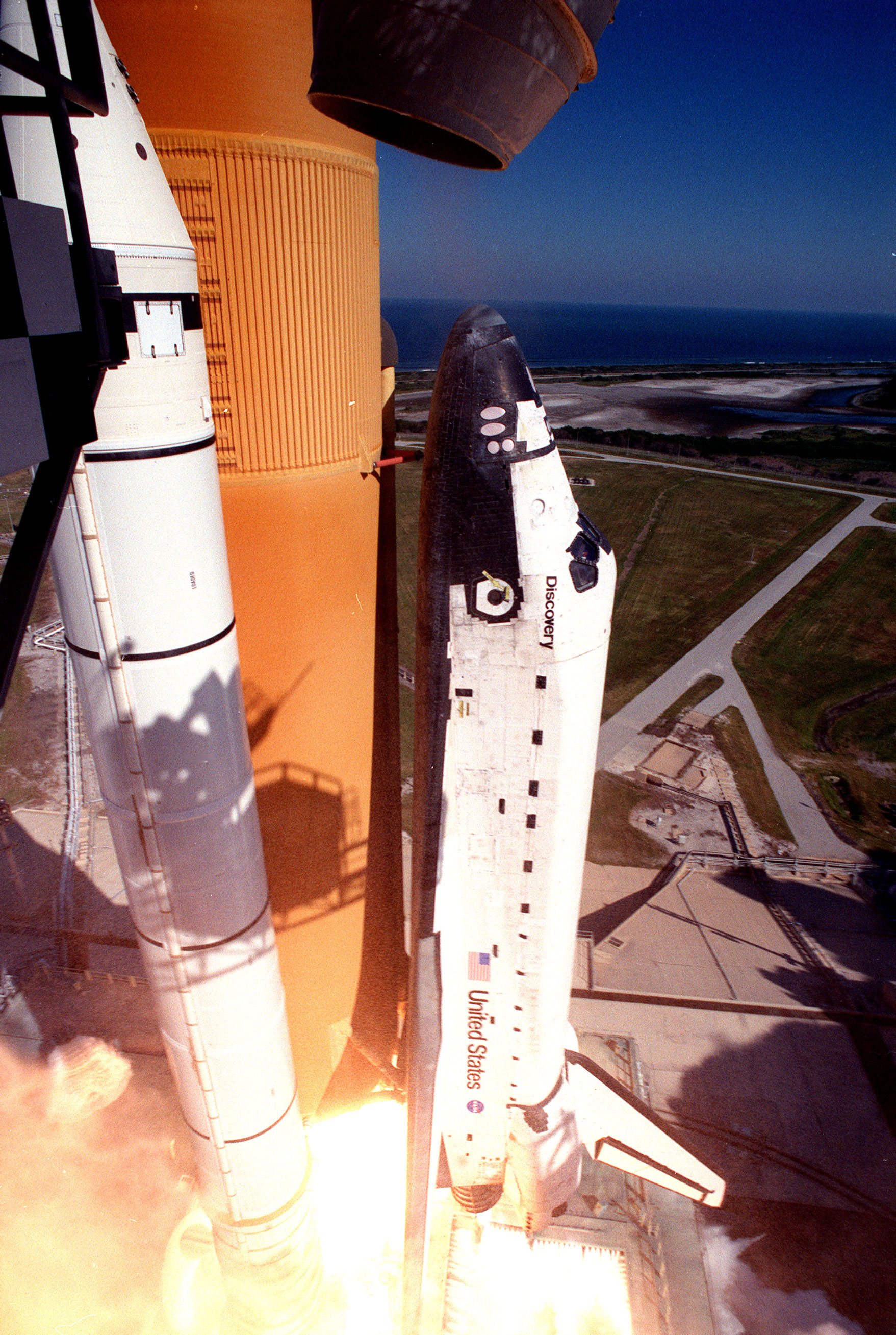
On October 29, 1998, NASA’s space shuttle Discovery launched on mission STS-95 with John Glenn aboard. Glenn had become the first American to orbit Earth in February 1962. His return, more than 36 years later, attracted worldwide attention because he was 77 and, at that time, the oldest person to fly in space.
The mission was not merely a commemorative flight. NASA conducted research on how weightlessness affects the human body, including balance, immune response, bone and muscle health, metabolism and sleep. The nine-day mission also carried scientific payloads involving solar observation and spacecraft systems. Studying an older participant did not mean that a single flight could settle the biology of aging, but it offered an unusual research opportunity.
Glenn’s career connected the early American space race to a more mature era of international science aboard reusable spacecraft. NASA’s mission record confirms the October 29 launch and November 7 landing. Readers interested in other space milestones can explore our October 15 history article on science and aviation.
Why October 29 matters today
These events resist a simple story of uninterrupted progress. A republic can expand national self-government while raising difficult questions about inclusion. Financial markets can channel investment while exposing people to dangerous speculation. International disputes can escalate into war, and technological breakthroughs can begin with a crashed computer. Space exploration can inspire while demanding careful scientific evaluation.
The strongest way to commemorate October 29 is to check original records, distinguish immediate events from later consequences and acknowledge more than one perspective. The anniversary is a useful invitation to understand how institutions, risks and discoveries changed the world.
Sources and further reading
- Republic of Turkey, Ministry of Culture and Tourism: 1923 chronology.
- Federal Reserve History: Stock Market Crash of 1929.
- U.S. Department of State: Documents on the Suez Crisis.
- UCLA: The first ARPANET message and original log.
- NASA: STS-95 mission facts.
Discover more from NewsNation Online
Subscribe to get the latest posts sent to your email.
आपके लिए सुझाव










Leave a Reply