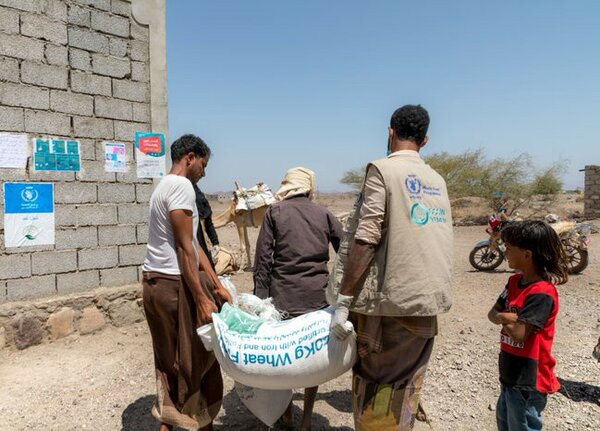
Yemen’s hunger crisis is worsening rapidly as renewed fighting forces families from their homes, disrupts markets and cuts humanitarian access, with the World Food Programme warning that food insecurity has reached alarming new levels in areas it can monitor.
The United Nations agency said on October 2 that 18.3 million people across Yemen face acute food insecurity and 2.2 million children under five are acutely malnourished. Recent WFP monitoring in accessible areas controlled by Yemen’s internationally recognized government found 74% of households unable to meet their basic food needs — the highest level recorded there this year.
More than 149,000 people displaced by renewed fighting
Renewed conflict has displaced more than 149,000 people, according to figures cited by WFP from the International Organization for Migration. Many had already experienced displacement during Yemen’s long conflict, meaning families are being uprooted again with fewer resources and weaker coping mechanisms.
Food is among the most urgent needs for newly displaced families. WFP says it has already assisted more than 70,000 people in two major displacement hotspots in Ta’iz and Lahj and is preparing to expand its emergency response to as many as 1.5 million people if the fighting triggers further displacement.
Three in four households struggling to meet food needs
The deterioration has happened quickly. WFP Assistant Executive Director Matthew Hollingworth told reporters that a record number of people in government-controlled areas accessible to the agency can no longer meet their food needs. Reuters reported that roughly three out of four households are skipping meals.
Government-held areas have an estimated population of around 10 million. The finding does not therefore describe every household across Yemen, particularly areas where humanitarian operations are restricted or suspended, but it provides a stark indication of conditions where WFP can conduct current monitoring.
2.2 million young children face acute malnutrition
The crisis is particularly dangerous for children. WFP says 2.2 million children under five are acutely malnourished, including around 500,000 suffering from severe acute malnutrition, its most life-threatening form.
Malnutrition is not simply a shortage of calories. Children deprived of adequate nutrition become more vulnerable to disease, and illness can in turn make it harder for their bodies to absorb nutrients. Prolonged malnutrition can affect physical growth and cognitive development even after an immediate emergency has passed.
Food prices are rising as supply routes are disrupted
Conflict is hitting households through both displacement and prices. WFP said wheat flour prices have increased by 10% in only two weeks in parts of Ta’iz, while traders estimate local wheat stocks could cover only about two months of demand. Disruptions to vegetable-oil supplies are adding further pressure.
This is especially serious because Yemen imports around 90% of its food. The country is therefore highly exposed to interruptions affecting ports, roads, shipping lanes and commercial supply chains. Even families that are not directly displaced can face worsening hunger if staple foods become unavailable or unaffordable.
Why Bab al-Mandab matters to Yemen’s food supply
Yemen sits beside the Bab al-Mandab Strait, one of the world’s most important maritime chokepoints connecting the Red Sea with the Gulf of Aden. Instability around the west coast and the strait can affect both humanitarian deliveries and commercial trade.
WFP warned that further disruption around the corridor could drive food prices higher not only inside Yemen but across parts of the wider region. The humanitarian consequences are therefore closely connected to the security of ports and shipping routes.
Humanitarian access is shrinking
WFP says conflict has cut access to parts of Ta’iz and Hodeidah, preventing the agency and its partners from reaching approximately 350,000 people. Insecurity, disrupted transport routes and rising delivery costs are making it more difficult to move food into frontline areas.
Some displaced communities cannot use cash assistance because functioning markets are limited or inaccessible. In those locations, physical food distributions become essential — but they also depend on warehouses, roads, trucks and humanitarian personnel being able to operate safely.
WFP faces a major funding gap
The agency says it needs $109 million to provide emergency food and nutrition assistance for up to 1.5 million people affected by the latest escalation. It needs another $158 million to sustain regular food, cash, nutrition and school-meal operations for 2.4 million people through March 2027.
WFP has already reallocated resources that had been intended for November food distributions. Without new funding, it warns that vulnerable people could begin experiencing additional assistance gaps within weeks.
Aid operations face additional constraints
WFP says 73 United Nations personnel remain detained by Houthi de facto authorities, including 38 WFP employees. The agency has joined calls by the UN Secretary-General for their immediate and unconditional release.
WFP activities in areas under Houthi de facto authorities are currently suspended in line with a wider pause in UN operations there. This makes nationwide assessments and assistance more difficult and is one reason current monitoring figures must be interpreted according to where humanitarian organizations have access.
The conflict has intensified again
Reuters reported that Yemen is experiencing its most serious escalation between Saudi Arabia and the Iran-aligned Houthi movement since a UN-brokered truce largely halted cross-border attacks in 2022. Fighting has intensified in several areas, including Ta’iz.
The parties dispute responsibility for some attacks and incidents. For humanitarian agencies, however, the immediate concern is the impact on civilians: displacement, market disruption, blocked roads and reduced access to food and essential services.
The crisis is already crossing Yemen’s borders
Thousands of people have crossed the Bab al-Mandab Strait to Djibouti seeking safety. WFP said more than 3,700 people had arrived there by late September, adding pressure to already stretched humanitarian services and reception facilities.
WFP and its partners are supporting Djiboutian authorities as they respond to the arrivals. A prolonged escalation could increase displacement both within Yemen and across nearby borders.
Why Yemen remains exceptionally vulnerable
More than a decade of conflict has weakened Yemen’s economy, public services and household finances. WFP estimates that 5.2 million people are internally displaced nationwide. Climate shocks, disease outbreaks and economic deterioration have compounded the effects of conflict.
For millions of families, there is little financial buffer left when food or fuel prices rise. A household that has already sold assets, accumulated debt or reduced the number of meals it eats has fewer options when another shock arrives.
What happens next will depend on access, trade and funding
Three variables will be critical in the coming weeks. The first is whether fighting continues to expand and produces another wave of displacement. The second is whether commercial and humanitarian supply routes remain open. The third is whether WFP and other agencies receive enough funding to maintain existing assistance while responding to newly displaced families.
None of those factors can be viewed in isolation. A functioning port does little for a family that cannot afford rising food prices; humanitarian funding cannot reach people if roads are inaccessible; and food assistance becomes harder to sustain when insecurity forces agencies to suspend operations.
A humanitarian emergency inside a wider regional crisis
The renewed fighting has strategic implications for the Red Sea, but the most immediate effect is being felt by Yemeni families. WFP’s October 2 data show a population entering another dangerous phase of a crisis that has already lasted more than a decade.
With 18.3 million people facing acute food insecurity, 2.2 million young children acutely malnourished and more families being displaced, the scale of the humanitarian challenge is growing at the same time that aid resources and access are under severe pressure.
Sources and image credit
This report is based on the World Food Programme’s October 2, 2026 Yemen emergency update and Reuters reporting published the same day. Featured image shows a WFP food distribution in Yemen and is credited to the World Food Programme.
आपके लिए सुझाव
