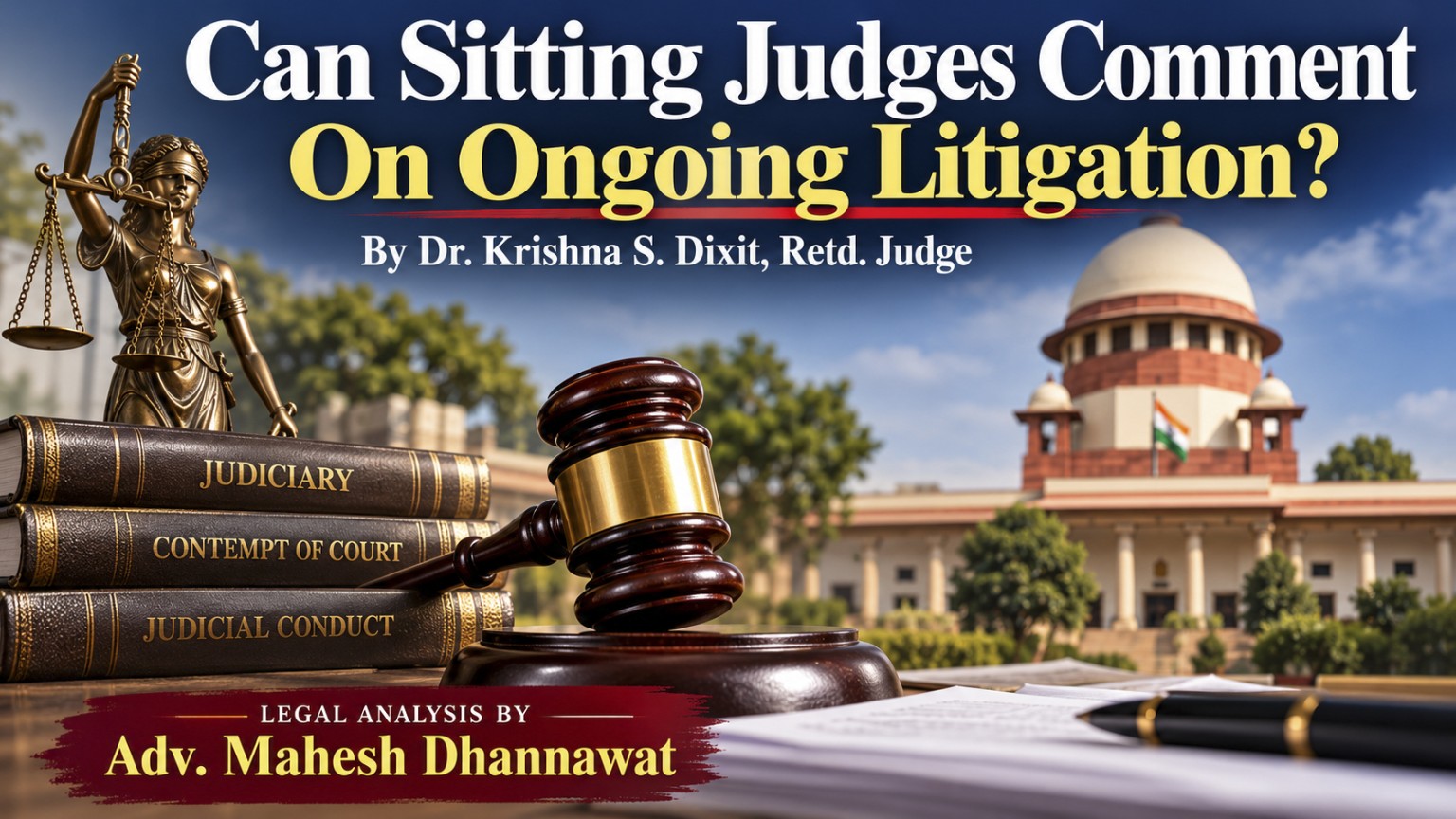
New Delhi | Legal Analysis: Can a sitting judge publicly comment on a controversy already before the courts? The question has returned to the centre of debate following remarks attributed to Supreme Court Justice Ujjal Bhuyan at a NALSAR University event in Hyderabad concerning the Special Intensive Revision (SIR) litigation.
In an opinion column published by Verdictum on 7 October 2026, former High Court judge Dr. Krishna S. Dixit argues that judges should avoid public observations capable of influencing pending proceedings, the parties or public confidence in the eventual judgment. His criticism is an author’s opinion, not a judicial finding of misconduct against Justice Bhuyan.
What is the controversy?
The SIR dispute concerns electoral-roll revision and allegations about the potential exclusion of eligible voters. Dr. Dixit argues that a sitting judge commenting on a matter before another Supreme Court bench can create an appearance of prejudgment. The merits of the SIR process, including the rights of affected voters, remain separate legal questions that must be determined on evidence and law.
Judicial conduct rules in India
The Supreme Court’s Restatement of Values of Judicial Life, adopted at its full court meeting on 7 May 1997, says in paragraph (h) that a judge should not enter public debate or express views publicly on political matters or matters pending or likely to arise for judicial determination. Paragraph 2.4 of the Bangalore Principles of Judicial Conduct (2002) similarly warns judges against comments reasonably expected to affect an outcome or undermine the manifest fairness of proceedings.
Dr. Dixit also cites In Re: P.C. Sen (1969), where comments by a sitting West Bengal Chief Minister on an ongoing proceeding were treated as contempt. That case concerns a political officeholder rather than a judge, so its application to judicial speech requires careful distinction.
Precedents from around the world
The column discusses historical contempt decisions from Britain, including Roach v. Garvan (1742), King v. Clemen (1821) and the Privy Council decision in Independent Publishing Co. Ltd. v. Attorney-General of Trinidad and Tobago (2004). It also refers to the United States’ Toledo Newspaper Co. v. United States (1918), Australia’s Packer v. Peacock (1912), Canada’s R. v. Bryan (1954), and Singapore’s Attorney General v. Pang Cheng Lian (1974).
On judicial conduct specifically, the author invokes California’s Broadman v. Commission on Judicial Performance, Mississippi’s judicial discipline proceedings involving Judge Carlos E. Moore, and Maine’s In the Matter of Benoit. The column additionally discusses The Queen v. Gray (1900) and Australian judicial remarks associated with R. v. Martinez (2023). These cases arise under different legal systems and should not be assumed to establish identical sanctions under Indian law.
Judicial independence also protects fair public discussion
The issue is not whether judges lose all freedom of expression. Academic discussion of law, constitutional education and institutional transparency remain important. The key distinction is between general legal commentary and statements reasonably perceived as prejudging a live controversy. Nor does every public criticism of a pending case automatically amount to contempt.
Adv. Mahesh Dhannawat’s legal perspective
Adv. Mahesh Dhannawat, B.Com., LL.M., Jalna, emphasises that the judiciary’s authority rests on both actual impartiality and the public perception of impartiality. Judicial restraint should apply consistently, while allegations of misconduct must be examined through established constitutional procedures rather than media verdicts. He also stresses that judicial accountability and judicial independence are complementary principles, and that voters’ constitutional rights in the SIR dispute must be decided fairly on their own merits.
Why it matters
The debate highlights a difficult balance: judges are public constitutional figures, yet litigants are entitled to a fair hearing free from an appearance of external influence. Transparent standards, proportionate accountability and restraint in discussing live cases help preserve confidence in the courts.
Source: Dr. Krishna S. Dixit, “Can Sitting Judges Comment On Ongoing Litigation?”, Verdictum, 7 October 2026. This report summarises and contextualises the author’s arguments; the original column represents his views. Read the original column.
सीधे अपनी Facebook फ़ीड में पाएँ — News Nation Online पेज को Follow करें।
Discover more from NewsNation Online
Subscribe to get the latest posts sent to your email.
आपके लिए सुझाव