


Jalna | Legal News: A medical disability certificate cannot, by itself, determine the true economic consequences of a road accident. The Supreme Court has reiterated that compensation must reflect the actual impact of an injury on a person’s occupation, future earning capacity and ability to live with dignity.
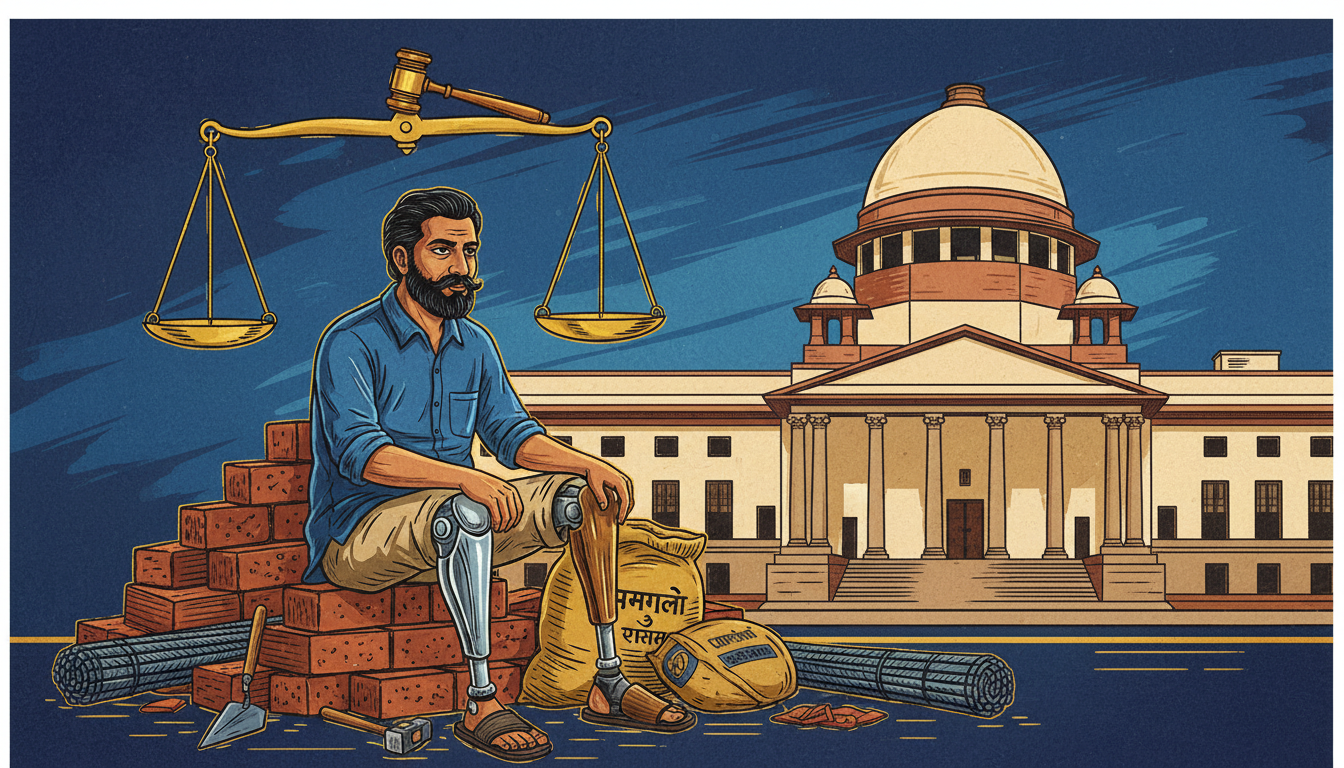
In M. Paramesh v. VRL Logistics Ltd., a mason from Tamil Nadu lost his right leg above the knee. His certified physical disability was 70%, but the nature of masonry work meant that the injury effectively deprived him of his occupation. Justices Prashant Kumar Mishra and N.V. Anjaria assessed his functional disability at 100% and increased compensation from approximately ₹23.86 lakh to ₹40,29,730. The Motor Accident Claims Tribunal had originally awarded ₹10,84,330.
A companion ruling concerning carpenter Shankar Dutt reinforced the same occupational approach. Carpentry requires squatting, balancing and working in demanding physical positions. After an above-knee amputation, the Court assessed his functional disability at 100% and enhanced compensation from approximately ₹11.51 lakh to ₹35,95,923.
Physical disability measures bodily impairment; functional disability concerns the effect of that impairment on earning capacity. These are not automatically identical. Nor does a 70% medical certificate automatically entitle every claimant to a 100% functional-disability assessment. Courts must evaluate the claimant’s actual trade, medical evidence, work history, remaining capabilities and realistic employment opportunities.
Fair compensation may also require consideration of future income loss, future prospects where applicable, prosthetic limbs and their maintenance or replacement, medical expenses, attendant care, pain and suffering, and loss of amenities, subject to the evidence and applicable law.
Proposed legal comment by Adv. Mahesh Dhannawat: ‘A mason or carpenter who loses a leg loses far more than a percentage of physical ability. The accident may extinguish the livelihood on which an entire family depends. Courts should examine what work the victim can realistically perform after the accident, not merely reproduce a number from a medical certificate. Injured workers should preserve evidence of their occupation, earnings, treatment and future rehabilitation needs.’
For construction workers, agricultural labourers, drivers and other physically demanding occupations in Maharashtra, these decisions illustrate why occupational evidence is crucial in Motor Accident Claims Tribunal proceedings. The precise compensation in every case remains fact-specific.
Sources: LiveLaw analysis, 20 July 2026; Supreme Court: M. Paramesh v. VRL Logistics Ltd. (2026 INSC 655); Shankar Dutt v. United India Insurance Co. Ltd. (2026 INSC 656).
Discover more from NewsNation Online
Subscribe to get the latest posts sent to your email.
आपके लिए सुझाव












Leave a Reply