
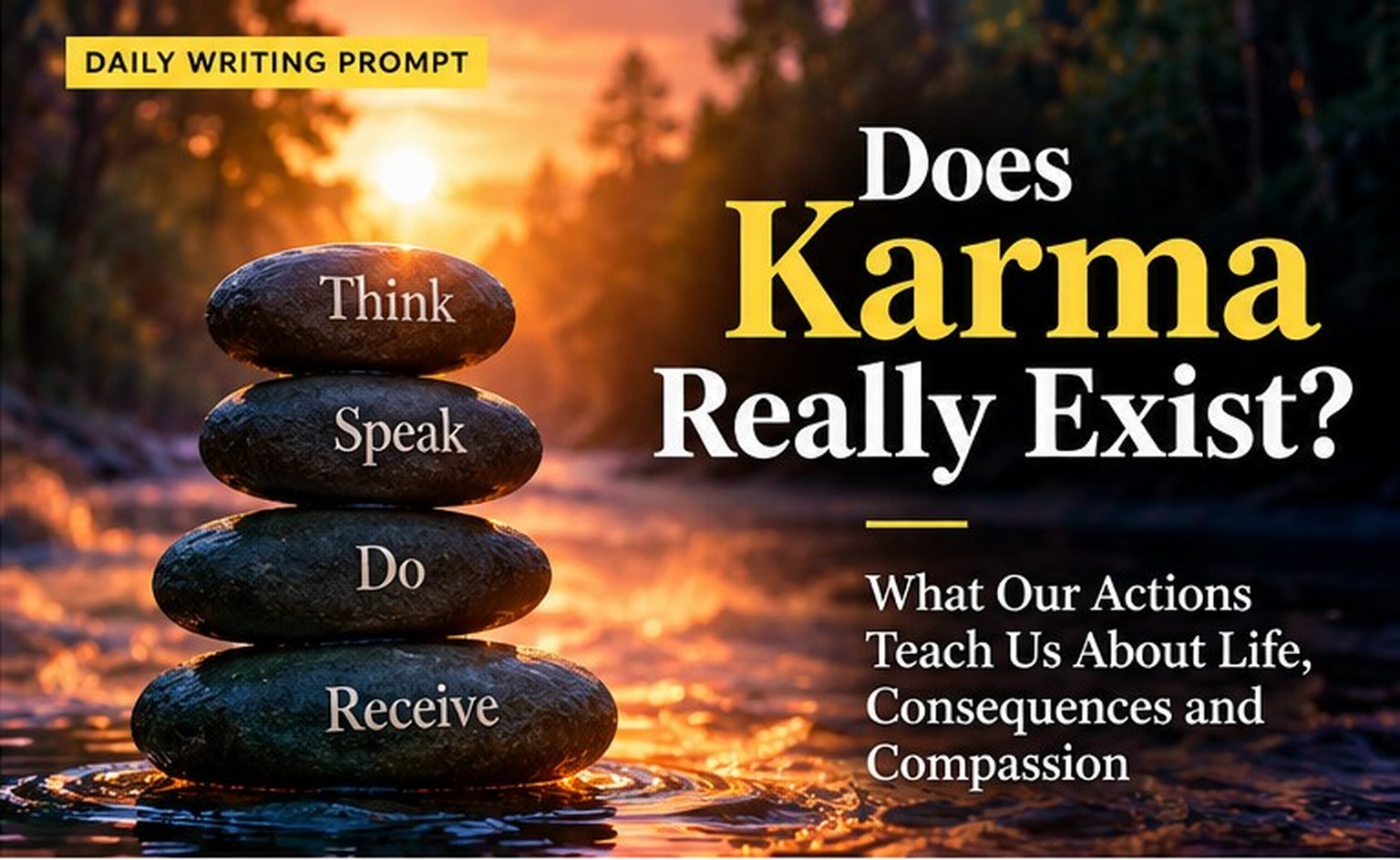
WordPress Daily Writing Prompt: Do you believe in karma?
When someone acts unfairly, we often hear the reassuring phrase that karma will take care of it. But what does that really mean? Is karma a cosmic accounting system, a moral philosophy, or a way of describing the consequences of our choices?
What people mean by karma
In everyday conversation, karma is often shorthand for the idea that good actions will be rewarded and bad actions punished. In several Indian philosophical and religious traditions, however, the concept is more complex and is connected with intention, action and their consequences. Those traditions should not be reduced to a simple promise of instant justice.
Why the idea appeals to us
People want to believe that fairness matters. When the world seems arbitrary, the thought that conduct carries consequences can provide moral reassurance. Yet the appeal of an idea does not, by itself, establish how the universe works.
Actions create real consequences
Even without assuming a supernatural mechanism, choices have effects. Reliability can build trust. Dishonesty can damage relationships. Generosity may strengthen communities. These outcomes are not guaranteed, but our habits influence the environments we help create.
Why good people still suffer
One danger of simplistic karma talk is blaming people for illness, poverty or tragedy. Suffering is not proof that someone deserves it. Accidents, injustice, structural barriers and chance all affect human lives. Compassion must come before easy explanations.
The difference between justice and revenge
Believing that actions matter should not encourage us to celebrate another person’s pain. Accountability is important, especially when harm has occurred, but revenge rarely repairs the original injury. A fair response focuses on responsibility, prevention and restoration where possible.
The quiet power of intention
Two people may perform the same outward action for very different reasons. Giving help to attract praise is different from helping because someone needs support. Examining motives can make ethical reflection more honest, even when motives are mixed.
What science can and cannot tell us
Psychology and social research can investigate how cooperation, reputation and behavior influence outcomes. They cannot demonstrate a universal moral force that guarantees reward or punishment. It helps to distinguish observable social consequences from spiritual beliefs.
Living well without demanding a reward
Perhaps the most practical question is not whether every good deed returns to us. It is whether we would still choose kindness if nobody noticed. Integrity becomes meaningful when it is practiced without an invoice attached.
A personal answer
I find value in the principle that actions matter and character is built through repeated choices. I also believe that life is too complicated to treat every misfortune as a verdict. Responsibility and compassion belong together.
The question worth asking
Rather than waiting for the universe to settle every account, we can ask what our next action will contribute. Will it create trust or suspicion, healing or harm? That is a form of moral responsibility available to us today.
For more reflections on memory, growth and the choices that shape us, read If I Could Go Back in Time, This Is What I Would Tell My Younger Self. Share your own experience in the comments.
Can we separate consequences from destiny?
A thoughtful discussion of karma needs room for uncertainty. We can observe that habits affect relationships and that institutions can reward or punish behavior, but life does not distribute outcomes with perfect fairness. People sometimes prosper despite causing harm, while generous people experience terrible losses. That reality should motivate us to improve human systems of accountability rather than assume that unseen forces will always resolve injustice.
Discover more from NewsNation Online
Subscribe to get the latest posts sent to your email.
आपके लिए सुझाव














Leave a Reply