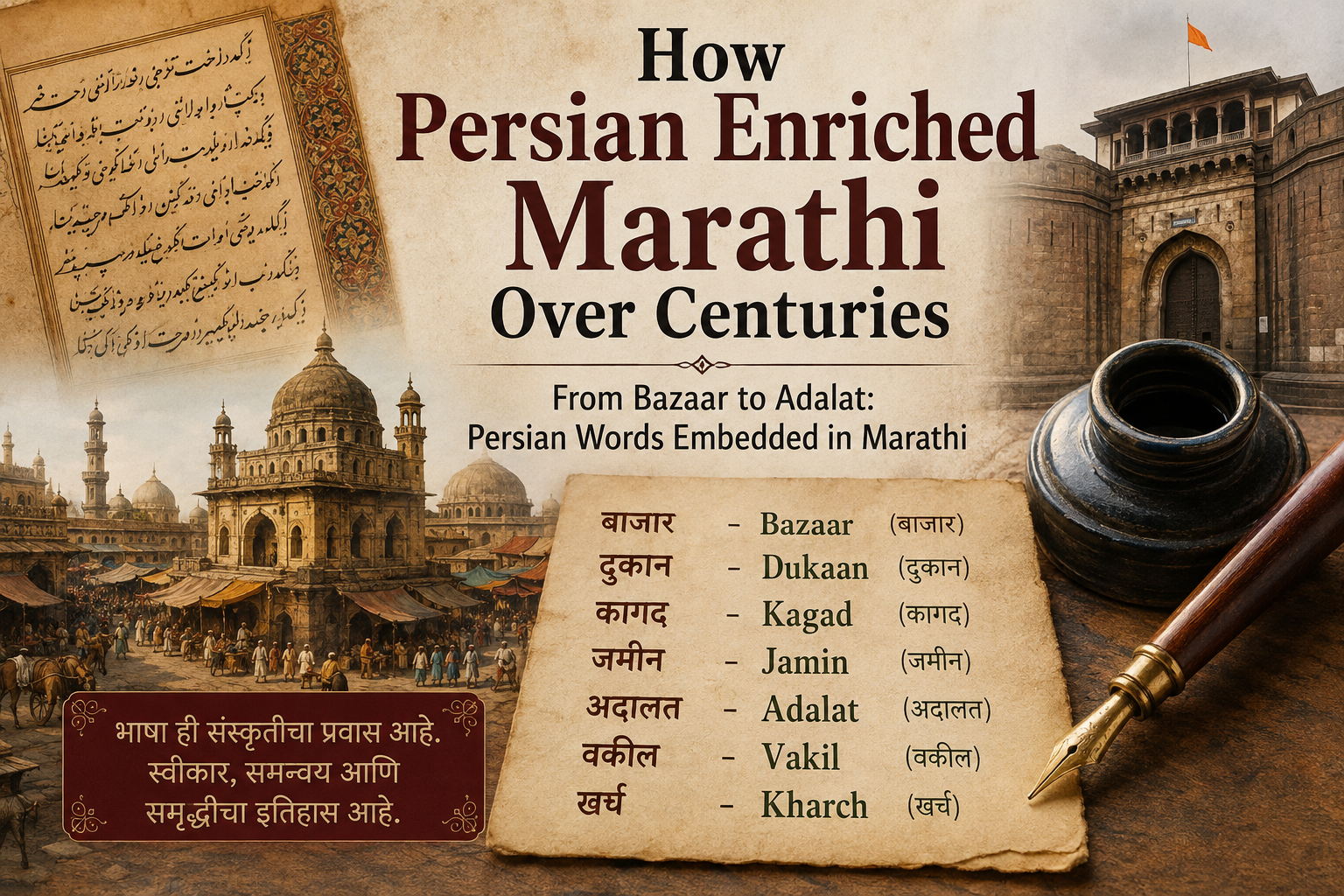
From Bazaar to Adalat: Persian Words Embedded in Marathi
By Ahmed Noor Qureshi
At a time when debates over the use and promotion of Marathi are increasingly visible in Maharashtra, an important linguistic question deserves attention: Is the Marathi spoken and written today a completely “pure” language, or is it the product of centuries of interaction with other languages and cultures?
The answer, linguistically speaking, is clear: no living language is completely pure.
Languages evolve through trade, migration, administration, literature, cultural exchange and everyday interaction. Marathi, one of India’s major regional languages, has similarly developed over centuries by absorbing words and expressions from several languages, including Sanskrit, Persian, Arabic, Urdu, Portuguese and English.
Among these influences, Persian played a particularly important role during the medieval period in the Deccan.
The interaction affected not only Marathi vocabulary but also administration, literature, official terminology, surnames, place names, idioms and everyday speech.
Scholar Maulvi Abdul Haq, in his Urdu work Marathi Zuban Par Farsi Ka Asar (1931), examined the influence of Persian on Marathi vocabulary and culture and documented the extensive linguistic interaction between the two traditions.
Historical Roots of Persian Influence
The roots of Persian influence in Marathi can be traced to the medieval Deccan, particularly during the rule of the Deccan Sultanates, including the Adil Shahi and Nizam Shahi dynasties.
Persian was widely used in administration, courts, scholarship and literary circles. Its influence continued and expanded during the Mughal period.
However, Persian did not spread only through rulers and royal courts. Scholars, poets, Sufis, administrators, traders and migrants also contributed to the exchange.
Marathi continued to be the language of the people. But as Persian became important in administration and official communication, Persian terminology gradually entered Marathi usage.
Government records, revenue documents and legal proceedings often combined Marathi grammatical structures with Persian administrative vocabulary.
This process was not simply imposed from above. Over generations, many of these words became part of ordinary speech.
Early Marathi literature, including the works associated with Sant Dnyaneshwar in the late 13th century, predates the major expansion of Persian influence in the Deccan. The linguistic interaction became more pronounced after the establishment of Muslim rule in the Deccan from the 14th century onward.
Even during the period of Chhatrapati Shivaji Maharaj, Persian-derived terminology continued to appear in administration and official records, despite later efforts to develop more Sanskrit-oriented administrative vocabulary.
Over several centuries, hundreds of Persian and Arabic-derived words became familiar in Marathi.
Persian Words in Everyday Marathi
Some words of Persian origin—or words that entered Marathi through Persian and related Indo-Persian usage—are now so familiar that their foreign origins are rarely noticed.
Examples include:
- Bazaar — market
- Dukaan — shop
- Karkhana — workshop or factory
- Shahar — city
- Kagad — paper
- Jamin — land
- Hazar — thousand
The influence is particularly visible in legal and administrative vocabulary:
- Adalat — court
- Vakil — lawyer
- Diwani — civil administration/case
- Faujdari — criminal administration/case
- Tehsil — revenue subdivision
- Taluka — administrative subdivision
- Inam — grant
- Hukoom — order/command
- Jahir — public/announced
- Arj — application/request
- Saheb — respectful title
- Mehnat — hard work
- Aajar — illness
- Zakat — alms/tax
- Kharch — expense
Several place names and administrative descriptions in Maharashtra also preserve terminology associated with the Persian administrative tradition. Words such as Khurd, meaning smaller or junior, and Budruk, meaning larger or senior, are examples of terminology that became established in place names.
Persian Influence on Administration and Surnames
Persian influence is also visible in the historical titles and surnames associated with Maharashtra’s administrative system.
Examples include:
- Peshwa
- Fadnavis
- Chitnis
- Daftardar
- Havaldar
The title Peshwa is derived from the Persian pēshwā, meaning a leader or one who is foremost.
Similarly, Fadnavis, a prominent administrative title and surname in Maharashtra, is generally traced to the Persian administrative term fard-navis, referring to a record or account writer.
Such terminology illustrates how Persian administrative vocabulary became embedded in institutions that later became an important part of Maharashtra’s political history.
Personal names such as Shahaji and Sarfaraz also demonstrate the broader Persianate cultural influence that existed in the Deccan.
Persian and Arabic Words in Marathi Proverbs
The influence did not remain confined to courts and government offices. Persian- and Arabic-derived vocabulary also entered Marathi proverbs, idioms and everyday expressions.
Consider the saying:
“ज्याला नाही अक्कल, त्याची घरोघरी नक्कल”
Jyala nahi akkal, tyachi gharoghari nakkal
Meaning: A foolish person becomes an object of imitation everywhere.
The words akkal (wisdom/intelligence) and nakkal (imitation) have Arabic/Persian linguistic histories and became widely used in several Indian languages.
Another familiar expression is:
“अशी नियत तशी बरकत”
Ashi niyat tashi barkat
Meaning: As your intention, so shall be your blessing.
Here, niyat (intention) and barkat (blessing/prosperity) are also Persian-Arabic words that have become familiar in Marathi speech.
Such expressions demonstrate that linguistic borrowing was not restricted to educated elites. Borrowed vocabulary entered households, markets, villages, folk culture and ordinary conversation.
The Question of “Pure” Marathi
The history of Persian influence also raises the larger question of linguistic purity.
Attempts have periodically been made to replace Persian- and Arabic-derived words with Sanskrit-based alternatives. Maulvi Abdul Haq discussed such attempts in his work on Persian’s influence on Marathi.
Haq also referred to criticism of linguistic purism in the Marathi press, including Kesari, the newspaper founded by Lokmanya Bal Gangadhar Tilak.
The argument was essentially that words that had already become deeply established in everyday Marathi could not simply be removed without affecting the language’s natural character.
Words such as killa (fort) and fauj (army), for example, had become familiar parts of the linguistic landscape.
Whether every historical claim attributed to individual scholars or newspapers is accepted or not, the broader linguistic principle remains significant: languages normally retain words that communities find useful, regardless of their original source.
A Shared Cultural Legacy
The Marathi-Persian connection is part of the wider cultural history of the Deccan.
For centuries, the region served as a meeting ground for different linguistic and cultural traditions. Marathi, Persian, Dakhni and later Urdu interacted through administration, trade, literature, religion and everyday social contact.
People frequently moved between linguistic worlds, while words travelled from one language to another.
The result was not the replacement of Marathi by Persian. Instead, Marathi retained its grammatical and literary identity while incorporating vocabulary from the languages with which its speakers interacted.
Maulvi Abdul Haq described the relationship between Marathi and Persian as “choli-daman”—a metaphor suggesting an inseparable relationship.
Languages Grow Through Contact
The history of Marathi demonstrates a broader truth about language: linguistic strength does not necessarily come from isolation.
Marathi has survived and flourished precisely because generations of speakers have used it, adapted it and allowed it to evolve.
Persian words that entered Marathi centuries ago are today often perceived simply as Marathi words. Their origins may be forgotten, but their presence remains a living record of Maharashtra’s interconnected history.
Therefore, discussions about promoting Marathi need not necessarily be framed as a choice between Marathi and other languages.
A language can be promoted while acknowledging the cultural and linguistic influences that helped shape it.
The Marathi spoken today is not a museum artifact frozen in one historical period. It is a living language—one that has absorbed, adapted and evolved through centuries of contact.
Its richness lies not in linguistic isolation, but in its ability to absorb the world around it.
The author is a senior journalist and PTI stringer based in Jalna, Maharashtra.
आपके लिए सुझाव
