
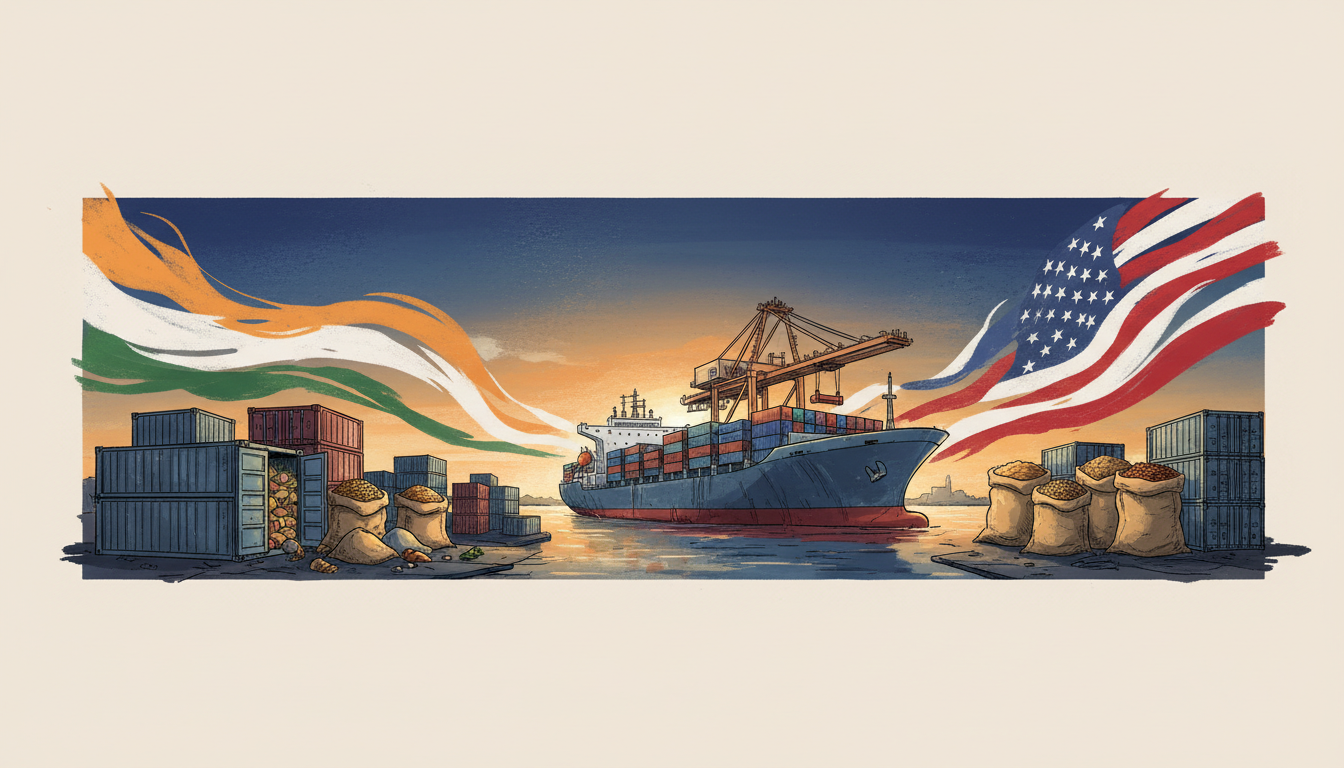
India’s Commerce and Industry Minister Piyush Goyal said on October 29, 2026, that the proposed India-US trade deal would protect the interests of Indian farmers and other stakeholders. His comments came as New Delhi and Washington worked toward completing the next stage of a bilateral trade agreement, with the final terms still awaiting public release.
Speaking at a conference on India’s industrial transformation in New Delhi, Goyal argued that the country could gain a stronger competitive position through trade agreements while safeguarding sensitive domestic interests. The remarks were reported by Reuters and reflected in a statement issued by India’s Press Information Bureau.
What did Piyush Goyal say about the India-US trade deal?
Goyal said he expected the eventual agreement to demonstrate that farmers and other sensitive sectors had not been sacrificed. His broader message emphasized quality, manufacturing scale, global market access and inclusive growth as priorities for Indian industry.
The Press Information Bureau’s October 29 release outlined the minister’s industrial-policy priorities and his argument that comprehensive trade agreements can improve international market access while protecting national interests.
His assurance is a statement of the government’s negotiating position, not proof that every affected group will benefit. The full commercial and agricultural consequences will depend on the final tariff schedules, safeguards and implementation rules.
Why are farmers concerned?
Indian farm organizations have expressed concern that lower barriers for some American agricultural products could intensify competition for domestic producers. Reuters reported objections involving products such as maize, nuts, apples and soybean oil, and said farm groups were demanding greater transparency about the terms.
Trade negotiations often involve competing priorities. Exporters may benefit from lower duties abroad, while producers in sensitive domestic sectors may worry about imports. A meaningful assessment therefore requires more than a broad claim that an agreement is good or bad for agriculture.
The central questions include which products receive lower tariffs, whether import quotas or exclusions apply, how quickly changes are introduced and what protections remain for smaller producers. Until the final documents are available, precise claims about individual farm products should be treated cautiously.
What is the status of negotiations?
India and the United States have discussed a broader bilateral trade framework during 2026, but the remaining negotiating steps and final documentation are crucial. As of October 29, Reuters reported that the next phase was close to completion rather than fully signed and implemented.
The two countries have major trade links in goods and services. For official background, the Office of the United States Trade Representative explains the bilateral trade-policy framework and its work on agriculture, manufacturing, services and intellectual property.
NewsNationOnline previously covered India-US talks involving S. Jaishankar and Marco Rubio. Readers following the broader economy can also see our World Bank commodity-price outlook and our report on US concerns over global industrial subsidies.
What should businesses and consumers watch next?
The next useful milestones are the publication of final negotiating texts, a clear list of tariff and non-tariff commitments, dates of implementation and responses from affected industry and farmer organizations. Exporters should verify any claimed new preference against the actual rules before changing prices or shipment plans.
For now, Goyal’s assurance provides an important indication of India’s stated priorities. It does not settle the debate over the agreement’s detailed impact, which will become clearer only when the final terms can be examined.
Sources: Reuters, October 29, 2026; India’s Press Information Bureau, October 29, 2026. Featured image is an editorial illustration, not a documentary photograph.
Discover more from NewsNation Online
Subscribe to get the latest posts sent to your email.
आपके लिए सुझाव












Leave a Reply