

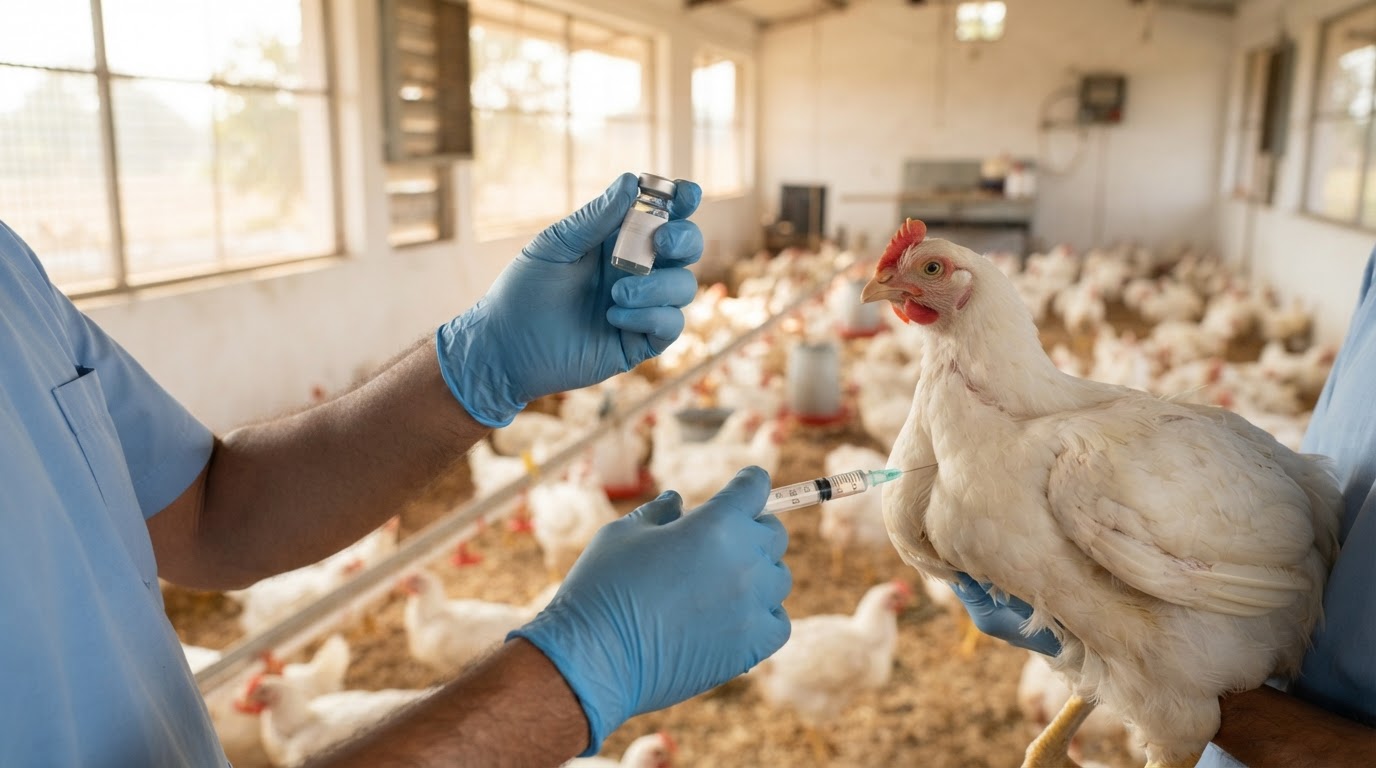
BHOPAL — India has dedicated to the nation its first indigenous vaccine to protect chickens against H5N1 avian influenza, the strain of bird flu behind most poultry outbreaks in the country. Union Minister for Agriculture and Farmers’ Welfare and Rural Development Shivraj Singh Chouhan released the H5N1 bird flu vaccine on Friday, 20 November, at the ICAR-National Institute of High Security Animal Diseases (ICAR-NIHSAD) in Bhopal, according to an official statement issued by the Press Information Bureau (PIB).
The Ministry said the vaccine will cost only ₹1-2 per dose, so that even small poultry farmers can afford to vaccinate their birds. The minister also announced a new ₹300-crore state-of-the-art animal disease laboratory for Bhopal.

At a glance
- What: India’s first indigenous inactivated vaccine against H5N1 (Clade 2.3.2.1a) highly pathogenic avian influenza in chickens
- Developed by: ICAR-NIHSAD, Bhopal
- Released on: 20 November 2026, in Bhopal
- Price: ₹1-2 per dose, as stated by the Ministry
- Also announced: A ₹300-crore animal disease research laboratory in Bhopal
- Why it matters: India has recorded more than 500 bird flu outbreaks since 2006
What is the new H5N1 bird flu vaccine?
The vaccine is an inactivated (killed-virus) shot made for chickens. It targets the H5N1 virus of Clade 2.3.2.1a, which official studies cited by the Ministry identify as the variant responsible for most bird flu outbreaks in Indian poultry. In a curtain-raiser statement on 18 November, the Ministry said no specific commercial vaccine had so far been available against this clade, which is why an indigenous product was needed. The government described the shot as the world’s first vaccine against this particular variant.
The research team named by the Ministry included Dr. S. Nagarajan, Dr. Manoj Kumar, Dr. C. Tosh, Dr. H. V. Murugkar, Dr. Aniket Sanyal, Dr. Senthil Kumar D., Dr. Naveen Kumar and Dr. Yogisharadhya R. According to the statement, the scientists worked for months, including weekends, under strict biosafety rules, such as mandatory sanitisation on entering and leaving the high-security laboratory and not keeping pets at home during the research.
Why bird flu is a big worry for poultry farmers
Highly pathogenic avian influenza can kill nearly all infected birds in a flock. Farmers also lose income when birds near an outbreak are culled and when trade in poultry is restricted. The Ministry recalled that India’s first outbreak, in 2006 at Navapur in Maharashtra, killed about 10 lakh chickens, and lakhs more had to be culled. About 9 lakh chickens died in 2021 and another 2 lakh this year, it said.
Official figures released earlier put the losses from the 2006 outbreak at ₹2,200-3,000 crore. The Ministry has warned that a major outbreak could cut India’s GDP growth by up to 1.5 per cent and put more than 20 per cent of the country’s poultry at risk if left unchecked. The virus can also infect mammals and, rarely, humans, which makes control at the farm level important for public health.
₹56,000 crore lost every year to animal diseases
Speaking at the event, the minister said animal husbandry contributes about 14 per cent of India’s GDP and poultry about 1 per cent more. He put the yearly losses from four major livestock diseases at roughly ₹56,000 crore:
- Foot and Mouth Disease: about ₹22,000 crore
- Lumpy Skin Disease: about ₹20,000 crore
- Brucellosis: about ₹9,212 crore
- Peste des Petits Ruminants (sheep and goats): about ₹4,683 crore
According to the statement, more than 147 crore free doses against Foot and Mouth Disease have been given under the National Animal Disease Control Programme. ICAR-NIHSAD has earlier developed indigenous vaccines for Gumboro disease, Brucella abortus S-19 Delta, Classical Swine Fever and African Swine Fever.
What it means for farmers in Maharashtra and Marathwada
Maharashtra has a large layer and broiler poultry sector, and many small farmers in Marathwada keep backyard birds as a second source of income, especially in drought years. A low-cost vaccine against the locally circulating strain could reduce the risk of mass deaths and culling. Details on when and how the vaccine will reach state animal husbandry departments and private farms have not yet been announced; farmers should watch for advisories from their district animal husbandry office.
Also read:
- Maharashtra Declares 6 More Talukas Drought-Hit, Total Rises to 310
- Who Is Eligible for ₹5,000 Drought Relief and When Will It Be Credited?
Frequently Asked Questions (FAQ)
Who developed India’s first H5N1 bird flu vaccine?
It was developed by scientists at the ICAR-National Institute of High Security Animal Diseases (ICAR-NIHSAD), Bhopal, which works under the Indian Council of Agricultural Research.
How much will the vaccine cost?
The Ministry of Agriculture says it is priced at ₹1-2 per dose to keep it affordable for small poultry farmers.
Is this vaccine for humans?
No. It is meant for chickens. Protecting poultry, however, lowers the chance of the virus spreading to other animals and people.
Which bird flu strain does it target?
It targets H5N1 of Clade 2.3.2.1a, the variant behind most outbreaks in Indian chickens, according to the government.
When will farmers be able to get it?
The government has not yet announced a rollout schedule. Farmers should contact their district animal husbandry office for updates.
Where was India’s first bird flu outbreak?
At Navapur in Maharashtra’s Nandurbar district in 2006. Since then India has seen more than 500 outbreaks.
Source: Press Information Bureau, Ministry of Agriculture and Farmers’ Welfare. More farm news: Farmers.
NewsNation Online Desk
सीधे अपनी Facebook फ़ीड में पाएँ — News Nation Online पेज को Follow करें।
Discover more from NewsNation Online
Subscribe to get the latest posts sent to your email.
आपके लिए सुझाव


Leave a Reply