

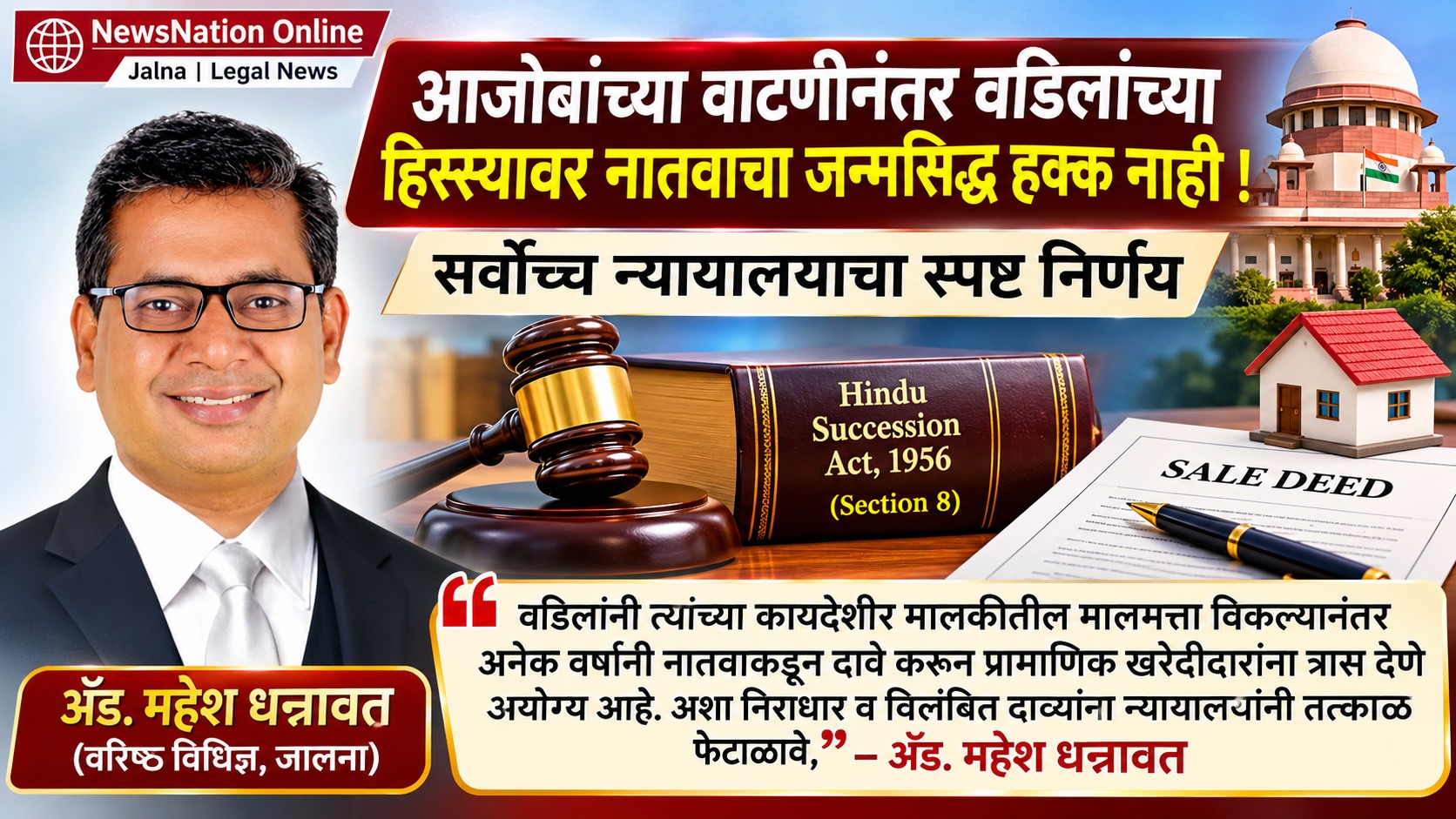
Jalna, November 22, 2026: A grandson does not acquire an automatic right by birth in the share that devolves upon his father under Section 8 of the Hindu Succession Act, 1956, where the grandfather’s estate has devolved upon his Class I heirs and has been partitioned, the Supreme Court has held.
In J. Rajesh (Minor) v. M. Kumaran (Dead) through LRs & Ors., the grandfather’s estate was divided among his Class I heirs through a compromise decree. The father received a specific share and subsequently executed sale deeds in respect of the property. During the father’s lifetime, the grandson sought a share, claiming that the property retained its ancestral character and that he had acquired coparcenary rights by birth.
A Bench of Justices Augustine George Masih and Sunita Agarwal, in its judgment dated November 6, 2026, explained that where a Hindu male dies intestate, his property devolves upon the Class I heirs under Section 8. A son’s son is not a Class I heir while his father is alive. The property inherited by the father under Section 8 is held in his individual capacity and does not become coparcenary property vis-à-vis his own son merely because it originally belonged to the grandfather. The Court dismissed the appeal.
Also read: Dharashiv to Get 1 TMC Water From Ujani Dam to Ease Drinking Water Crisis
Commenting on the ruling, Advocate Mahesh Dhannawat said, “In practice, it is often seen that after a father sells property lawfully owned by him, a son or grandson challenges the sale deed after a long lapse of time. It is not fair to drag a bona fide purchaser into years of litigation merely by raising a claim based only on relationship or birth.”
He added, “Courts should examine at the threshold the claimant’s legal entitlement, the source and nature of the property, the partition documents, the sale deed and the explanation for delay. Where a claim is clearly not maintainable or lacks a legal foundation, it should be rejected at the appropriate stage in accordance with law. Every case must, however, be assessed on its own documents and facts. Genuine purchasers should not be subjected to needless harassment through baseless claims.”
The judgment should not be read to mean that every delayed challenge to a sale deed must automatically fail. The outcome in each dispute will depend on the manner in which the property devolved, the applicable succession law, the nature of the partition, the parties’ rights and the relevant documents.
Case citation: J. Rajesh (Minor) through his Mother and Natural Guardian J. Gomathi v. M. Kumaran (Dead) through LRs & Ors., Civil Appeal No. 7020 of 2012, 2026 INSC 1208, decided 6 November 2026. Read the Supreme Court judgment (PDF).
Further reading: Supreme Court Observer – J. Rajesh v. M. Kumaran | LiveLaw – Case analysis.
सीधे अपनी Facebook फ़ीड में पाएँ — News Nation Online पेज को Follow करें।
Discover more from NewsNation Online
Subscribe to get the latest posts sent to your email.
आपके लिए सुझाव


Leave a Reply