

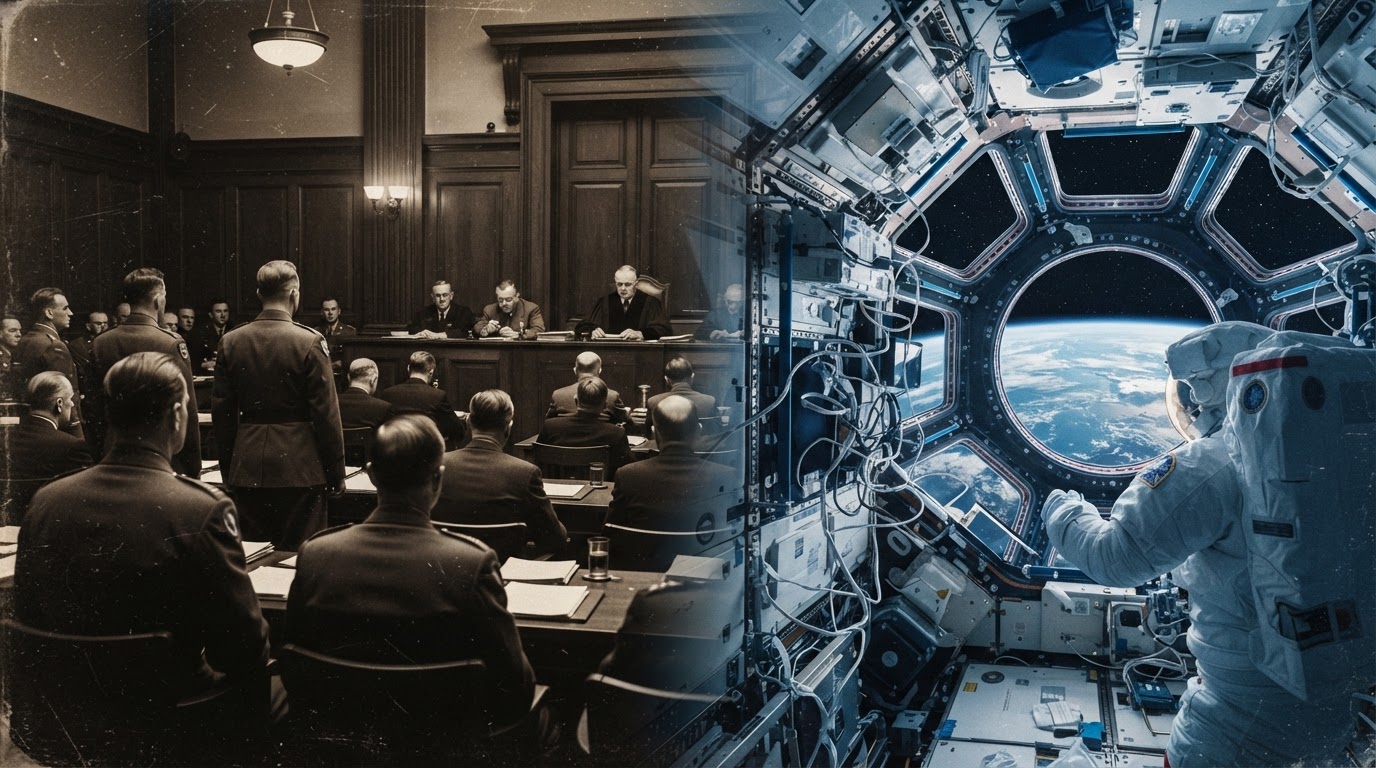
November 20: Three turning points in world history
November 20 connects three major developments: the opening of the Nuremberg trial in 1945, the adoption of the UN Convention on the Rights of the Child in 1989, and the launch of the first International Space Station module in 1998. They concern accountability, human dignity and international cooperation. Each milestone was a beginning, not a completed solution. Understanding the surrounding events helps explain why these anniversaries still matter.
1945: The major Nuremberg trial opens
On November 20, 1945, the International Military Tribunal opened proceedings against leading figures of Nazi Germany in Courtroom 600 at the Palace of Justice in Nuremberg. The Second World War had ended in Europe earlier that year. Allied investigators had assembled extensive records of aggressive war, mass persecution and atrocities. The tribunal was established by the United States, Britain, the Soviet Union and France, whose judges and prosecutors worked within a new international legal framework.
The prosecution included crimes against peace, war crimes and crimes against humanity. The defendants were individuals rather than a country as a whole. This distinction mattered: leaders could be held responsible for decisions and conduct even when those acts had been carried out through the machinery of a state. The proceedings were documented with testimony, captured records and film evidence.
Also read: November 19 in History: Gettysburg Address, Indira Gandhi and Apollo 12
The trial was not the only effort to confront Nazi crimes. Other proceedings followed, and the genocide of European Jews and the persecution of many other groups cannot be reduced to a single courtroom. Historians also examine criticism of the tribunal, including questions about selective prosecution by victorious powers and the legal principle against retroactive punishment. Those debates are part of a balanced account of its legacy.
The major trial concluded in 1946. Its significance extended beyond the sentences: it helped establish the idea that official rank does not automatically shield an individual from responsibility under international law. Later international criminal courts developed under different treaties and circumstances. Nuremberg is a landmark, not a claim that the world has since achieved consistent justice.
1989: The Convention on the Rights of the Child is adopted
On November 20, 1989, the United Nations General Assembly adopted the Convention on the Rights of the Child through resolution 44/25. The treaty entered into force on September 2, 1990. Adoption and entry into force are separate legal events, a distinction often missed in anniversary summaries.
The convention treats children as people who possess rights, not merely as recipients of adult charity. Its provisions address survival, development, education, health, protection from exploitation, family life and participation in decisions affecting children. The treaty also recognizes responsibilities of parents and guardians, while requiring governments to safeguard children’s interests.
The agreement emerged from decades of discussion about the vulnerability and agency of young people. It built upon earlier declarations and expanded their aspirations into a treaty framework. UNICEF describes it as the most widely ratified human-rights treaty. Ratification, however, is not the same as full implementation. Poverty, discrimination, armed conflict, displacement and gaps in public services continue to prevent many children from enjoying these rights.
For readers in India and elsewhere, the anniversary offers a useful question: how are rights translated into schools, healthcare, protection systems and fair legal procedures? A treaty provides standards and mechanisms for scrutiny, but governments, institutions and communities must still deliver practical improvements. November 20 is also associated with World Children’s Day, which draws attention to this unfinished work.
1998: The International Space Station begins with Zarya
On November 20, 1998, a Russian Proton rocket launched Zarya from the Baikonur Cosmodrome in Kazakhstan. Zarya was the first module of the International Space Station. It provided early power, propulsion and control functions while the orbital complex was being assembled.
The station did not arrive in orbit fully formed on that day. Modules and equipment were added over successive missions. The US-built Unity module followed in December 1998, and astronauts subsequently joined the components in space. NASA’s historical account makes clear that construction was a long international project rather than a single spectacular launch.
Zarya’s development illustrates a distinctive form of cooperation after the Cold War. Russian engineering and launch capabilities were combined with funding and contributions from the United States and other partners. Cooperation did not erase political differences between governments, but the station created a shared technical enterprise requiring coordination, safety planning and sustained scientific work.
The station later became a laboratory for research in microgravity, human physiology, materials and Earth observation. Its history also reminds us that major scientific achievements depend on technicians, engineers, flight controllers and public investment as well as astronauts. The anniversary commemorates the start of assembly, not the start of continuous human habitation, which came later.
What November 20 teaches us
These three events should not be treated as morally equivalent. The Nuremberg trial addressed extraordinary crimes; the child-rights convention established a global standard of protection; the space-station launch opened a collaborative scientific project. Their common thread is institutional cooperation across borders, accompanied by real disagreements and limitations.
A useful way to remember the date is to distinguish an opening trial from its verdict, treaty adoption from implementation, and the first space module from a completed station. Historical accuracy depends on such distinctions. Readers can explore previous editions in our Today in History archive and consult the original institutions below.
Authoritative sources
Memorium Nuremberg Trials; UNICEF treaty text; United Nations legal history; NASA history of Zarya.
सीधे अपनी Facebook फ़ीड में पाएँ — News Nation Online पेज को Follow करें।
Discover more from NewsNation Online
Subscribe to get the latest posts sent to your email.
आपके लिए सुझाव


Leave a Reply