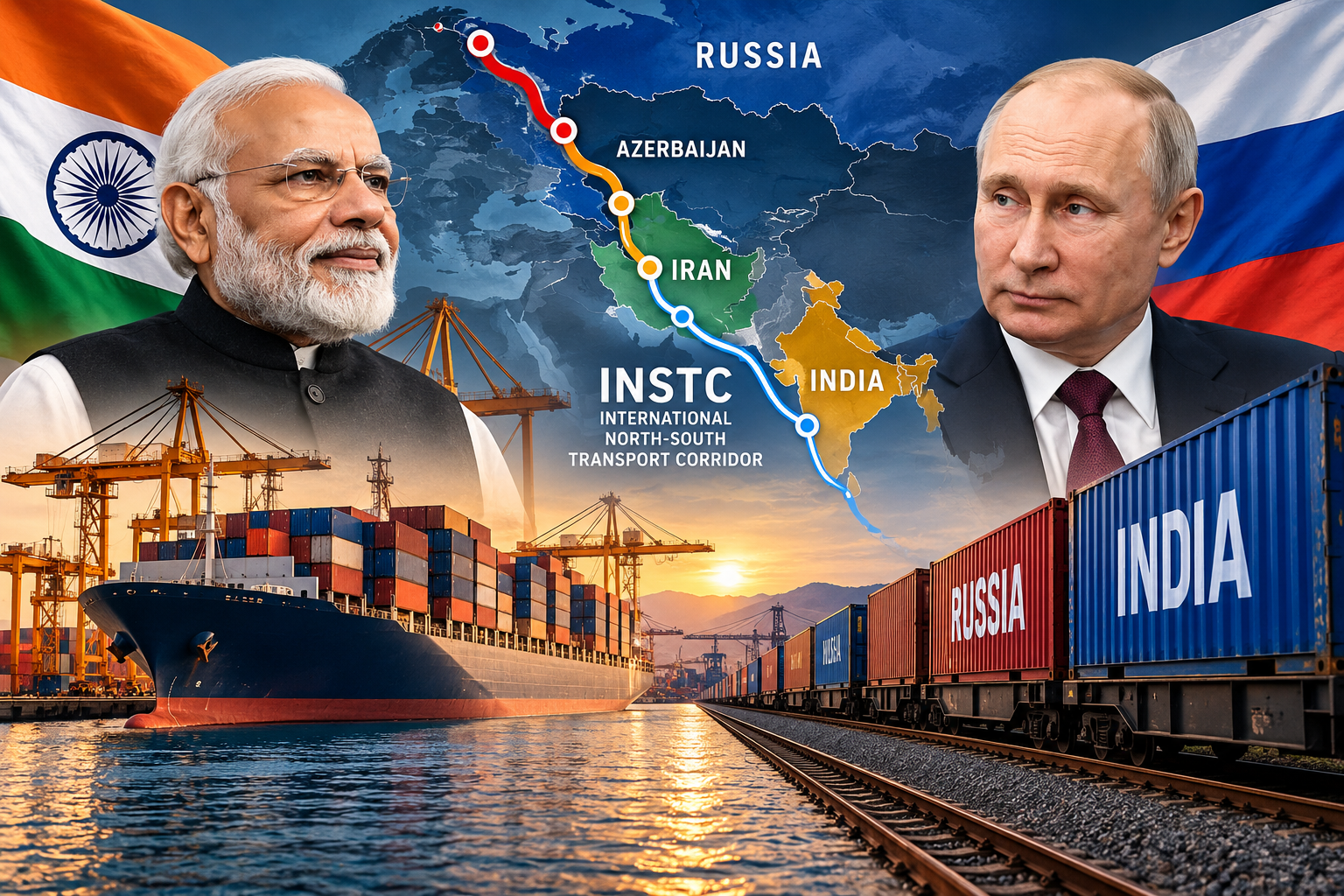
Russian President Vladimir Putin has highlighted what he described as major potential for deeper economic cooperation with India, while saying Moscow is ready to provide credit resources to advance the International North-South Transport Corridor (INSTC).
The remarks put renewed focus on one of the most ambitious connectivity projects linking India with Iran, Russia and the wider Eurasian region. Speaking at the Valdai International Discussion Club, Putin said economic cooperation between Russia and India has significant room to expand beyond logistics and indicated that Moscow wants New Delhi to participate more extensively in emerging international transport and maritime corridors.
Russia Ready to Provide Credit Resources
A major part of Putin’s remarks concerned the International North-South Transport Corridor. The INSTC is a multimodal network involving sea, rail and road transportation intended to improve connectivity between India, Iran, Russia and markets further north.
Putin said Russia is prepared to provide credit resources for development of the corridor. However, he stressed that completion of the route does not depend on Russia alone. According to Putin, Iran still needs to complete work related to its section of the project.
He also referred to Azerbaijan’s role in the corridor and said Moscow remains in contact with Azerbaijani President Ilham Aliyev. Putin said Azerbaijan supports implementation of the project.
Why the North-South Corridor Matters for India
For India, the INSTC could become an important additional trade route to Russia and Eurasian markets. Instead of depending entirely on conventional maritime routes, cargo can potentially travel from Indian ports to Iran and then move north using rail, road and maritime connections.
The strategic significance of the project goes beyond Russia-India bilateral trade. A functioning multimodal corridor could provide businesses with additional logistics options connecting South Asia with Central Asia, the Caucasus and Russia. Its commercial impact, however, will ultimately depend on infrastructure completion, customs procedures, freight costs, reliability and geopolitical conditions.
Putin Wants India Involved in Wider Trade Corridors
Putin’s comments were not limited to the INSTC. He said Russia has already piloted commercial shipping involving China and South Korea and is also discussing cooperation with India. Moscow, according to Putin, supports jointly using international corridors that could provide new opportunities for trade.
The remarks indicate that Russia is looking at India not simply as a buyer or seller of goods, but as an important participant in a broader Eurasian connectivity network.
India-Russia Trade Target: $100 Billion by 2030
Connectivity has become an important part of the economic agenda between New Delhi and Moscow. India and Russia previously agreed on a target of $100 billion in bilateral trade by 2030.
Their official economic cooperation framework also identifies increased cargo movement through the International North-South Transport Corridor as a priority. Other routes discussed by the two countries include the Chennai-Vladivostok Eastern Maritime Corridor and Russia’s Northern Sea Route.
The challenge is not simply increasing the overall value of bilateral commerce. India and Russia have also discussed the need for more balanced trade and increased Indian exports to the Russian market. Readers can see the official India-Russia economic cooperation statement for the bilateral framework.
INSTC Could Change India-Russia Logistics
The success of the North-South Corridor could have significant consequences for companies trading between India and Russia. A more efficient corridor could provide another option for exporters and importers moving commodities, manufactured products, agricultural goods and other cargo between the two markets.
India and Russia have previously said they want greater use of the INSTC to help reduce transportation time and costs. But the full benefits depend on individual sections of the network becoming operational and working efficiently together.
Putin’s latest comments therefore highlight both the opportunity and the remaining challenge: Russia says financing is available, while infrastructure and coordination involving other participating countries still need to advance.
Iran Is Crucial to the Project
Iran occupies a central geographical position in the INSTC. For India, Iranian ports and onward rail and road connections provide a potential gateway toward the Caspian region and Russia. That explains why Putin specifically referred to work that remains to be completed by Iran.
Any delays affecting crucial Iranian infrastructure could affect the wider corridor’s capacity and efficiency. At the same time, cooperation involving Azerbaijan is significant because one important branch of the route passes through the country on its way toward Russia.
India at the Centre of New Eurasian Connectivity Plans
Putin’s remarks come as Russia seeks stronger economic and transportation relationships across Asia. India, meanwhile, has an interest in diversifying connectivity with Eurasian markets.
The INSTC is therefore more than an infrastructure project. It is part of a wider effort to create alternative trade routes connecting major economies across the Eurasian region. Whether the corridor reaches its full commercial potential will depend on financing, infrastructure completion, political cooperation and the ability of participating countries to make cross-border cargo movement competitive.
For now, Putin’s declaration that Russia is ready to provide credit resources adds fresh momentum to the project and underscores Moscow’s interest in expanding its economic relationship with India.
आपके लिए सुझाव
