
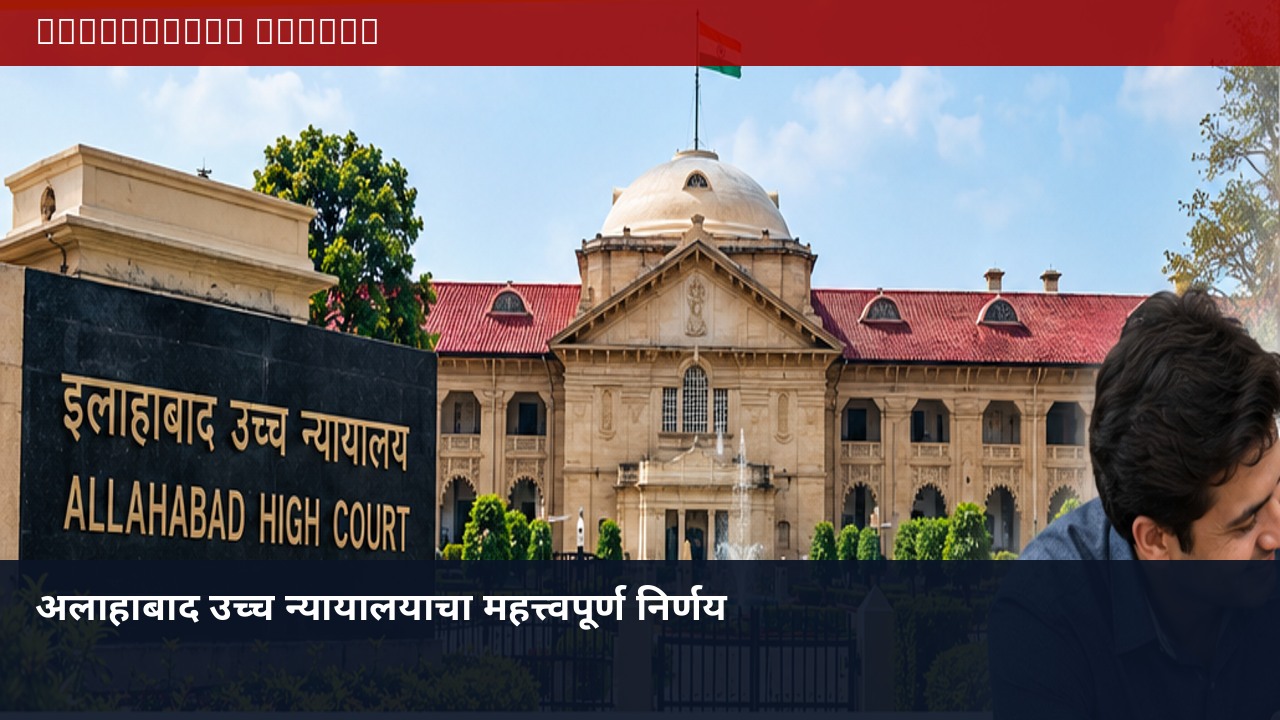
25% of husband’s eligible salary to be transferred to wife; Advocate Mahesh Dhannawat discusses the wider significance.
Prayagraj/Jalna: When a marriage breaks down, can financial responsibility towards a dependent spouse and child simply disappear? The Allahabad High Court has reiterated that supporting a dependent wife, minor children and aged parents is not merely a legal obligation but a solemn family duty.
A mother and daughter’s legal struggle
Pinki Verma and her minor daughter sought maintenance from the husband, a window operator with Indian Bank in Unnao district. The wife had requested ₹40,000 per month. On December 22, 2025, the Kanpur Nagar Family Court awarded ₹19,000 monthly. The wife and daughter challenged the amount before the High Court.
An ancient text in a modern courtroom
In the October 22, 2026 order, Justice Praveen Kumar Giri cited a Manusmriti verse concerning the duty to maintain aged parents, a wife and young children. The reference highlighted the moral dimension of family responsibilities; the enforceable legal direction rests on statutory maintenance law and judicial precedent, not scripture alone.
Loans versus family obligations
Counsel for the wife, Advocate Diwas Verma, sought 25% of the husband’s income and argued that voluntary loans and instalments should not override maintenance obligations. The husband’s counsel indicated willingness to have 25% of salary deducted.
Direct bank transfer ordered
The High Court modified the Family Court’s order, directing that 25% of gross salary after income tax be credited each month to the wife’s verified bank account. The concerned bank officials and Family Court were directed to facilitate implementation. The Court also considered Supreme Court guidance including Anju Garg v Deepak Kumar Garg.
Advocate Mahesh Dhannawat’s statement
“Marriage creates responsibilities that cannot simply be abandoned when personal relationships deteriorate. Children must not suffer because of parental differences. Although the Court referred to Manusmriti, the binding foundation is Indian law and judicial precedent. Maintenance is not punishment; it protects dignity and financial security. Direct salary deductions can improve compliance, but 25% is not a universal formula for every case. Courts must examine the circumstances, income and needs,” said Advocate Mahesh S. Dhannawat, Jalna.
The message extends beyond one family: separation does not erase enforceable responsibilities towards dependants.
Source: Law Trend. Case: Pinki Verma and Another v State of Uttar Pradesh and Another, Criminal Revision 1465/2026, order dated 22 October 2026.
Discover more from NewsNation Online
Subscribe to get the latest posts sent to your email.
आपके लिए सुझाव








Leave a Reply