

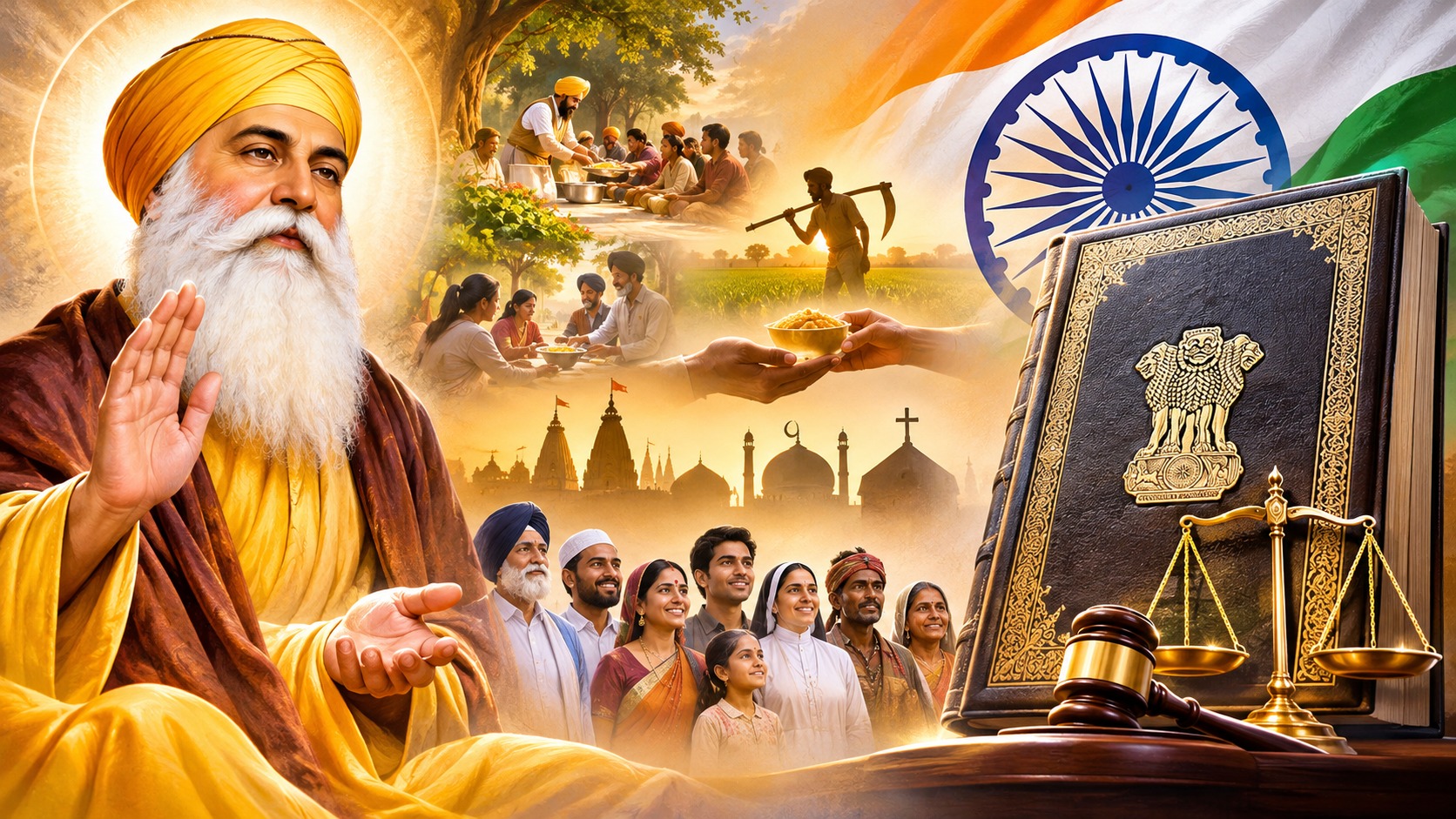
Special Editorial | Reflections on Constitutional Values
The Constitution of India is more than a legal framework for governing a country. It is a promise of justice, liberty, equality and dignity to every individual. The teachings of Guru Nanak Dev Ji, the fifteenth-century spiritual teacher, and the constitutional values of modern India reveal striking thematic parallels. The Constitution does not name Guru Nanak Dev Ji or expressly codify his teachings, and it would be inaccurate to claim a proven direct historical influence on constitution-making. Yet his humanist philosophy offers a powerful ethical lens through which the spirit of the Constitution can be understood.
Ik Onkar: The oneness of humanity
At the heart of Guru Nanak Dev Ji’s philosophy is “Ik Onkar”—the affirmation of one universal Creator and the oneness of creation. This vision challenges divisions based on caste, birth, wealth, gender or social status. If the same divine light is present in all, no human being can be considered inherently superior or inferior.
Also read: Pune: Software Engineer Dead at Hinjewadi PG, Boyfriend Arrested; He Sat Beside Her Overnight
The Preamble to the Constitution promises social, economic and political justice; liberty of thought, expression, belief, faith and worship; equality of status and opportunity; and fraternity assuring the dignity of the individual. Article 14 guarantees equality before the law and equal protection of the laws. Article 15 prohibits discrimination on specified grounds, including religion, race, caste, sex and place of birth, while Article 16 guarantees equality of opportunity in public employment. Article 17 abolishes untouchability. Guru Nanak’s insistence on human equality resonates deeply with these constitutional commitments.
Langar: Equality translated into everyday practice
The Sikh tradition of langar, the community kitchen, is a living expression of equality. People from different castes, economic backgrounds and walks of life sit together and share the same meal. It is not merely an act of feeding the hungry; it is a social statement that dignity cannot be measured by wealth, lineage or status.
Constitutional equality becomes meaningful when it is reflected in daily conduct—in schools, workplaces, public spaces, places of worship and community life. Langar reminds society that equality must not remain a sentence in a legal text; it must become a lived experience. The constitutional prohibition of untouchability under Article 17 and the protections against discrimination under Articles 15 and 16 point towards the same broad social aspiration.
Naam Japo, Kirat Karo, Vand Chhako: Ethics of citizenship
Three principles commonly associated with Guru Nanak’s teachings are Naam Japo—remember the Divine; Kirat Karo—earn an honest livelihood through sincere work; and Vand Chhako—share with others. Together, they encourage spiritual reflection, integrity in economic life, dignity of labour and responsibility towards those in need. Their relevance extends beyond religious practice into the ethical foundations of public and civic life.
The Directive Principles of State Policy reflect the Constitution’s commitment to social and economic justice. Article 38 directs the State to promote a social order informed by justice and welfare. Article 39 addresses, among other things, adequate means of livelihood, fair distribution of resources and prevention of economic concentration. These principles are not directly enforceable by courts in the same manner as Fundamental Rights, but they are fundamental to governance. The values of honest work and sharing find a meaningful philosophical parallel in this constitutional vision.
Freedom of conscience and respect for different faiths
Guru Nanak Dev Ji emphasised truthfulness, compassion, humility and inner integrity over empty ritualism. His engagement with people of different religious traditions conveyed a message of dialogue and respect rather than hostility. This should not be simplified into the claim that all religions are identical. The deeper lesson is that differences of belief must never become a reason to deny another person’s dignity.
Article 25 guarantees freedom of conscience and the right freely to profess, practise and propagate religion, subject to public order, morality, health and other constitutional limitations. Article 26 protects the rights of religious denominations to manage their religious affairs. Articles 27 and 28 deal with taxation for the promotion of religion and religious instruction or worship in specified educational institutions. True religious freedom requires both the protection of one’s own conscience and respect for the equal freedom of others.
The constitutional text contains specific references relevant to Sikh practice: Explanation I to Article 25 provides that the wearing and carrying of kirpans is included in the profession of the Sikh religion. Explanation II to Article 25(2)(b) provides that references to Hindus for the purposes of that sub-clause include Sikhs, Jains and Buddhists. These provisions should be understood in their precise constitutional context.
Dignity of women and care for the environment
Guru Nanak’s verses affirm the importance and dignity of women and question attitudes that treat them as inferior. The Constitution’s guarantee of equality under Article 14 and its prohibition of sex-based discrimination under Article 15 support the same broad commitment. Article 51A(e) further calls upon every citizen to renounce practices derogatory to the dignity of women.
The line from Japji Sahib, “Pavan Guru, Pani Pita, Mata Dharat Mahat”—air as the Guru, water as father and earth as the great mother—expresses a profound respect for the natural world. At a time of climate stress, pollution and water scarcity, this ecological wisdom has renewed relevance. Article 48A directs the State to protect and improve the environment, forests and wildlife, while Article 51A(g) makes it a fundamental duty of citizens to protect and improve the natural environment and show compassion for living creatures.
Seva and fraternity: The social foundation of democracy
Seva, or selfless service, is service without expectation of reward, status or publicity. Alongside sangat and the practice of sharing, it creates bonds of mutual responsibility. Article 51A(e) asks citizens to promote harmony and the spirit of common brotherhood across religious, linguistic, regional and other differences. Article 51A(h) encourages scientific temper, humanism, inquiry and reform.
Democracy is not exhausted by the act of voting. It depends on respect for others, the ability to disagree without hatred, protection of vulnerable communities, care for public property and the courage to oppose injustice. Guru Nanak’s teachings call individuals away from ego and towards service; the Constitution reminds citizens that rights must be accompanied by duties.
Adv. Mahesh Dhannawat’s statement
“The similarities between the teachings of Guru Nanak Dev Ji and the values of the Indian Constitution must not remain confined to speeches and ceremonial observances; they must be reflected in our personal and public conduct. Constitutional equality means equal dignity for every citizen. Religious freedom means respecting another person’s faith, and fraternity means treating every individual as a human being beyond the walls of caste and religion. ‘Kirat Karo’ teaches integrity, ‘Vand Chhako’ teaches social responsibility, and ‘Seva’ teaches humanity. At a time when society must guard against hatred, discrimination and intolerance, the humanist message of Guru Nanak Dev Ji and the values of the Constitution must both be practised. Respect for the Constitution is not merely holding a copy of it; it is ensuring that justice, liberty, equality and fraternity become a lived reality,” said Adv. Mahesh Dhannawat.
Different histories, a shared ethical horizon
The historical origins of Guru Nanak Dev Ji’s teachings and the Constitution of India are distinct. Yet both place human dignity, equality, service and coexistence at the centre of a just society. The Constitution provides the legal framework of rights and institutions; Guru Nanak’s teachings offer an ethical reminder about how human beings should treat one another. The meeting of the rule of law with compassion and moral responsibility can help build a more just, equal and sensitive India.
The Sikh ideal of “Sarbat da Bhala”—the welfare of all—echoes the Constitution’s commitment to fraternity and the dignity of the individual. Respecting people irrespective of caste, religion, language or economic position, earning honestly, sharing with those in need and protecting nature are practical ways to honour this shared ethical horizon.
References: Constitution of India—Preamble; Articles 14, 15, 16, 17, 25–28, 38, 39, 48A and 51A. For the teachings of Guru Nanak Dev Ji, see the Shiromani Gurdwara Parbandhak Committee’s published exposition and the Government of India’s Press Information Bureau material on his teachings.
सीधे अपनी Facebook फ़ीड में पाएँ — News Nation Online पेज को Follow करें।
Discover more from NewsNation Online
Subscribe to get the latest posts sent to your email.
आपके लिए सुझाव


Leave a Reply