

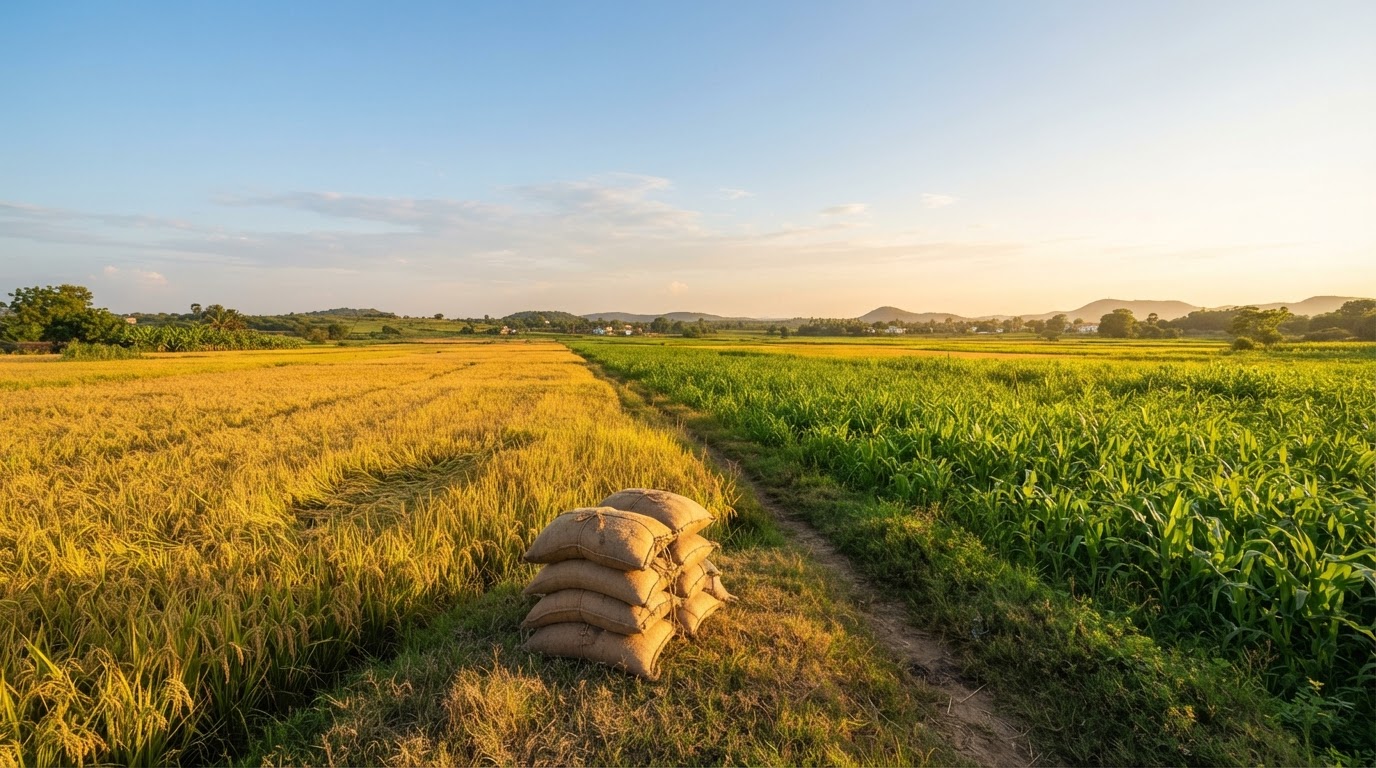
NEW DELHI — India’s record foodgrain production touched an all-time high of 3,785.38 lakh tonnes (about 378.5 million tonnes) in the 2025-26 agricultural year, the Ministry of Agriculture and Farmers Welfare said in an official statement on Thursday, November 26, 2026. That is 208.06 lakh tonnes more than the 3,577.32 lakh tonnes produced in 2024-25.
Union Agriculture and Farmers Welfare Minister Shri Shivraj Singh Chouhan released the final estimates for 2025-26 along with the first advance estimates for the Kharif season of 2026-27 at a press conference in Delhi, according to the Press Information Bureau (PIB). Despite a weak start to the monsoon and drought in several states, including Maharashtra, Kharif foodgrain output this year is estimated at 1,671.43 lakh tonnes — 97.67 lakh tonnes above the average of the last five years.

At a glance
- Total foodgrain 2025-26 (final): 3,785.38 lakh tonnes — an all-time record, up 208.06 lakh tonnes
- Rice: record 1,551.54 lakh tonnes; Wheat: 1,220.64 lakh tonnes
- Pulses: 272.40 lakh tonnes; Oilseeds: record 432.55 lakh tonnes
- Kharif 2026-27 foodgrain (first advance estimate): 1,671.43 lakh tonnes
- June 2026 rainfall was 35–40% below normal; Maharashtra, Karnataka, Telangana and Andhra Pradesh faced dry conditions
- Indian rice exports rose by 5%, the minister said
Record foodgrain production in 2025-26: crop-wise figures
According to the final estimates, rice output rose by 49.70 lakh tonnes to a record 1,551.54 lakh tonnes, from 1,501.84 lakh tonnes in 2024-25. Wheat production climbed 41.19 lakh tonnes to 1,220.64 lakh tonnes, compared with 1,179.45 lakh tonnes a year earlier.
Maize recorded one of the sharpest jumps, rising to 550.25 lakh tonnes from 434.09 lakh tonnes. Total nutri/coarse cereals stood at 740.80 lakh tonnes, of which millets (“Shree Anna”) accounted for 172.09 lakh tonnes.
Total pulses production increased by 15.57 lakh tonnes to 272.40 lakh tonnes. Moong reached a new record of 43.96 lakh tonnes, while gram (chana) stood at 125.13 lakh tonnes and tur (arhar) at 35.99 lakh tonnes.
Oilseeds reached a record 432.55 lakh tonnes, up 2.66 lakh tonnes from 429.89 lakh tonnes. Groundnut rose to a record 131.71 lakh tonnes (up 12.29 lakh tonnes) and rapeseed-mustard to a record 137.66 lakh tonnes (up 10.99 lakh tonnes). Soybean output was 126.36 lakh tonnes.
Among commercial crops, sugarcane production was 5,037.29 lakh tonnes, cotton 280.06 lakh bales (of 170 kg each), and jute and mesta 94.28 lakh bales (of 180 kg each).
Kharif 2026-27: first advance estimates despite El Niño
The minister said the 2026-27 Kharif season faced the return of El Niño, a delayed monsoon with 35% to 40% less rain in June, and low soil moisture and drought-like conditions in major farming states such as Maharashtra, Karnataka, Telangana and Andhra Pradesh. Sowing of paddy, maize, tur, soybean and cotton was affected as a result.
Even so, total Kharif foodgrain output is estimated at 1,671.43 lakh tonnes. The ministry credited farmers’ efforts, government schemes and climate-resilient seed varieties developed by scientists.
- Kharif rice: 1,219.05 lakh tonnes
- Nutri/coarse cereals: 381.05 lakh tonnes — maize 260.64, bajra 89.43, jowar 14.79, ragi 12.48 and small millets 3.71 lakh tonnes
- Kharif pulses: 71.32 lakh tonnes — tur 31.22, moong 16.59, urad 14.49 and other pulses 9.02 lakh tonnes
- Kharif oilseeds: 239.47 lakh tonnes — groundnut 111.68, soybean 102.44, castor 18.97, sesamum 4.91, sunflower 1.17 and niger seed 0.30 lakh tonnes
- Sugarcane: 4,543.39 lakh tonnes
- Cotton: 248.66 lakh bales; Jute and mesta: 97.06 lakh bales
Also read:
- Maharashtra Drought: Crops on 141 Lakh Hectares Hit, 266 Talukas Severe
- Jalna Rabi Sowing Just 6.27% So Far, Against 148% at This Time Last Year
India’s global ranking and focus on pulses and oilseeds
According to the ministry, India now ranks first in the world in the production of rice, pulses, jute, millets and spices. It ranks second after China in wheat, cotton, groundnut and fruits and vegetables, and second after Brazil in sugarcane.
Shri Chouhan said the country holds sufficient stocks of rice and wheat, and that with a surplus in these two crops, the government’s focus has now shifted to crop diversification and self-reliance in pulses and edible oils. Production is being pushed through dedicated national missions for pulses and oilseeds, as demand for both keeps rising.
What it means for Maharashtra and Marathwada farmers
The ministry specifically named Maharashtra among the states where poor June rain and low soil moisture hurt Kharif sowing. For Marathwada farmers, the national picture of strong output sits alongside a difficult local season, as covered in our reports on the Jalna Kharif paisewari falling below 50 paise. Higher national estimates for soybean, tur and cotton — the region’s key crops — can influence market prices, so farmers may want to track mandi rates closely before selling.
How the estimates were prepared
The ministry said the Kharif figures are preliminary and will be revised in the second and final estimates once actual yield data from crop-cutting experiments (CCEs) at harvest is available. Figures for both years were compiled from state and Union Territory inputs, remote sensing, the weekly Crop Weather Watch Group, the Digital Crop Survey and the Digital General Crop Estimation Survey, and consultations with industry, followed by validation and triangulation. The full official release is available on the Press Information Bureau website.
Frequently Asked Questions (FAQ)
What was India’s total foodgrain production in 2025-26?
According to final estimates released on November 26, 2026, India produced a record 3,785.38 lakh tonnes (about 378.5 million tonnes) of foodgrain in 2025-26.
How much higher is it than last year?
It is 208.06 lakh tonnes more than the 3,577.32 lakh tonnes produced in 2024-25.
What is the Kharif 2026-27 foodgrain estimate?
The first advance estimate puts Kharif 2026-27 foodgrain output at 1,671.43 lakh tonnes, which is 97.67 lakh tonnes above the five-year average.
How much soybean, tur and cotton is expected this Kharif?
Soybean is estimated at 102.44 lakh tonnes, tur at 31.22 lakh tonnes and cotton at 248.66 lakh bales of 170 kg each.
Are these Kharif figures final?
No. They are first advance estimates and will be revised after crop-cutting experiment data comes in at harvest time.
Which crops did India rank first in globally?
The ministry said India is the world’s top producer of rice, pulses, jute, millets and spices.
More farmer news: Farmers News
NewsNation Online Desk
सीधे अपनी Facebook फ़ीड में पाएँ — News Nation Online पेज को Follow करें।
Discover more from NewsNation Online
Subscribe to get the latest posts sent to your email.
आपके लिए सुझाव


Leave a Reply