
Why October 17 matters
October 17 links a constitutional milestone in India with the international recognition of humanitarian work, the struggle against poverty, major advances in energy and the lessons of natural and industrial disasters. In 1949, India’s Constituent Assembly adopted a provision concerning Jammu and Kashmir. Thirty years later, the announcement of the Nobel Peace Prize focused worldwide attention on Mother Teresa’s work in Calcutta. The date is also observed as the International Day for the Eradication of Poverty. Looking further back and across borders, a nuclear power station opened in Britain, an earthquake shook California and a brewery accident devastated a London neighbourhood. A responsible historical account explains not only what happened, but also why it mattered and what questions remain.
1949: the Constituent Assembly adopts draft Article 306A
On 17 October 1949, India’s Constituent Assembly considered and adopted draft Article 306A, which subsequently became Article 370 of the Constitution. N. Gopalaswami Ayyangar introduced the provision during debates on the constitutional relationship between the Union and Jammu and Kashmir. The text addressed Parliament’s legislative authority, consultation and concurrence with the state’s government, and a possible mechanism for future changes. The official debate record documents the discussion and the motion’s adoption. This date should not be confused with the commencement of the Constitution as a whole on 26 January 1950. The original provision emerged from the unusual circumstances surrounding Jammu and Kashmir’s accession and the negotiations of that era. Constituent Assembly debate transcript.
Article 370 in its later historical context
Article 370’s scope and interpretation remained politically and legally contested for decades. In August 2019, the Union government made constitutional changes that ended the previous special arrangements, alongside legislation reorganising the former state. A five-judge Supreme Court bench upheld the constitutional validity of the 2019 abrogation in December 2023. Views differ on the political and social consequences of these developments, especially for democratic representation and federal relations. A balanced anniversary account distinguishes the 1949 adoption of a draft provision from later executive, parliamentary and judicial decisions; it should not suggest that the original provision remains unchanged today. Supreme Court Observer: case history.
1979: Mother Teresa is named a Nobel Peace Prize laureate
On 17 October 1979, the Norwegian Nobel Committee announced that Mother Teresa would receive the Nobel Peace Prize. Her Missionaries of Charity had become widely known for assisting people living with serious illness, abandonment and poverty in Calcutta, now Kolkata. Contemporary reporting confirms the date of the announcement, and the Nobel organisation records her as the 1979 laureate for her assistance to suffering humanity. The prize ceremony occurred later, so October 17 marks the announcement, not the presentation. For India, the news brought international recognition to an organisation rooted in the experiences of people often excluded from public services. Nobel Peace Prize profile and UPI’s contemporary report.
The complexity of a celebrated humanitarian legacy
Mother Teresa’s work inspired volunteers and supporters across the world. At the same time, a balanced account must acknowledge criticism of medical care and pain relief in some facilities, and debate about her public positions on social issues. Even the Nobel Peace Prize’s official biographical account notes criticism alongside the humanitarian achievements. These competing assessments need not be reduced to either unconditional praise or dismissal. They raise enduring questions about the relationship between charitable compassion, professional healthcare, dignity and accountability. The 1979 announcement is therefore important both as a moment of international recognition and as a starting point for thoughtful discussion about how communities support their most vulnerable members.
1987: a gathering that helped create a global observance
The International Day for the Eradication of Poverty is observed every October 17. Its origins reach back to 17 October 1987, when more than 100,000 people assembled at the Trocadéro in Paris to honour those affected by extreme poverty, hunger and violence. Participants argued that poverty must be understood through the lens of human rights and dignity. The United Nations General Assembly subsequently adopted Resolution 47/196 on 22 December 1992, formally designating October 17 as the international day. The observance emphasises listening to people experiencing poverty rather than speaking only about them. UNESCO’s historical overview; United Nations background.
1956: Calder Hall enters the nuclear age
On 17 October 1956, Queen Elizabeth II formally opened Calder Hall in Cumbria, Britain. The station became an internationally recognised milestone in generating electricity from nuclear power on a commercial scale. Delegates from dozens of countries attended, reflecting postwar expectations about the possibilities of atomic technology. There is an essential qualification: the facility was closely linked to Britain’s nuclear-weapons programme, and producing plutonium was a central purpose of the original reactors. Its history therefore includes both civilian electricity generation and military technology. Calder Hall operated for decades and later became part of a complex decommissioning challenge. UK government anniversary account.
1989: the Loma Prieta earthquake strikes California
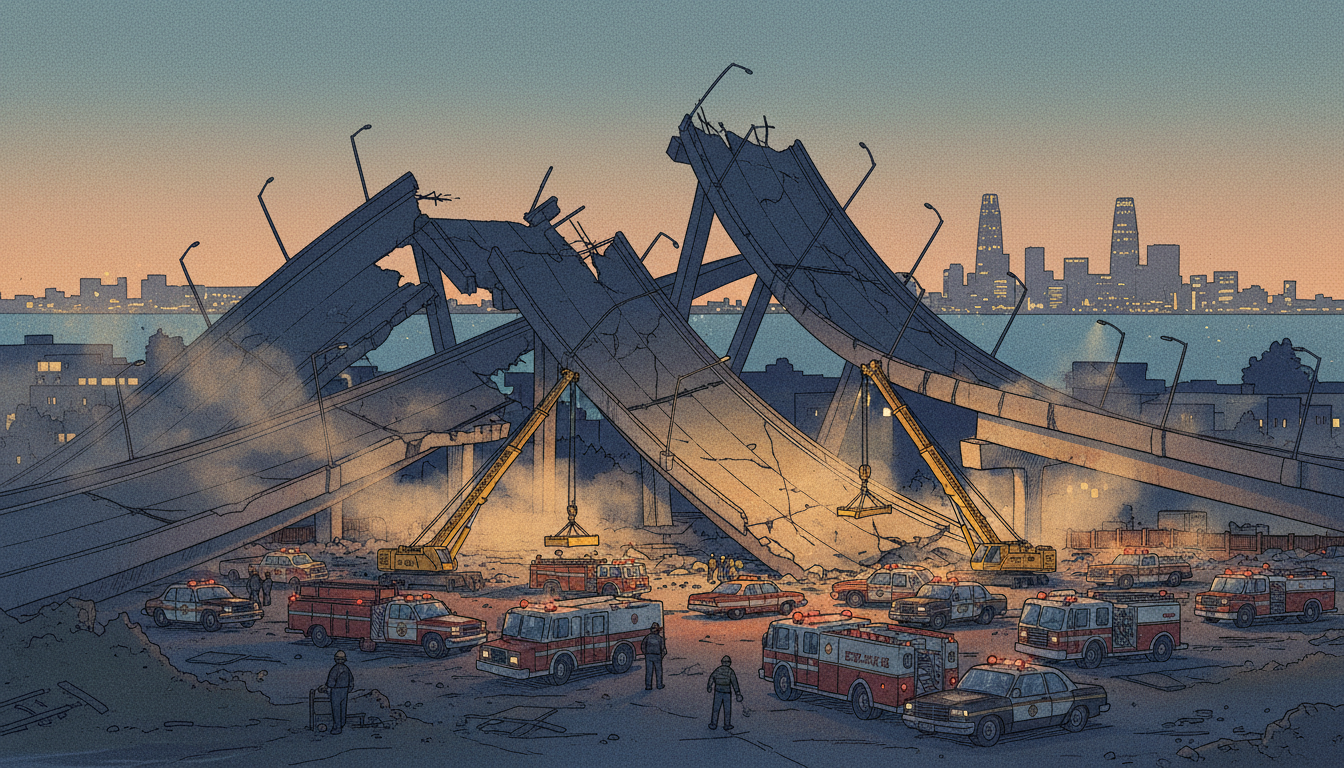
At 5:04 p.m. local time on 17 October 1989, a magnitude 6.9 earthquake shook the San Francisco and Monterey Bay regions of California. The epicentre was near Loma Prieta in the Santa Cruz Mountains. The US Geological Survey reports 63 deaths, 3,757 injuries and approximately $6 billion in damage. Collapses affecting older transport infrastructure, including the Cypress Street Viaduct, exposed serious vulnerabilities. The disaster became a defining event for earthquake engineering, emergency preparedness and public awareness of seismic risk. Its lasting lesson is that the consequences of a natural hazard depend greatly on the safety of buildings, bridges and communities. US Geological Survey event record.
1814: London brewery disaster
On 17 October 1814, a huge vat ruptured at the Horse Shoe Brewery in London’s St Giles area. The resulting surge of porter damaged nearby buildings and killed at least eight people. Although the event is often retold as the unusual London Beer Flood, its victims lived in a crowded and impoverished neighbourhood, where fragile housing made the accident particularly dangerous. The disaster illustrates the human cost of industrial hazards and the unequal exposure of poorer residents to risk. The later inquest and questions about responsibility are as historically significant as the extraordinary nature of the accident itself. Historic UK historical account.
What these anniversaries tell us
October 17 reminds us that history is not a contest to collect the most dramatic dates. A constitutional decision can shape relationships between institutions and citizens for generations. An international honour can elevate the experiences of neglected communities while leaving room for critical assessment. An observance can give people facing poverty a public voice. Energy innovations carry responsibilities, and disasters reveal the need for safety and planning. Readers interested in the previous instalment can explore October 16 in History and the Today in History archive.
Discover more from NewsNation Online
Subscribe to get the latest posts sent to your email.
आपके लिए सुझाव











Leave a Reply